• Skip to main content
  • Skip to footer

The Horses Back

Body Talk for Thinking Owners

  • Home
  • Articles
  • BEMER
  • Store
    • Store
    • Shipping
    • Returns
    • Support
  • Equine Healthworks
    • Bodywork for Horses
    • Reviews
    • Leave a Review
  • About & Contact
    • About
    • Contact

Jane @ THB

Yes, We Can Image for Transitional Vertebrae in Horses

September 23, 2021 by Jane @ THB 7 Comments

It’s been a question of mine for a while. Can diagnostic imaging show the presence of transitional vertebrae?

We’re seeing many bone samples from dissections, as shown in my previous article on transitional vertebrae.

But if we’re to help our horses that live with this issue, we need to identify it before they’re dead. (Yes, right?!)

Allow me to introduce a practicing vet and educator who is doing just that.


Imaging for Transitional Vertebrae 

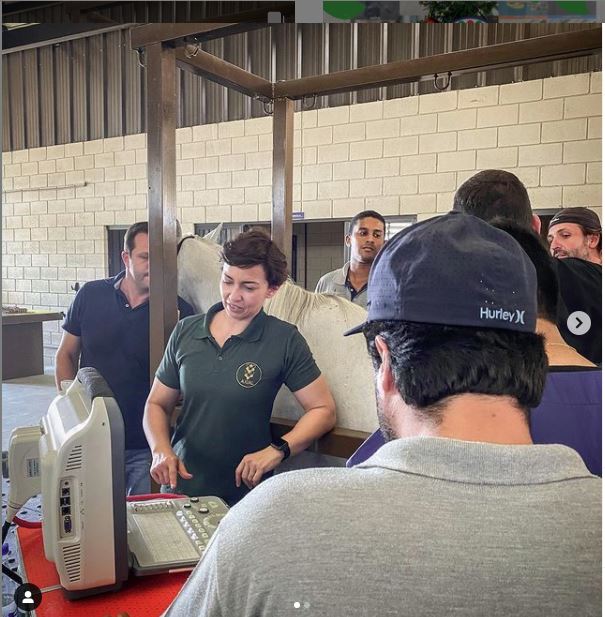
Meet Dr Brunna Fonseca, Associate Professor, educator and specialist in equine orthopedics, focusing on the spine and nervous system. She’s based in São Paulo, Brazil.
I’ve been following her Instagram for a while, because she posts brilliant videos and photos explaining what she does, and how, and why.

I was delighted to see a recent post on imaging for a transitional vertebra, which included fantastic visuals. Such a great communicator!

Dr Brunna has kindly given me permission to repost her images and descriptions here. So without further ado…

  • All images copyright of Axial Vet

Ultrasonograms

Ultrasonography for transitional vertebrae
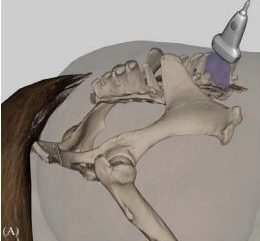
Angle of transducer. Image: Equine Neck and Back Pathology: Diagnosis and Treatment, 2nd Edn. Ed. Frances M.D. Henson. © 2018 John Wiley & Sons, Ltd.

The following ultronographic images are each a composite of two images, one showing the left side and the other the right.

This textbook illustration helps to show the angle the image is taken at. This angle is usually used for imaging the articular facets of the vertebrae.

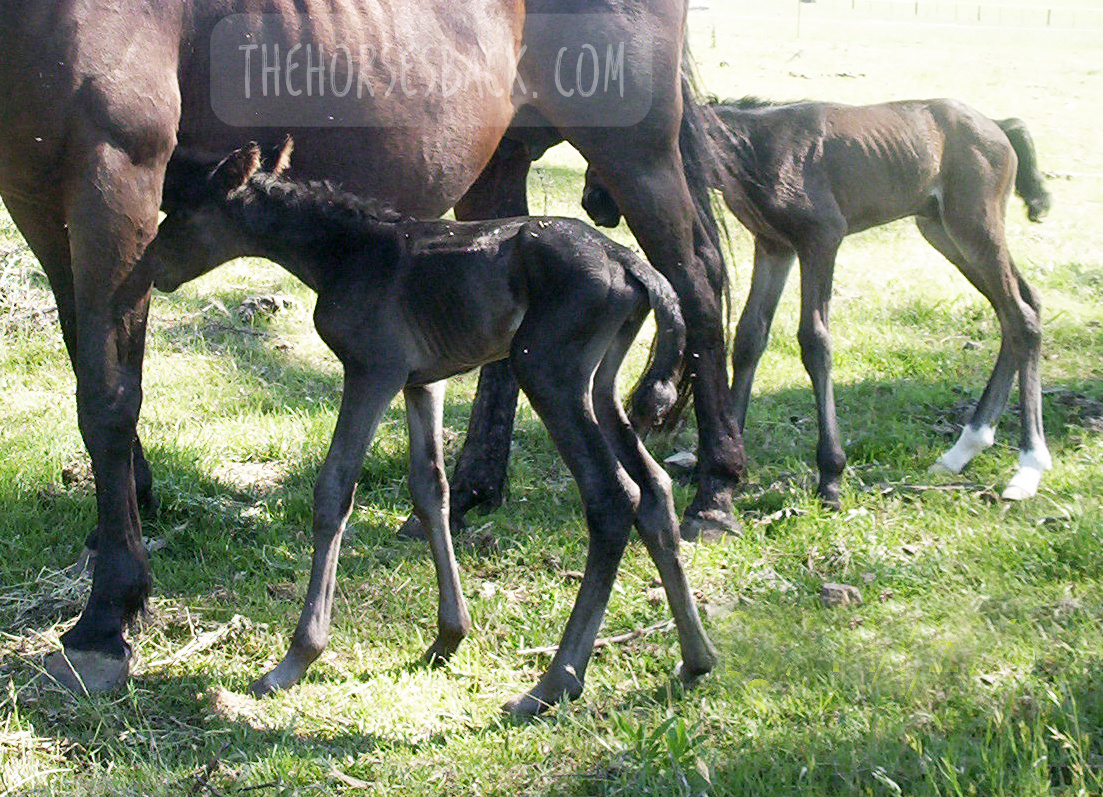
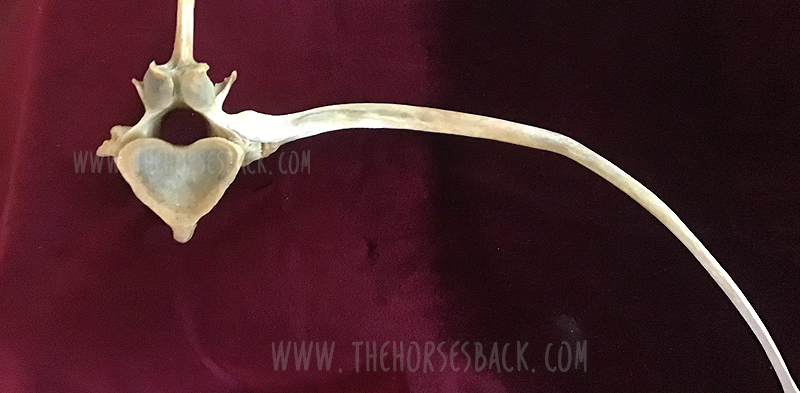
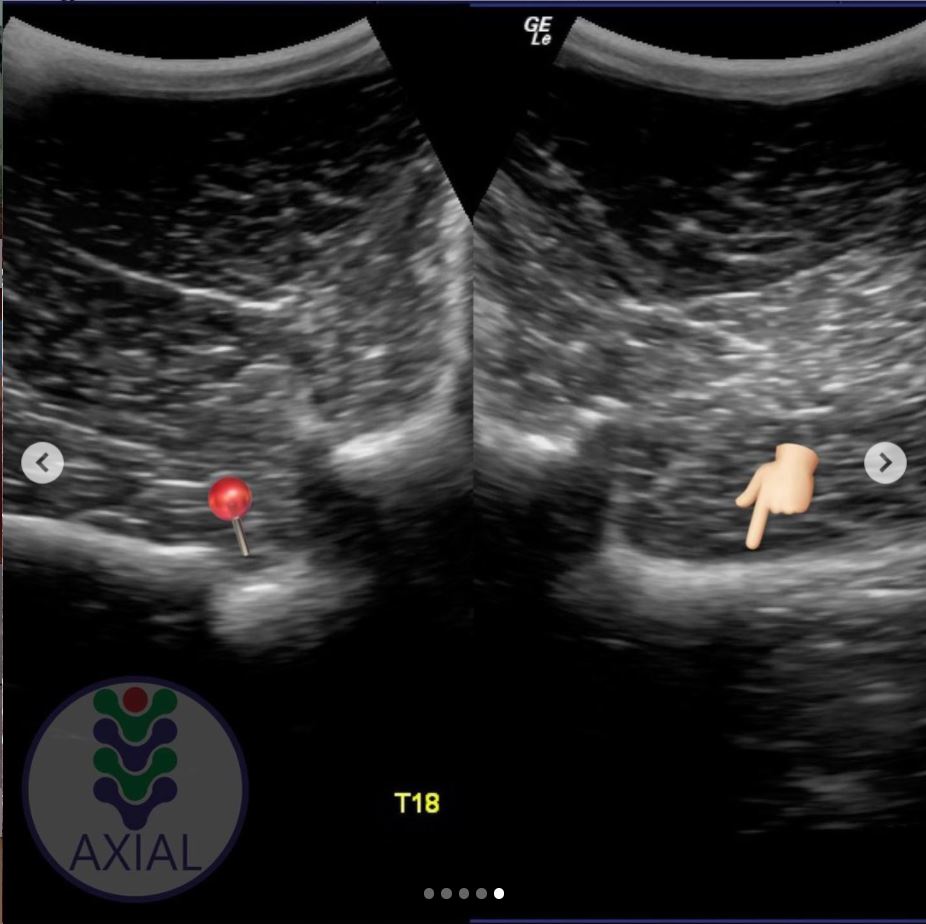
Additionally, the image at the top of this article shows a transitional vertebra at T18, like the mare being diagnosed by Dr Brunna.


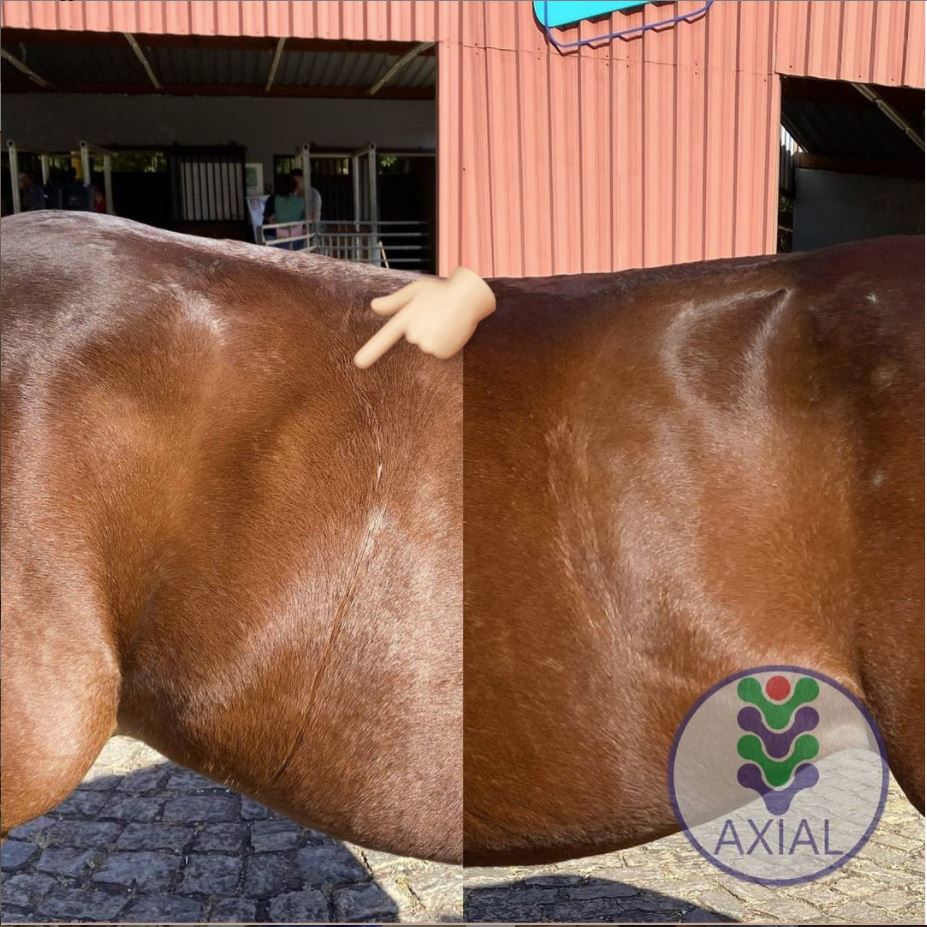
1.  Can we recognise transitional vertebrae?

The first image shows two sides of a mare’s body. The hand icon gives us a strong hint of where to look… This appearance is very similar to that of the TB mare in my previous post.

Dr Brunna writes, “This mare has the T18 transitional vertebra, presenting a transverse process similar to the lumbar vertebrae on the right side, which causes the appearance of the horse to have the most visible rib on that side.

The occurrence of transactional vertebrae in the horse is not uncommon, especially in the thoracolumbar transition, which can occur in T18 or L1.”


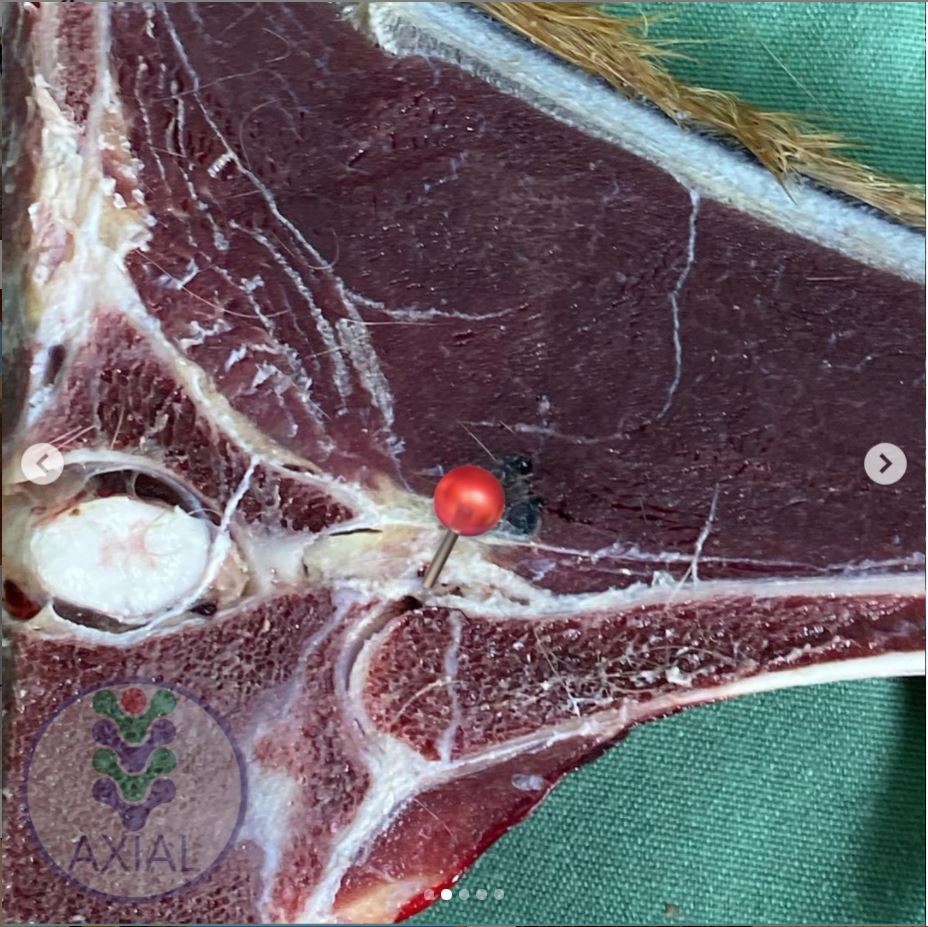
2. Section of a thoracic vertrebra

This image is from a different horse showing a normal rib head and its joint with the vertebra.

Dr Brunna writes, “This is the image of a thoracic vertebra, showing the costotransverse joint.”


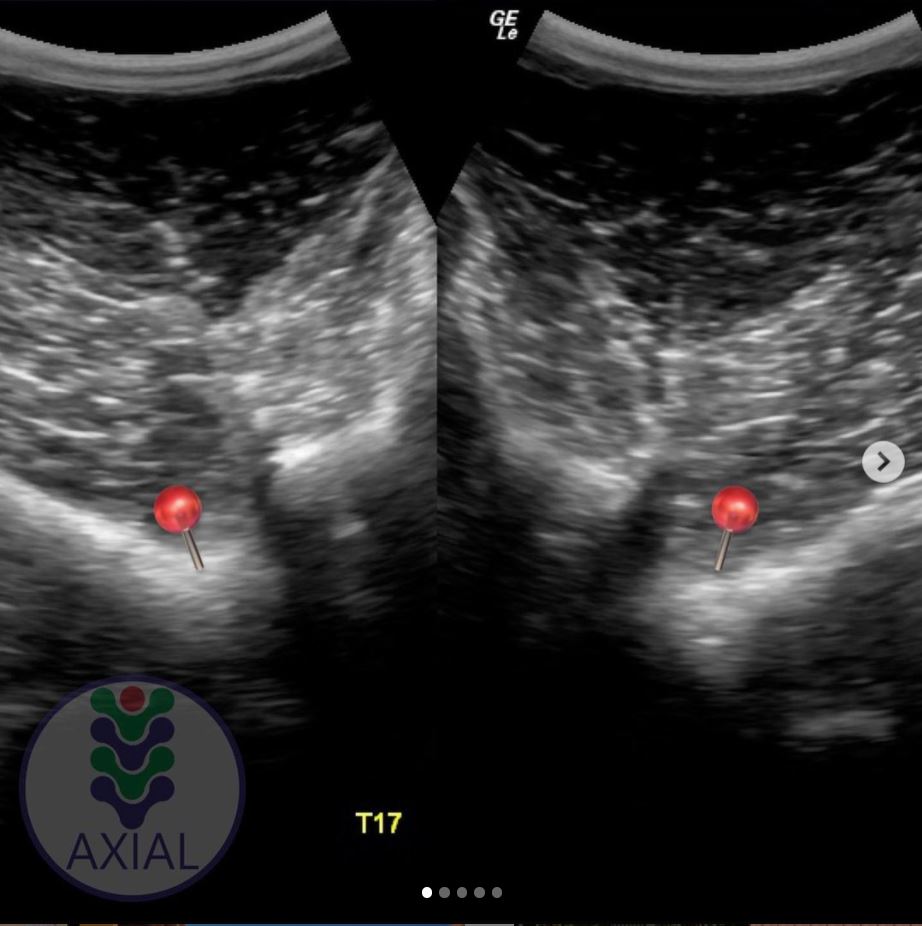
3. Image of a normal vertebra

Dr Brunna writes, “This is a T17 ultrasound image, where we can see the image of the normal costotransverse joints.”

This is the bay mare again.

As with the previous cross section, the red pins which show the facet joint between rib head and vertebra.


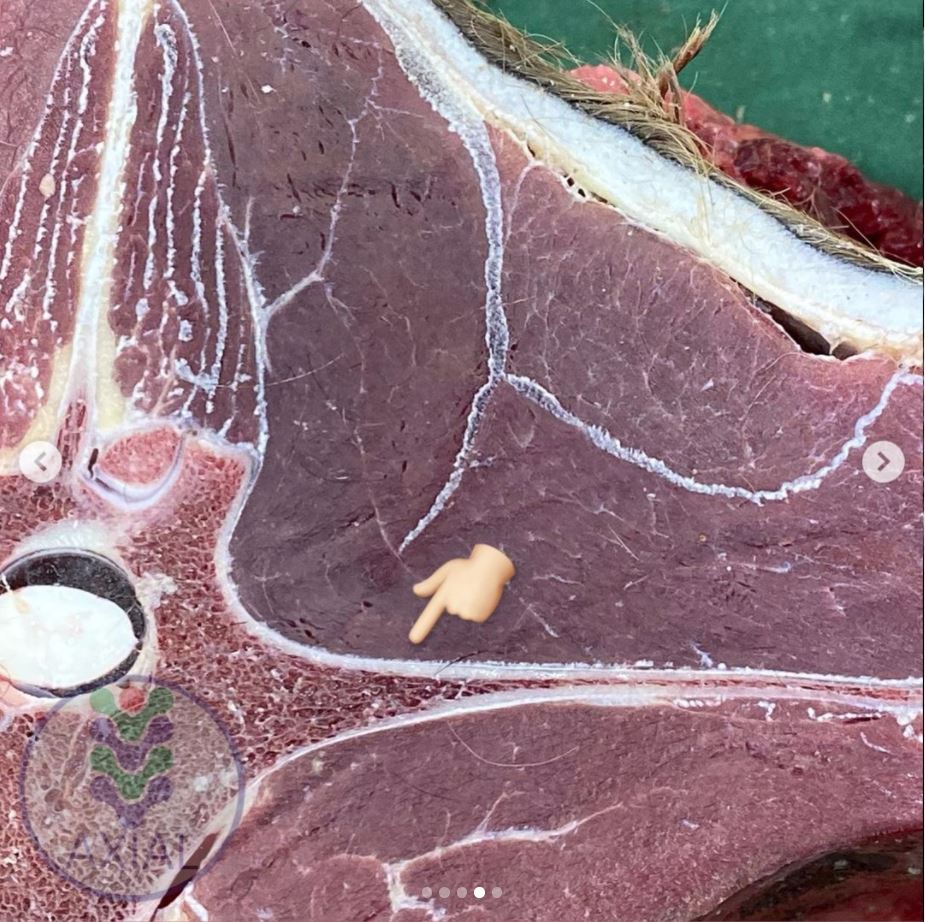
4. Section of a lumbar vertebra

This is cross section is of a normal lumbar vertebra from a different horse.

As you can see,  there is no joint between the  transverse process and the vertebral body.

The process is wide and flat, and integral to the vertebra.


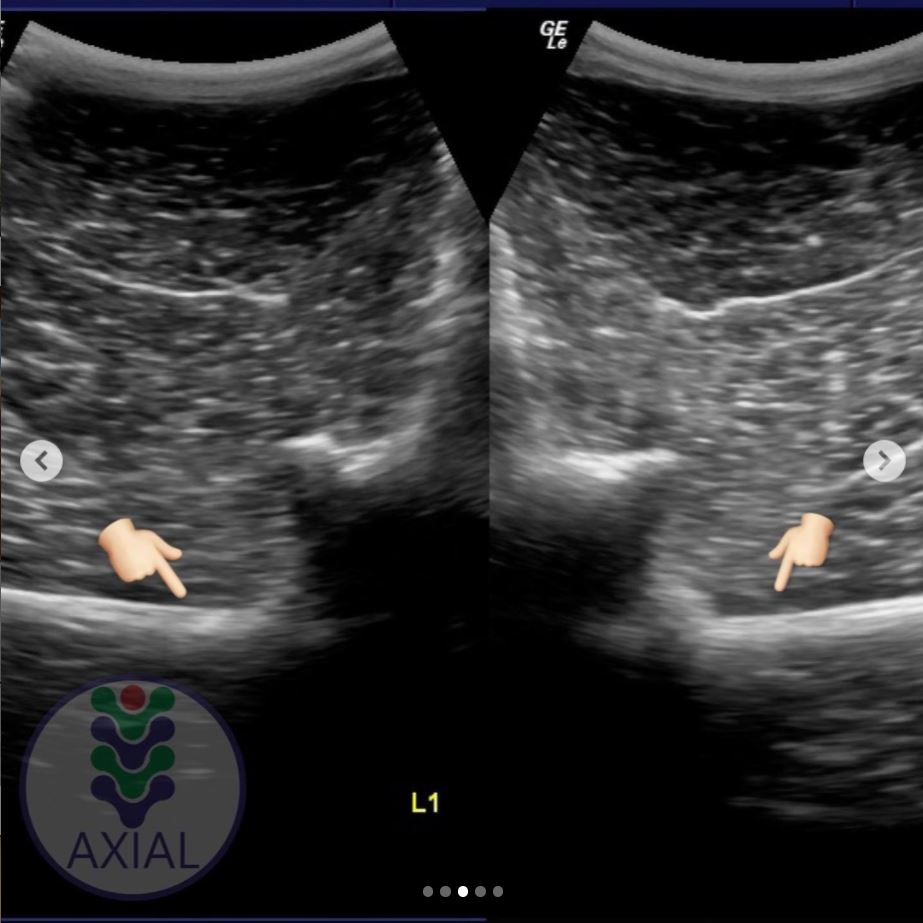
5. Image of a lumbar vertebra

Here’s an ultrasound of the first lumbar vertebra (L1) in the bay mare.

As in the above cross section (picture 4), there is no joint between the transverse processes and the vertebral body.

We now have ultrasound images of the normal T17 and normal L1. As we will see, the transitional vertebra mixes elements from both.


6. Imaging transitional vertebrae

“This is an ultrasound image of T18, where we can see the image of the costotransverse joint on the left side (red pin) and image of the transverse process on the right side.”

So here’s the underlying skeletal issue in the bay mare.

The left side is a normal joint, being the same as the T17 thoracic vertebra (picture 3).

The right side is similar to the previous image of the lumbar vertebra (picture 5).

It is not identical, for while the process-like rib is joined to the vertebra, it is not the same shape and does not lie as flat as the lumbar process.


Want to Hear More From Dr Brunna Fonesca?

You can follow her Axial Vet Instagram page to see examples of her equine cases and their assessment, in images and videos.

An increasing number of captions are now translated into English.


Filed Under: Bodywork Tagged With: Anatomy, equine anatomy, equine bodywork, equine malformation, equine skeleton, GA, horse anatomy, transitional vertebra, transitional vertebrae

10 Rehab Tips for Horses with High-Low or Upright Hooves

January 1, 2021 by Jane @ THB 11 Comments


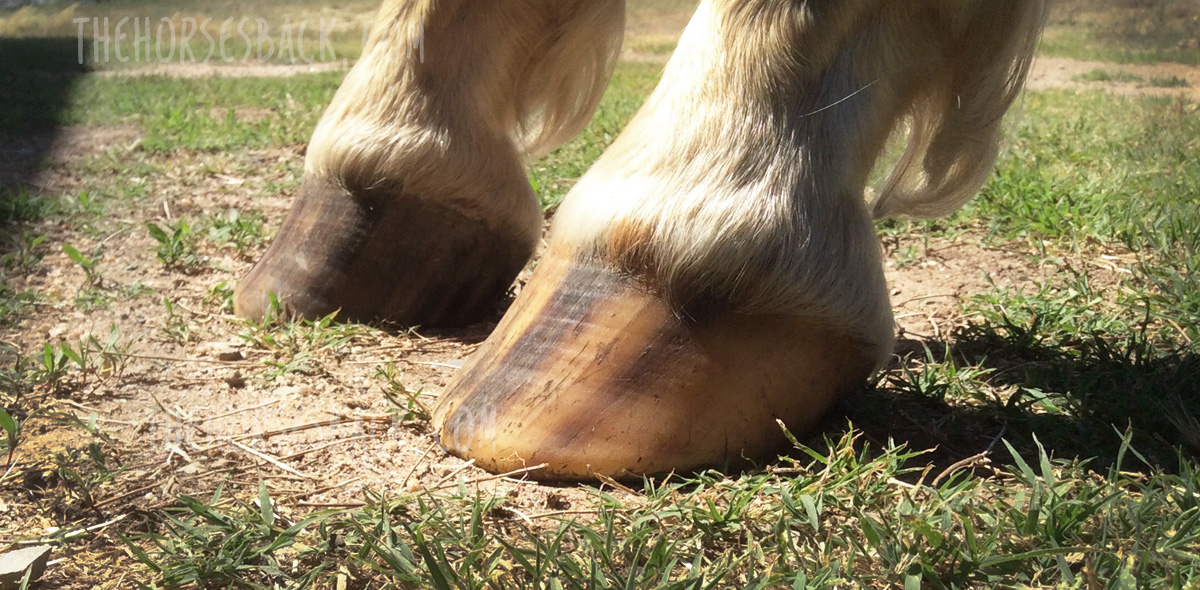
Sorting out that high-low hooves situation. It’s the farrier’s job, isn’t it?

Well yes, they’re clearly the primary professional. But there are plenty of things you can also do to help.

As their horse’s bodyworker, I’m often the first to tell an owner that unbalanced forefeet are causing problems right through the body.

Related issues can include ringbone, carpal arthritis, shoulder asymmetry, base of neck arthritis, atlas rotation, TMJ issues, spinal rotation, scoliosis and even sacroiliac dysfunction – all depending on the severity and duration of the hoof issue.


That’s not me being dramatic. In an older horse, that’s absolutely the type of problems I can find when there’s a long term high hoof.

And don’t forget, there are the saddle fit issues that go along with all of that.

Here, in plain speak, is the list of rehab tips that I offer my clients, so that they can help their farrier to help their horse.


© All text copyright of the author, Jane Clothier, https://thehorsesback.com. No reproduction of partial or entire text without permission. Sharing the link back to this page is fine. Please contact me for more information. Thank you! 


Before We Start: Choose Your Hoofcare Professional Well

It’s obvious, but this is essential.

Hoofcare professional
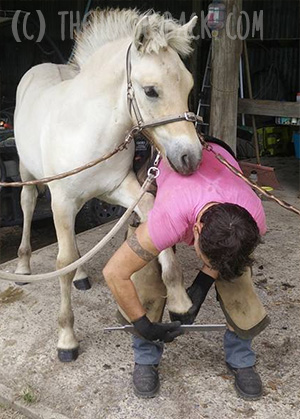
No problems here! Megan Matters trims 3.5 month-old Fjord, Lodur (c) Karen Groneng, Greenfield’s Stud

Engage a hoof professional who walks the walk as well as talking the talk.

This is someone who can tell you about hoof function and how the ‘normal’ hoof works during loading and movement.

This is someone who frequently updates their professional training.

Professionals who take continuing education are informed about current research into hoof function, as well as methods to address problems.

They know a lot more about current best practice and are more likely to demonstrate it, too.

This most definitely isn’t someone who relies solely on the apprenticeship they completed many years ago.

How it helps:

Skilled hoofcare professionals will aim to achieve a similar height in the two front hooves, even though the hoof angles may be different when viewed from the side.

They will trim each hoof according to its underlying structure, making corrections where needed.

They will NOT simply try to create similar angles and toe length, which creates stresses in a high hoof, and sets your horse up for numerous hoof and body problems.

With a skilled hoofcare practitioner on board, there is plenty more you can do to help your horse through this process of change. The more effort you put in, the more your horse will improve.


1. Use Variable Feeding Positions

Variable feeding positions were first described by Sharon May-Davis, who recognised their value as a form of passive physio.

Haynet at poll height
(c) Jane Clothier, equinehealthworks.com

This one is easy: hang a haynet at poll height to replicate eating from trees. This encourages the horse to stand square while eating.

You’ll gain the best results from small hole nets, as your horse will twist her head from left to right while eating. She’ll also drop down to eat hay from the ground.

Doing so activates the deep muscles beneath the neck vertebrae. It also activates the muscles beneath both shoulder blades as she shifts her weight one foot to the other.

If you feed more than one net a day, place the other at chest height.

How it helps:

Think thoracic sling and freeing up the restrictions that have arisen from stabilising the weight over different height limbs, as well as adopting a ‘scissor’ position to eat (which will have contributed to the problem in the first place).


2. Introduce Different Surfaces

The hoof balance is changing, but there may still be asymmetries in your horse’s body that are slow to shift.

Horses on varied footings
All horses seem to appreciate the stimulation of new surfaces during hoof rehab for a variety of issues. (c) Tanja Kraus Horsemanship

Standing your horse on different and unfamiliar surfaces can make the body’s self-adjustments happen quicker.

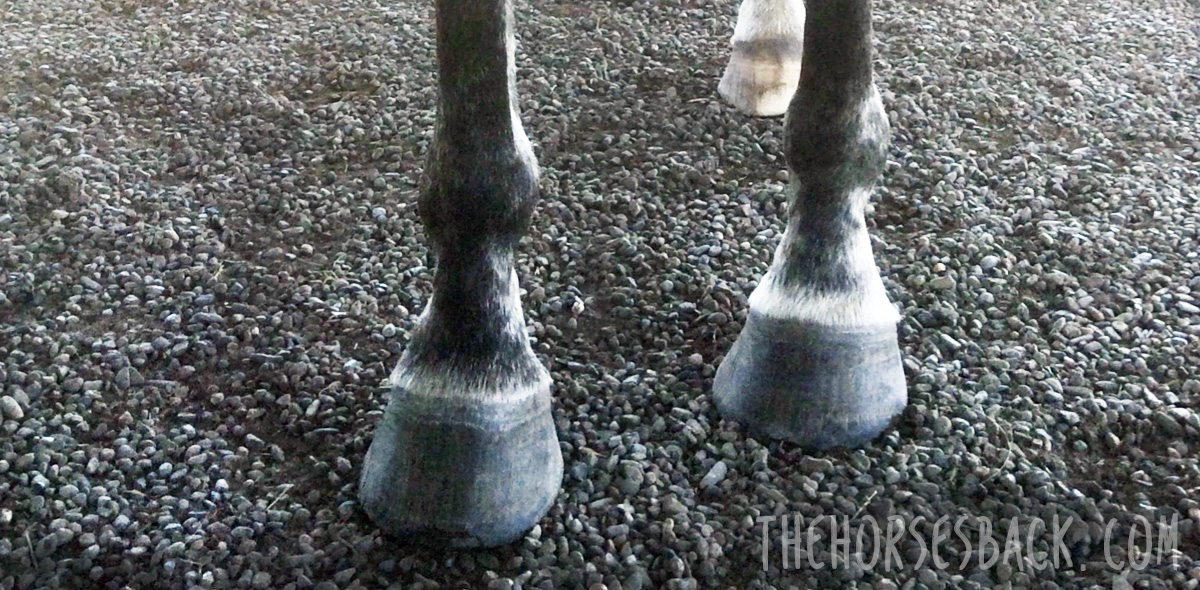
If you’re able to put some down, gravel provides wonderful under-hoof stimulation. Sand too. Your horse can tilt his hooves toe-down, heel-down or side-down, as he wishes.

Interlocking mats are also effective and can be used anywhere, as can commercially made physio mats and pads.

Watch your horse become curious, start relaxing and yawning, and you know that body adjustments are happening from within.

How it helps:

It can take the nervous system a while to wake up and catch up with what’s new.

The horse has sensory nerves in the feet, and new surfaces provide different proprioceptive.

It’s not just the hoof – changes in balance are registered from the many neuroreceptors of the lower leg.

As the parasympathetic nervous system (‘rest and repair’) is activated, musles are allowed to relax and reset.


3. Feed on a Slope

Again, think thoracic sling. The horse must open up the spine at the cervico-thoracic junction (base of neck).

Feeding on a slope
(c) Jane Clothier, equinehealthworks.com

It’s also next to impossible to adopt a scissor position (the foreleg grazing stance, see no. 7 below) when eating on a slope.

How it helps:

Your horse is encouraged to load into the front hooves equally, left and right.

Finally, the soft tissue structures at the back of the leg will be gently stretched on the limb with the upright hoof.


4. Rock the Withers

Standing alongside your horse when she is standing square, gently rock the withers from side to side.

Rocking the withers
(c) Jane Clothier, equinehealthworks.com

Hold one or two wither processes at a time (feel for the ‘buttons’) and swing gently from one side to another.

This makes the horse load into one forefoot, then back into the other.

Do this from both sides to ensure equal work, as most of us are either stronger pullers or stronger pushers.

How it helps:

The horse is being asked to mobilise between the shoulder blades. When there’s restriction, she’ll raise a hoof on the swing away from that leg.

Easing any restriction will help with relaxing the shoulder on the high side and allowing the joint angles to open out.

She may dislike the exercise at first if it’s uncomfortable, but it will improve over time. You are also gently mobilising the spine deep to the shoulders.


5. Massage the Neck Muscles

When there’s a high foot, the restriction and reduced movement on that side (the stride and therefore leg swing is often shorter) will transfer up through the shoulders to the neck.

Tension also builds because the horse is trying – and failing – to balance their weight centrally.
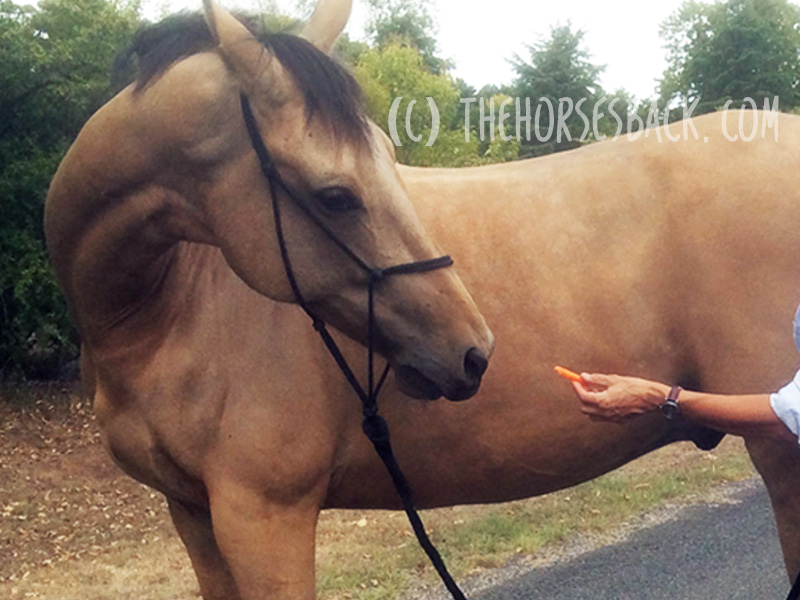
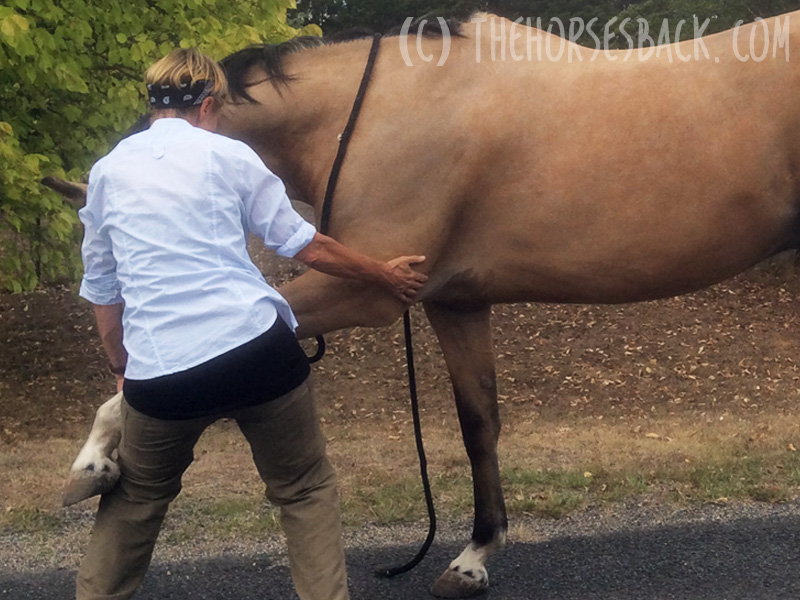
This is a secondary effect, caused by the horse’s changed posture.

Pay particular attention to the fine muscles behind the poll, which will be imbalanced.

How it helps:

Releasing muscular tension will help the horse to move to a more symmetrical posture through training and postural improvement.


6. Good Old Carrot Stretches 

Use pieces of carrot to encourage stretches to either side.

This will help your horse to become more familiar with loading into both forehooves to a more equal degree.

Lateral carrot stretch
(c) Jane Clothier, equinehealthworks.com

There are many variations on these stretches and everyone has an opinion!

If you try to ensure that your horse is standing square in front, these stretches will help, whatever the exact approach.

How it helps:

The horse is stretching out the shoulder and neck muscles, including those beneath the shoulder blade, which are going to be more restricted on one side than the other.

This action will also stimulate and activate the deep spinal muscles, bring fresh ‘body awareness’ to the region (ie, proprioception).


7. In-Hand Grazing Tricks

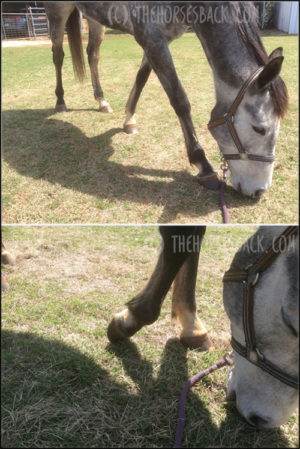
Does your horse have an obvious ‘scissor’ grazing stance, as in the first photo (right)?

Grazing stance
Change is difficult at first! (c) Jane Clothier, equinehealthworks.com

If you horse’s high hoof is always the one at the back, then there is more you can do.

Try to spend up to 20 minutes a day feeding your horse in-hand.

Walk with her and let her graze, but ONLY allow her to do so when the upright foot is placed either level with the lower foot, or further ahead.

This means lots of stepping forward, stopping, stepping again, until she’s stood as you’d like.

This will be hard for your horse at first, as you can see here, but should become easier over time.

How it helps:

As grazing positions became long term, they also familiar and are adopted habitually. It’s like folding our arms or crossing our legs in one direction.

As the hooves become balanced, the horse will continue adopting the ‘old’ position.

This is a way of reprogramming your horse as the hooves start to become more balanced.


8. Daily Leg Stretches 

This is where little and often really helps. Perform gentle leg stretches forward.

Don’t haul the leg, but allow your horse to take up the last inch or so herself.

Foreleg stretch
(c) Jane Clothier, equinehealthworks.com

If there’s a lot of tension, go very gently and don’t stretch to the limit.

Let the cannon hang vertically from the knee, so you’re only extending the upper leg.

A hand behind the elbow will help and your encourage your horse to ‘pop’ the last part of the stretch.

Don’t force it. It’s not about physically lengthening muscles: you’re allowing signals to reach the brachial plexus (nerve centre behind the shoulder blade).

Watch out for your horse looking down and touching his own knee as you start doing this, almost as if he’s surprised to see it there.

How it helps:

This is far more than a muscle stretch! You are influencing the horse’s nervous system’s awareness of the forelimb’s joints and muscles, and the leg’s position in relation to the body and then the ground.

This is proprioception and it will benefit from some help in resetting itself at shoulder joint level.

This ‘resets’ the leg and improves awereness around various joints’ range of motion.


9. Joint Mobilization

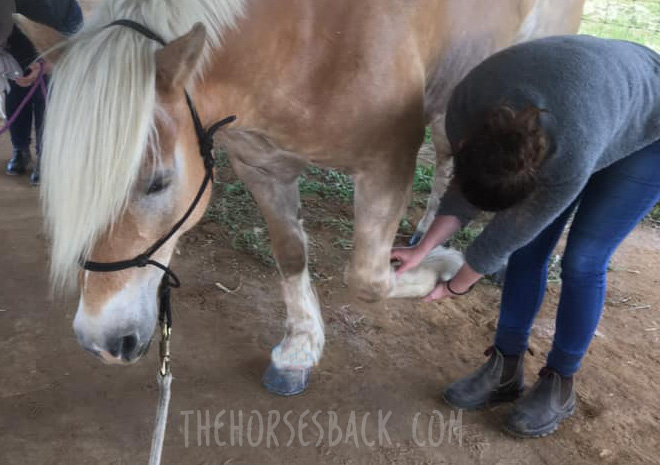
The hoof height is changing and becoming more equalized, meaning there’ll be changes higher up the legs as well.

(c) Jane Clothier, equinehealthworks.com

The high hoof side will have to open out a bit, while the low hoof side will be slightly less extended than before.

This involves the soft tissue structures around joints, particularly those of the fetlock and pasterns.

Do you ever see horses shaking their hooves or rotating their lower limb? No.

Your horse is likely to love you for gently rotating and flexing the lower joints, allowing structures to move in different ways, where previously they have been limited.

Pasterns above an upright side are likely to feel stuck. Above an underrun hoof, they will feel loose.

How it helps:

Mobilizing the joints through gentle rotation helps to restore range of motion where it has been restricted.

Spaces will be opened up that allow fluid to circulate, lubricating the joint and bringing more freedom to tendon movement.

This all helps the horse to stand above the changed hoof, positioning the leg closer to where it needs to be.


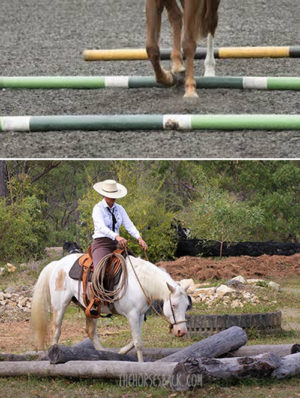
10. Work Over Poles

Many horses with long toes have a tendency to trip. Once again, as the hoof balance changes, they need to adjust their sense of ‘where their feet are’.

Top: Ground poles (c) FEI.org Bottom: Extending the exercises to the trail (c) Tanja Kraus Horsemanship

Working over poles helps your horse to focus on individual hoof placement, in terms of both stride length and height of motion.

This can be done over ground and raised poles, or over logs on the trail.

For stronger input, back your horse over poles.

Lead him over with one fore foot, then back with that foot. Lead him over with both forefeet, then back with both. And so on, until the horse knows how to navigate during back-up with all four feet.

How it helps:

Once again, it’s about the proprioceptive input.

As well as ‘equalizing’ your horse’s awareness of its feet, you’re correcting for any lasting effects of pain.

Pain in one hoof and the joints above it has a negative effect on proprioception. Same if two hooves are affected by pain.

By doing this kind of work, you’re helping your horse’s nervous system to ‘square up’, along with the feet.


There’s more – there’s always more. For example, make sure that nutrition is adequately providing the building blocks for hoof growth, development and strength.

As you get going, you’ll find that these are not so much short term changes for rehabilitation, but part of a move towards a more proactiveway of managing your horse.

(c) Jane Clothier, thehorsesback.com


Filed Under: Bodywork Tagged With: bare hoofcare, bare hooves, barefoot horses, club foot, farrier, farriery, feeding positions, GA, hay high, high-low hoof, hoof trimming, natural hoofcare, upright hoof, variable feeding positions

A Pelvic Blow Out? The Widened Pubic Symphysis in Horses

November 15, 2020 by Jane @ THB 20 Comments

Now here is something that’s just so common that people seem to think it’s normal. I guess that if you define ‘normal’ as something that’s nearly always seen, then yes, it’s probably normal – but that doesn’t make it a good thing.

So what are we looking at here?

Note: this article was edited for improved clarity on 19 May 2024.


First, a ‘Normal’ Equine Pelvis

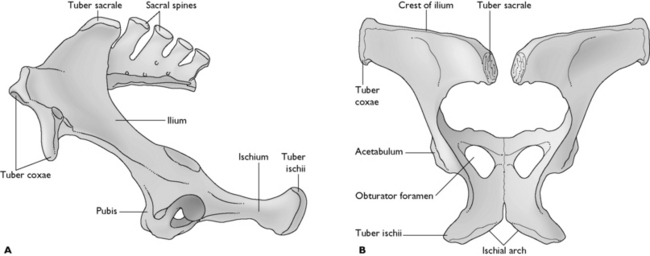
The horse’s pelvis is made up of two halves, these being the pelvic bones (os coxae). Each half – or hemipelvis – is made up of three flat bones, the ilium, pubis and ischium, which are fused into one.

The ilium attaches to the sacrum at the sacroiliac joint, a combined synovial and fibrocartilagenous joint which is supported by ventral, dorsal and lateral sacroiliac ligaments. The sacrum articulates with the lumbar spine and coccygeal (tail) vertebrae.


The equine pelvis. (c) Veterian Key


The two halves join at the pelvic floor, via a cartilaginous joint called the pubic (or pelvic) symphysis. Made of hyaline cartilage and fibrocartilage, this gradually ossifies so that by around 6 years of age, it is usually bone and mostly fused.

It is common to see a short opening at the rear, which possibly enables some valuable shock-abosrbing motion in the overall structure.

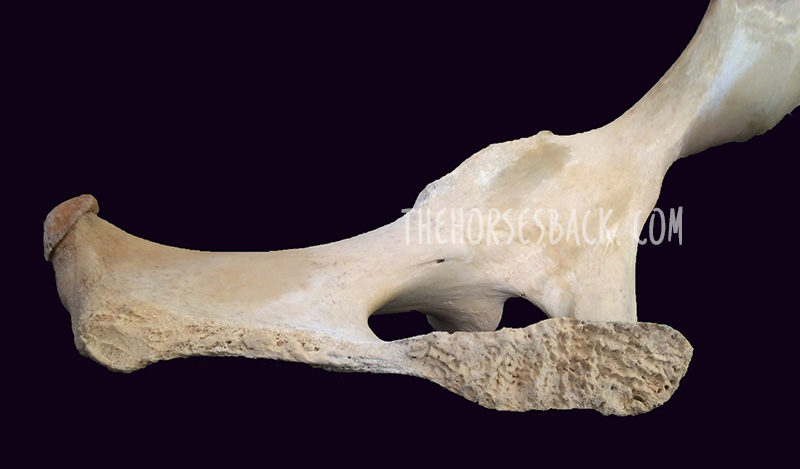
Hemi-pelvis (os coxae) of a 5- yo Australian Stock Horse, showing the pubic symphysis. Only the cranial (front) part of the ligamentous joint was intact. (c) The Horse’s Back


How the two halves would have been positioned in the living horse. The cranial part (top of photo) was still ligamentous at the time of death. The caudal section (bottom of photo) was separated as a result of traumatic falls. (c) The Horse’s Back


In older horses, this joint would normally completely ossify, so that the base of the pelvis is solid bone. Given that many of the equine pelvises we do get to see are from older horses, you’d think we’d see them all fused and ossified.

However, that’s not the case. While it’s normal for a short section to be widened at the rear of the symphysis, many are separated along 1/3 to 2/3 of their length, being fused only at the cranial (front) end of the pubic symphysis.

Separation of the Pubic Symphysis

We can sometimes see this condition without looking at the bones. The reason for this is that the two halves of the pelvis have opened out to the extent that there’s no symmetry in the living horse’s structure at all. The pelvis is both distorted and twisted.

  • The tuber sacrales tell us about sacroiliac damage, usually when these are of different heights > 5 mm.
  • The tuber coxae (point of hip) are positioned differently, with one higher or further forward.
  • The tuber ischii (seat bones) may be at different heights, or one may be further forward.
  • The horse is very often rotated along the thoracolumbar spine, with a noticeable direction change at T18-L1 (thoracolumbar junction).
The ex-racehorse’s pelvis can be particularly distorted. (c) The Horse’s Back

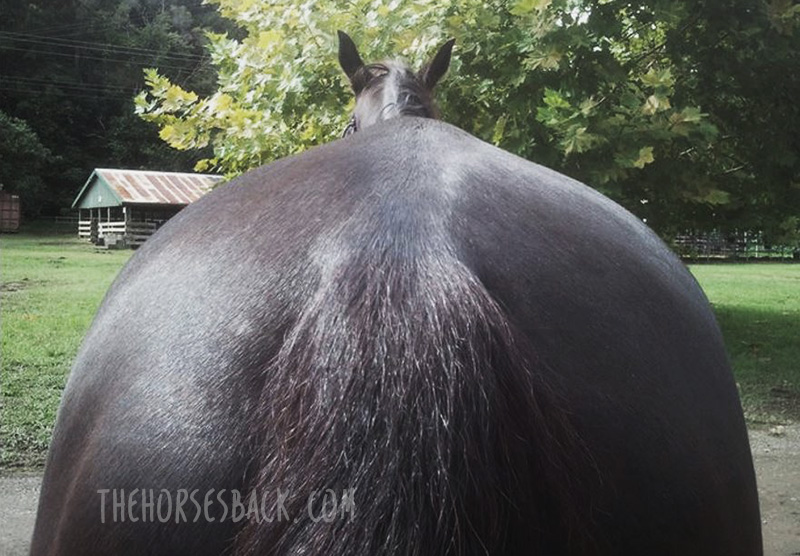
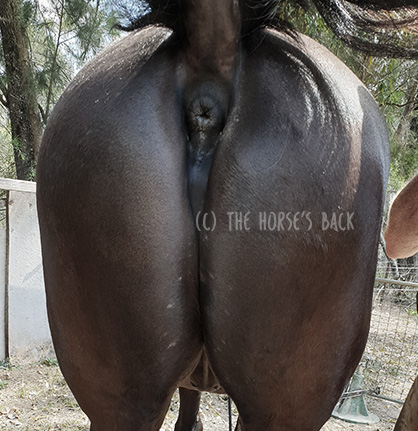
The problem can be very obvious. Always check under the tail, as what you see there can tell you a lot… The following horse had an outwardly rotated left hindlimb.

The asymmetrical height and position of the tuber ischii (seat bones) is visible under the tail, where it looks as if the anus is off to one side. Warmblood gelding, presumed traumatic fall (c) The Horse’s Back, posted with owner permission.

An older horse’s pelvis may become distorted due to a fall, trauma or long term muscular stresses, without the pubic symphysis being separated. This is because it has fully ossified.

The difference lies in the degree of the problem: a major trauma might cause additional fractures or ligaments rupture, with signs of serious injury at the time. Ongoing stress can gradually affect angles of the tuberosities (sacrales, ischii and coxae), albeit not as dramatically as in major trauma.

What About The Sports Horse’s Pelvis?

In ridden horses and especially in ex-racehorses, it’s not uncommon to see significant widening and associated asymmetry of the two pelvic halves. It can’t all be due to heavy falls, at least not in flat racing.

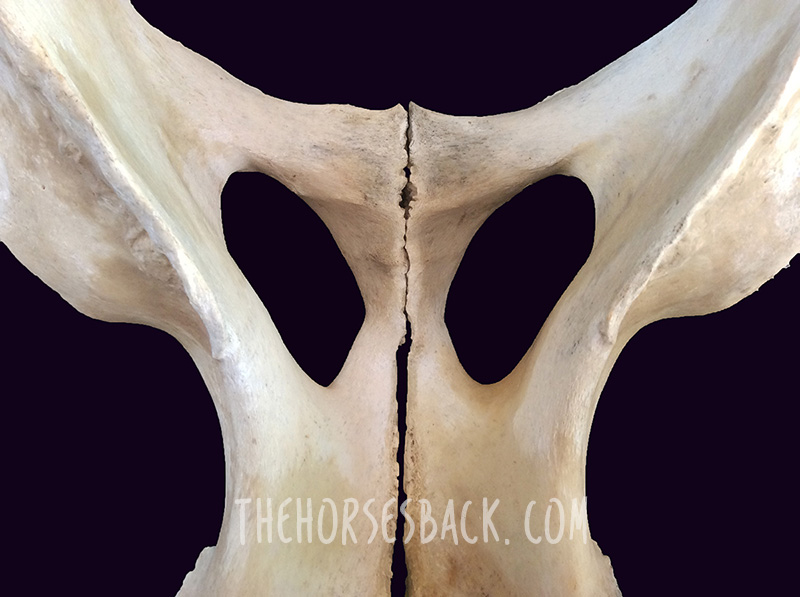
The following two photos show the pelvis of an ex-racehorse. This wasn’t an extreme case by any means, but look at how far forward the separation extends. It reaches right to the weakest part of the structure, between the obturator foramen (the two openings). This primes the pelvis for distortion.

Outcome? The bones show an overall distortion, nowhere more so than in the different angles of the acetabulum (cup part of the hip joints).

It can, of course, be worse.

Pelvis of a 9-yo OTTB gelding. The separation extends along the caudal 2/3 of the symphysis. This extends to the narrowest, weakest part of the symphysis, enabling greater lateral distortion of the two pelvic halves. (c) The Horse’s Back

It’s Not Always a Disaster

Some horses can do very well after experiencing this type of pelvic distortion. Here’s a TB who never made it to the track and has considerable distortion.

And yet, through a series of compensatory adjustments along his spine, he stands squarely and works quite well.

OK, so he only takes part in local competitions and is never going to be working at a serious level, but with good management of his body and hooves, and correct training and saddle fit, he’s very functional. He just needs those things to be absolutely correct, as there’s no wriggle room for further compensations.

This problem can be a career-changer without sounding a death knell.


If Horses Can Live With It, Should We Worry?

Let’s be clear: this may well have hurt when it happened. Whether through trauma or the effects of ongoing physical stress on bone, the wide separation of the pelvis would be painful.

The pain of a sacroiliac ligament lesion might get noticed and the horse be rested. A check for more common stress fractures in the ilium might yield no findings.

The fortunate ones will get rehabilitation exercises as they get going again.

Yet going by how rarely we hear about this issue, it can be assumed that it’s often overlooked.

But What About Later?

Once the horse is through the original trauma, does this distorted pelvis remain a problem? It all comes down to how bad it is.

Please note the use of “may” in the following points.

  • Some horses are fully able to compensate for a milder or fully symmetrical presentation and there is no effect on performance.
  • If the pelvis is distorted and the coxofemoral (hip) joints are in different positions, then stride length, lateral and circle work may be affected.
  • Different hindlimb positioning can also lead to asymmetric weight bearing, with different concussion through the hind limbs, and diagonal effects flowing forward.
  • If it’s bad, co-existing sacroiliac damage may lead to an ongoing vulnerability. Tuber sacrales may be extremely close together because the pubic symphysis has widened.
  • Pelvic asymmetry may link to rotation of the spine and scoliosis along its length.
  • Plus, a horse may retraumatise an existing opened pubic symphysis, leading to renewed pain.

As I always say, awareness is everything.

It’s always wise to check the pelvic symmetry of your horse, particularly a potential purchase off the track, while being sure to understand how and why this will affect performance.


[1] https://epos.myesr.org/poster/esr/ecr2020/C-08782/Findings%20and%20procedure%20details#poster

[2] Beatty T. Osteitis pubis in athletes. Curr Sports Med Rep. 2012 Mar-Apr;11(2):96-8. doi: 10.1249/JSR.0b013e318249c32b.


Footnote

In 2012, I asked Dr Sharon May-Davis about an ex-racehorse I was seeing. The TB, who had a very asymmetrical pelvis, had done some damage to himself and had obvious pelvic pain, with that dull, dull look of pain in the eye that I associate with fractures. Sharon asked me if I had a photo of the structure under his tail, and I did – it was so asymmetric that I’d photographed it. Sharon sent me a photo of some pelvic bones and for the first time, I saw the underlying nature of this problem. Yet again, I have to thank Sharon for alerting us to this disturbingly common issue in horses.

Footnote 2 (June 2025)

In the past 18 months, I have experienced some grief over this post on social media. I am now republishing it under a refreshed title, although with some reluctance. I stand by the information it contains, which was not formerly in the general domain until this appeared in late 2020. This pelvic issue is a contributory or causal factor to asymmetry in the horse, yet is not (in the vast majority of cases) a catastrophic event. However, this issue and consequent asymmetry, if serious, may prevent performance at the higher athletic levels, even if not in itself a source of pain or breakdown. As owners, we must recognise this and make appropriate decisions for the horse’s activities and career. If horses are to be helped and understood, I believe such topics should not be the sole preserve of articles in scientific journals. There are places for information at many levels – if some popular terminology help owners to understand, then I also question whether that is a bad thing.

Filed Under: Bodywork Tagged With: equine anatomy, equine pelvic symphysis, equine pelvis, equine pubic symphysis, equine sacroiliac, equine skeleton, fractured pelvis horses, GA, horse anatomy, horse skeleton, pelvic fracture horses, sacroiliac dysfunction

All About Crooked Legs: Angular Limb Deformities in Horses and Foals

April 5, 2020 by Jane @ THB 9 Comments

Angular Limb Deformities: it’s the technical term for crooked leg problems. The term sounds alarming, but how bad are they and exactly how common?                                                    

We’ve all seen shocking pictures of crooked foal legs in groups and forums, but thankfully they stand out exactly because they’re not so common.

However, many horses have mild or moderate versions of these. And what is normal is that many tend to slip under the radar, undetected by owners and breeders. And that’s not a good thing.

Image (c) Nådhammar on Flickr

The problem is that moderate angular limb deformities (ALDs, as we’ll now call them) can create bigger problems as the horse grows older, with increased risk of lameness, instability, and joint degeneration. 

They can cause complications when the horse is injured elsewhere in the body and needs to compensate, but can’t, because the non-straight limbs are already under pressure.

To repeat: many ALDs aren’t an issue. In fact, many are so mild that they’re never a problem.

The thing is, you need to know the difference. And that means knowing what to look for.

Some are obvious, others need veterinary radiographs to be sure. For all of them, the earlier you catch them in foals, the better. Always talk to your vet first.

So without further ado, here are ten ALDs you really ought to know about.


© All text copyright of the author, Jane Clothier, https://thehorsesback.com. No reproduction of partial or entire text without permission. Sharing the link back to this page is fine. Please contact me for more information. Thank you!

1. Carpal Valgus

‘Knock Knees’

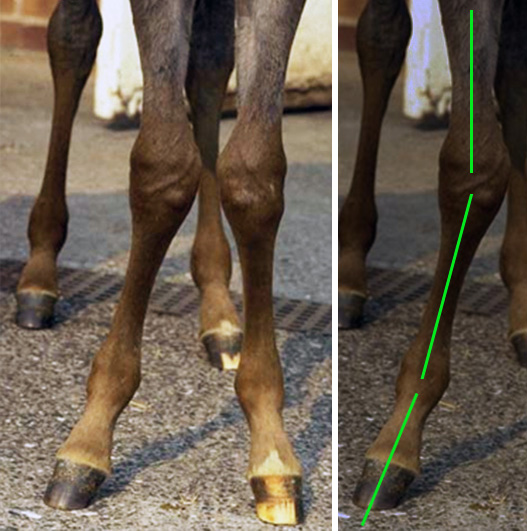
Carpal valgus (c) vetstream.com. Additional markup: THB.

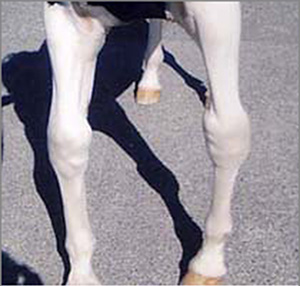
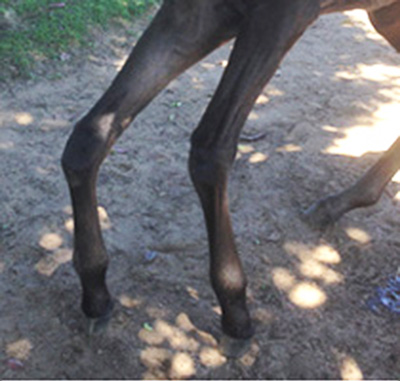
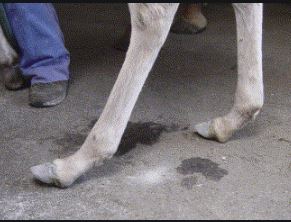
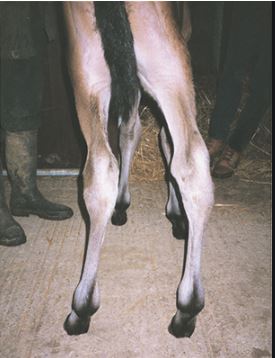
This is the most commonly seen ALD in foals and horses. Technically it is an outward deviation of the lower leg from the mid line. Most of us see the other effect – the knees coming closer together.

In foals, the hoof often points outward. In older horses, the hoof may turn inwards – this is compensation to bring weight bearing back in.

There may have been a fetlock valgus (see #3) lower down, which has then caused the carpal valgus higher up.

This can be congenital. It can also be acquired, as a result of physitis of the radial growth plate immediately above the knee at a few months of age.

Incomplete ossification, when the carpal bones are underdeveloped at birth due to dysmaturity or prematurity, can contribute to this problem.

Key points: ALD of forelegs; knock-kneed appearance; lower leg angled outwards; affects one or both forelegs.

2. Tarsal Valgus

‘Cow Hocks’ (mistaken for)

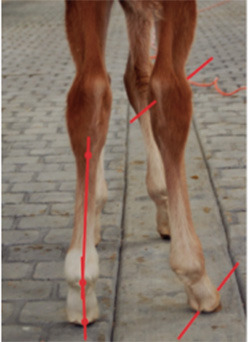
Tarsal valgus in a foal (c) Redden, RF [1]
This is an ALD that very often gets mixed up with the conformational trait of cow hocks. To further confuse matters, mature horses with back issues may also stand unusually behind.

In these limbs, the point of hock angles inwards, while the lower limb angles outwards. Often, the pasterns are also angled outwards, giving a splay-footed look. In walk, the foot will swing in and then land wide.

The entire leg may be rotated out from the midline, as in this image.

In older horses, the medial heel may be crushed or under run.

Key points: ALD of hind legs; lower limb or whole limb angled out; affected hinds land wide; affects one or both limbs; one limb often worse.

3. Fetlock Valgus

‘Toe Out’

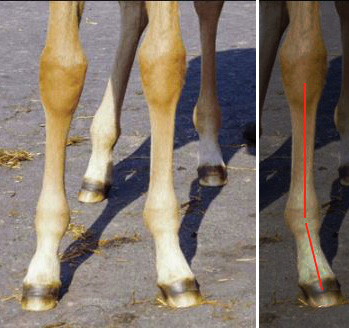
Fetlock valgus. (c) unknown. Additional mark-up: THB.

It’s extremely hard to find a picture that shows a fetlock valgus with no other visible limb deformity. Even the mild ones tend to be associated with rotation at knee level (see #10).

This is when the pastern and therefore hoof are angled away from the midline, below the level of the fetlock.

The valgus in this photo is reasonably clear, although there’s some rotation in the knee. Note that the foal is weighting this limb less and an upright foot is already starting to develop.

Key points: usually ALD of forelegs; sometimes with tarsal valgus in hind legs; one or both feet angled outwards; one often worse.

4. Fetlock Varus

‘Toe In, Pigeon-toed’

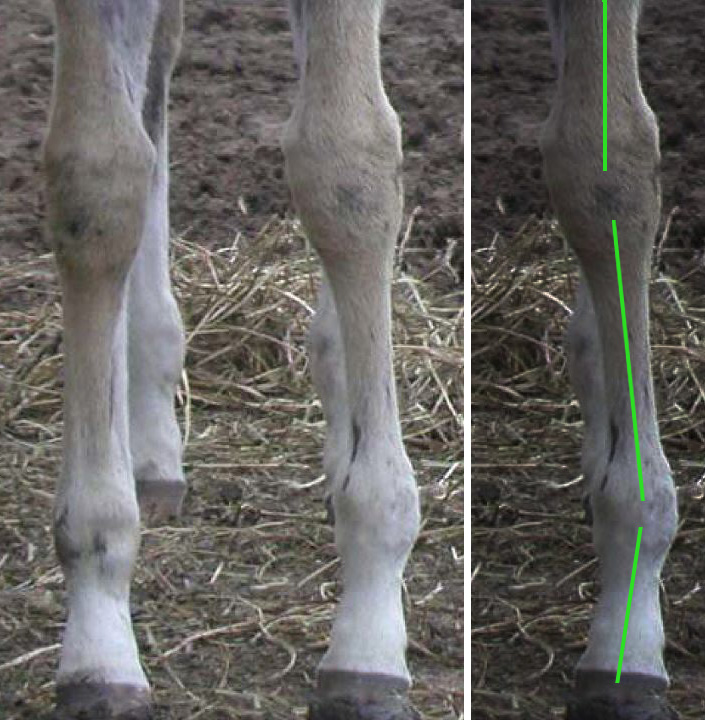
Fetlock varus (c) Stephen O’Grady [3]. Additional mark-up: THB
A fetlock varus is also often confused for conformation or a horse ‘just being like that’. 

With this problem, the foot is angled towards the midline below the level of the fetlock,

This problem is often combined with offset canons or rotated carpals (see # 9,10), as the foal is compensating in an effort to bring the weight bearing line back beneath the shoulder joint.

In older horses, the lateral heel may be crushed or wear down quicker. Depending on severity, there may be a tendency to ringbone in later life.

Key points: usually ALD of forelimb; affects one or both legs; often accompanied by a carpal ALD.

5. Carpal Varus

‘Bow Legs’

In a carpal varus deformity, the lower leg is angled inwards, towards the midline. Our eye tends to see it as the joint being angled outwards.

Advanced carpal varus (c) unknown

You don’t often hear about bow legs in horses, do you? That’s because it’s rare.

It’s usually seen in older horses, when the problems have layered up. Arthritis may already be present in the joints, while tendons and ligaments may have lesions.

Some may have had lax ligaments at birth, or have ruptured the common digital extensor tendon at a young age, causing misalignment of the carpal bones.

Key points: rare ALD of foreleg; bow-legged look; foot dishes inward; arthritis and lameness likely.

6. Flexural Deformity

‘Contracted Tendons’ (so-called)

This is a common deformity in newborn foals (call your vet).

Sometimes it affects the carpal (knee) joints only and the foal is still able to use the lower leg quite effectively. Or, it affects both the carpal joints and the fetlocks, leading to a more serious situation where they can’t walk on the hoof.

Severe congenital flexural deformity (c) J. Clothier

This can also be an acquired deformity related to incorrect nutrition during the first weeks and months of life. In these cases, nutritional measures, remedial hoofcare and even surgery may be required .

The hind legs can also be affected, although this is less serious as the direction of joint flexion encourages correction.

Mild cases in foals can often come right on their own in the first days of life with a little help. However, it is always important to involve a vet at an early stage for monitoring.

Key points: ALD mostly affecting forelegs; either knees only or knees and fetlocks.

7. Hyperextension

‘Lax Tendons’

Again, this is super-common in newborn foals and it can often resolve all on its own in the first few days of life with a mix of confinement and limited exercise.

Hyperextension in the hindlimbs

Occasionally, in the case of dysmature and premature foals, the problem can be more complex. Combined with incomplete ossification and lax ligaments, hyperextension can lead to another level of ALD, as the cuboid bones of the carpals and tarsals become misshapen.

Once more, give the foal a couple of days to straighten up and then talk to your vet if it persists.

Key points: affects forelegs and hindlegs often together; usually resolves with conservative exercise; support for limbs and hooves may be required.

8. ‘Windswept’

This startling looking deviation is often seen in foals that are  post-mature – they have had a long gestation and have been restricted within the uterus.

What we’re looking at is a combination of ALDs: carpal valgus and varus in front, and/or a tarsal valgus and varus behind.
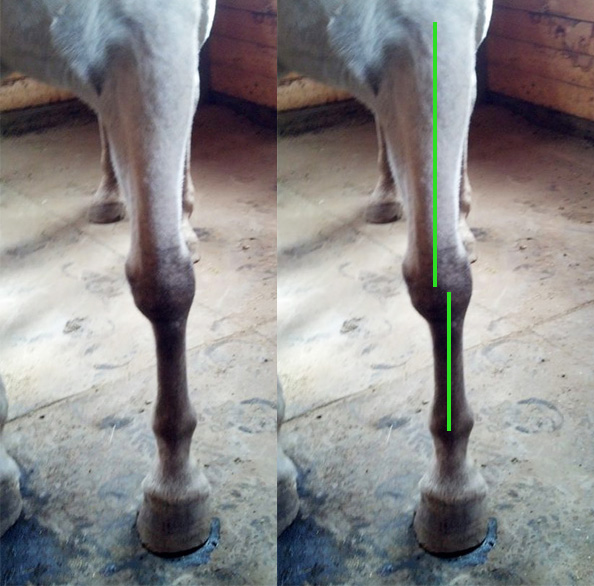
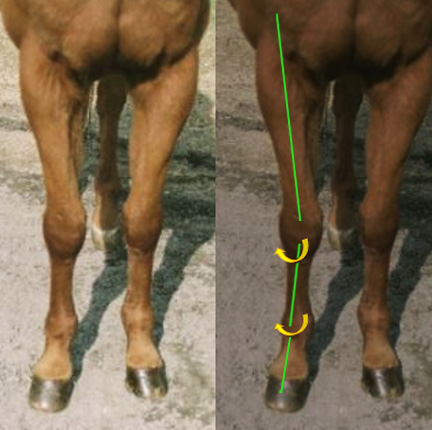
The problem will general resolve within a few days, sometimes with a bit of hoofcare and bodywork to assist.

However, if the foal appears weak despite being ‘over-cooked’, with hyperextension (#7) as well, be sure to monitor it especially carefully during the early weeks and months. This is because incomplete ossification may also be present.

Key points: affects forelimbs and/or hindlimbs; hyperextension may also be present; often resolves in days. 

9. Offset Cannons

Offset cannon (c) horsesidevetguide.com Additional markup: THB

Strictly speaking, this is a conformational trait, as it often visible in the sire or dam. However, it is still classified as an ALDs on account of the structural weaknesses involved. 

In the offset cannon, the cannon bone is positioned wider than the midline of the leg, although it still faces forwards. The hoof is also forward facing.

In one leg, this ALD may have no negative effect on athletic performance. Yet if present in both forelegs, the horse may be less stable in some situations, such as going downhill.

It increases the chances of two things: developing a splint (medial leg) and a tendency for the foot to turn inwards, which could then lead to an acquired fetlock varus (see #4).

In racehorses, it can increase the chance of injury in the medial carpals, while other sports horses may be prone to osteoarthritis in the joint.

Key points: cannon appears shifted sideways; cannon, hoof and knee face forwards; usually inherited conformation; medial splints more likely.

10. Carpal Rotation

‘Bench Knees’

Rotated carpals with associated fetlock valgus. (c) unknown. Additional markup by THB.

In this ALD, the cannon bones are rotated slightly outwards, as are the lower knee bones and the feet. This sets the horse up for a fetlock valgus (‘toe out’), as can be seen in the left foreleg in this image.

Also a conformational trait, this kind of leg is frequently seen in Quarter Horses. A wide chest and narrow lower limbs can also contribute to a postural rotation of the foreleg.

Similar rotation in the lower forelimb can also be an acquired ALD, if a young horse has to change its weight bearing for a long time, due to (say) an injury in the diagonally opposite hind limb.

From certain angles, this rotation can look like a carpal valgus. Always check from different angles to be sure.

Key point: face of cannon and knee appear rotated outwards; pastern and toe often angled outwards, medial splints more likely; medial hoof wears faster.


Other resources

[1] Redden, RF. How to Evaluate Foot Flight and Leg Alignment
AAEP PROCEEDINGS, Vol. 57, 2011, p.407

[2] O’Grady, SE, Routine Trimming and Therapeutic Farriery in Foals, Th Veterinary Clinics of North America, Equine Practice, 2017

Filed Under: Bodywork, Foals Tagged With: angular limb deformities, angular limb deviations, carpal valgus, crooked legs, foal legs, foal limbs, GA, tarsal valgus

‘The Size of a Walnut’ – Does Equine Brain Size Matter?

November 5, 2019 by Jane @ THB 7 Comments

There seem to be quite a few social media posts about the equine brain of late – and that’s no bad thing. 

In some ways, the brain is simply the latest part of the equine anatomy to come under the spot light. It’s being subject to statements about welfare, training and psychology – and that’s definitely a good thing (here’s one from Hippologic.)

However, I want to add something to this equine brain discussion. I just happened to run in to it when I went down a research rabbit hole a couple of years back.

We often hear how brain size is not directly linked to an individual’s intelligence. At the same time, a relatively large brain is said to signify intelligence in humans, while that of the horse, popularly said to be the size of a (large) walnut, is said to account for their lack of intelligence.

Vintage anatomy print showing relatively small size of equine brain to body size.

This falls down once we look at elephants, which have relatively small brains yet are pretty cluey.

In horses, innovative behaviors without evolutionary basis are often used as a measure of intelligence (read more here about unlatching gates). Leaving behaviour-based measurement methods aside for the moment, let’s ask: how do we figure out if there’s an association between different brain sizes and intelligence levels?

(Note: if you’re a neuroscientist of any description, look away now. What follows is a highly simplistic overview of this incredibly complex subject area.)

© All text copyright of the author, Jane Clothier, www.thehorsesback.com. No reproduction of partial or entire text without permission. Sharing the link back to this page is fine. Please contact me for more information. Thank you!


Measuring Equine Brain Mass and Body Mass 

In zoology, the starting point isn’t about brain size, but brain mass compared with body mass or weight.

Even then, it’s not a matter of separating the brain from the body and then weighing both. The most accurate way of measuring this accounts for several anatomical, physiological factors, including the amount of water in the brain.

The result is a single figure that is called the encephalization quotient (EQ). The EQ for a species is arrived at after researchers have performed the calculation for dozens of animals.

The parietal bones form the domed ‘cranial vault’ of the skull.


So How Does This Look for the Equine Brain?

Only a handful of equine researchers have delved into EQs, as this is mostly an area of zoological neuroanatomy.

In this study by Cozzi et al (2014), the brains of 131 mixed breed adult horses (no ponies) were collected and weighed.[1] Researchers found first that the adult horse’s brain weighs 600 – 700 g. The average brain weight for horses aged 2 years and over was 606 g, while the average bodyweight was 535.22 kg.

This meant the horses in this study had an EQ of 0.78.

Here are the EQs for some of the large mammals: Cow – 0.55, Pig – 0.6, Camel – 0.61, Horse – 0.78, Goat – 0.8, Wolf – 0.9, Domestic Cat – 1.00, African Elephant – 1.67, Gorilla – 1.76, Human – 6.62.

And if you’re really interested, here’s the calculation used in the equine paper. Other scientists use different calculations – there is no standard approach.

EQ = E i / 0.12 P2/3Ea/Ee


So, Are Horses Intelligent – or Not?

A larger brain mass compared with body mass is often associated with better cognitive functioning, but that does not mean it causes it.

Brain size is therefore a very general measure for intelligence. What actually matters are the specific areas of the brain and their relative sizes.

The bigger the frontal lobes, the more capable the species is of ‘goal directed’ behaviors – that is, the ability to analyse information and act accordingly, planning ahead. [2]

Here we hit an issue. The frontal lobes are either relatively small in the horse, or non-existent – and this is a matter of contention. Some published veterinary researchers maintain that they do, as shown below.

Rough comparison of the frontal lobes of the horse (left) and human brains.

However, researcher and author of Horse Brain, Human Brain Janet Jones PhD writes, “Basic anatomy shows that horses have no frontal lobes and no prefrontal cortex. No qualified PhD trained in neuroscience disputes this anatomy.”[3]

Whichever is true, the take home for both is that the horse is more likely to react in the moment. This is not to say that horses lack intelligence, but that they think and respond differently.


The brain’s fissures are also important. These are the wrinkles and grooves, known as sulci (sunken inwards) and gyri (protrude outwards). They’re standard within species, although the brains of some species have more complex surfaces than others.

Rats, considered to be on the lower end of the intelligence scale of mammals (although rat owners will surely disagree), have smoother brain surfaces than horses. In turn, horses have fewer fissures in their brains than primates.

The area contained within the cranium is the ‘cranial vault’. Its inner surface perfectly matches the outer surface of the brain, as they develop together as the animal grows.  If you could look inside this part of the skull, you would see a perfect mould of the fissures.

More recent research also links the organization of neurons (nerve cells) and synapses in the brain to intelligence.


Surely There’s a Difference Between Breeds?

Different breeds of horses certainly have differences in the shapes of their heads.

However, these differences are slight overall. In a study of TBs, STBs and Arabians, the relative proportions of the ‘neurocranium’ – the area above the frontonasal suture, including the cranium – were reasonably similar between breeds.

It was the lower part of the skull, primarily the nasal bones and the maxilla, that varied most and gave the breeds their different looks [4]. The study did not measure the cranium itself.

The neurocranium aligns with the ends of the frontonasal suture and includes the temporal and parietal bones, ending at the occiput.

This suggests that while some breeds may look extremely different – take the Welsh Cob and the TB, for instance – the neurocranium may be nearly square in all, at least when viewed from the front.

And even though some breeds may have proportionately larger heads, all (excluding ponies) will have EQs grouped around the average score of 0.78 mentioned earlier.

Small and wide ponies, incidentally, often have quite large parietal domes (or tuberosities, as they should be known), but the jury is out as to whether this makes them more intelligent… The fact is that we don’t know.


A Little More on Equine Brain Size

There are a few other differences that aren’t documented. Comparing horse skulls, we can see that some have a cranium that is narrower in relation to overall skull width than others. They also vary in shape: some are very full and round, while others are more teardrop shaped.

You can see this when you look at the spaces to either side of the parietal ‘dome’ and temporal bones, where the coronoid processes (tips) of the mandible protrude behind the zygomatic arch.

This may be due to breed or it may be individual. Our own skulls vary from person to person, with some aspects being just how we are, while others may be more developmental.

We can see this in horses too. Dwarf horses can have domed heads, as can horses that have been born prematurely.

This can affect intelligence – researchers have found that in humans, when the brain is smaller due to development delays, the intelligence can be lower. If it is smaller without any developmental delay, it makes no difference at all. [5]

Interestingly, a new study in humans shows that the longer the time Romanian orphans spent in the institutions as babies, the smaller their total brain volume, with these changes being associated with a lower IQ. You can read more about that study here. [6]

Personally, I would love to know more about this, as I’ve been researching the developmental effects of gestational problems in horses, including the effects of premature birth (my PhD thesis lives here). It’s the same old problem though: once a horse is at the stage where we can examine its skull, its early history is usually lost in the mists of time.

Ultimately, as with humans, what is going to make the most difference to us as horse owners is the individual’s learning experiences at different stages of its life. This is also where equine personality comes in, and the methods of training used, but those are different subject areas altogether.


[1] Cozzi et al., The Brain of the Horse: Weight and Cephalization Quotients, Brain Behav. Evol., 2014; 83:9-16

[2] McGreevy, P., Equine Behavior – A Guide for Veterinarians and Equine Scientists, Elsevier, 2012.

[3] Janet Jones – Horse Brains Facebook page

[4] Evans KE, McGreevy, PD., Conformation of the Equine Skull: a Morphometric Study, Anat. Histol. Embryol., 2006, 35(4): 221-7

[5] de Bie H. et al. Brain Development, Intelligence and Cognitive Outcome in Children Born Small for Gestational Age. Horm Res Paediatr 2010, (73)6-14.

[6] Mackes, NK. et al.,  on behalf of the E. Y. A. F. (2020). Early childhood deprivation is associated with alterations in adult brain structure despite subsequent environmental enrichment. Proceedings of the National Academy of Sciences.

Filed Under: Bodywork Tagged With: Anatomy, equine anatomy, equine brain, equine skull, GA, horse anatomy, horse brain, horse skull

  • « Go to Previous Page
  • Page 1
  • Page 2
  • Page 3
  • Page 4
  • Page 5
  • Page 6
  • Interim pages omitted …
  • Page 8
  • Go to Next Page »

Footer

Contact Me

Send your questions this way…

Get in Touch

  • Store Support
  • Shipping
  • Returns
  • Contact

Copyright © 2026 · Parallax Pro on Genesis Framework · WordPress · Log in