• Skip to main content
  • Skip to primary sidebar
  • Skip to footer

The Horses Back

Body Talk for Thinking Owners

  • Home
  • Articles
  • BEMER
  • Store
    • Store
    • Shipping
    • Returns
    • Support
  • Equine Healthworks
    • Bodywork for Horses
    • Reviews
    • Leave a Review
  • About & Contact
    • About
    • Contact

Recent Posts

What This Pony’s Tail Tells Us About Owners Who Abandon Their Horses

August 10, 2014 by Jane @ THB 26 Comments

abnadonment-header

I’ve been thinking about horses and abandonment recently. By abandonment, I mean a situation where a treasured or most favored horse has suffered an irreparable  injury and has suddenly been dropped by the humans who previously lavished attention upon it. It happens quite a bit.

Do the horses know they’ve been abandoned?  Yes, I believe so.

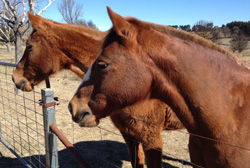
Bob-againTake this pony, who currently goes by the name of Bob. His conformation speaks of Quarter Horse crossed with Welsh, with the Quarter Horse mainly walking behind the Welsh. Paddock condition doesn’t help on the looks front, as he’s obviously a ‘fat on fresh air’ type. But I’m putting that to one side, as it’s Bob himself that I’m interested in.

A power-packed pocket rocket, he’s one of those lovely straightforward guys that makes you smile almost as soon as you meet him. He gives every appearance of having been a true sports pony and, whatever his sport was (barrel racing?), he did it fast. The lad finds it hard to stand still in the paddock – he is wired to move.

And yet, with a damaged knee that tells of an unpleasant accident, he subsequently found himself at the sales.

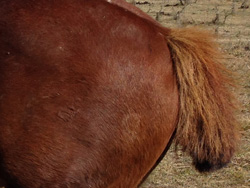
At some point during this process, his tail was cut off. I somehow doubt that the person responsible did it to make memento jewelry. We have to assume that the hair was sold, as the owner at that time knew the pony was advancing on a one-way trip to the meat man (or to ‘the doggers’, to use Australia’s typically direct term).

How to get a few more bucks out of a horse

In economic terms, this action could be called ‘asset stripping’ – ie, getting every last cent possible by breaking a possession down and selling the parts. There’s obviously no regard for preservation of the whole or what’s left at the end.

Now, I do realize that once a horse is slaughtered, its remains are subject to asset stripping. Indeed, there’s a company near here that collects tendons for use in research. I also realize that by the time a horse hits the slaughter house floor, its tail will be somewhat less than clean, for a variety of reasons. There are obvious practicalities involved. But what I’m concerned about here is what’s happening to a living horse. So, let’s return to Bob…

Clearly, he hit a remarkable upswing when he was bought from the sales by a good man with plenty of land. Thankfully, the new owner wasn’t concerned about lack of ridability due to the knee injury, and was happy just to watch Bob being a pony in the paddock. If the pony demonstrated that he could carry a toddler along on the lead rein, then that would be great. But if he couldn’t, that was fine too. He wouldn’t be required to earn his keep – he could just be Bob.


At this point, I was asked to come out and give the pony some bodywork, just to see whether it would help make him more comfortable.


Bob's knee
Advanced DJD due to injury

Now, during a bodywork session, it’s always apparent to me when a horse has lost its trust in people. I don’t mean a horse with so-called behavioral issues, although there are plenty of those, but a horse that knows its people have given up on it.

Such horses maintain a distance – not necessarily detaching themselves from what is happening, as they can be very physically cooperative. But they don’t come forward in an emotional sense. There’s a reserve that is incongruous to everything else that is going on.

It’s like being with a partner whose mind is partly on the football. Their presence is missing by, ooh let’s say 5-25%, depending on how much they support that team. No way can you  not be aware of it! (I’m trying desperately to think of the female partner equivalent and failing at the moment.)

I spent an hour working with this pony and yet he still maintained his not-quite-there reserve. That was the choice that felt best to him at the time, and that was OK with me. So I left, expecting that to be that.

Driving away, I thought more about that crudely chopped tail. The tail that somebody’s hands had once carefully groomed had, ultimately, been roughly removed. I had to wonder whether it was by the same or another pair of hands.

The next day, earlier than expected, I received a phone call from Bob’s owner.

“I went to the paddock today,” he said, “and that pony walked straight up to me for the first time, looking for a fuss. He’s not done that before.”

Now, this is the kind of thing I like to hear. It might sound a small thing, but as the owner recognized, the small thing was significant precisely because it had been absent before. Something important had changed for Bob during the intervening hours.

He felt physically better and had decided that it was OK to trust a person again.

Bob and a new friend

I am so pleased that this outcome transpired for this particular pony. And I am grateful for meeting horses like this, for it’s their beautiful forgiving souls that prevent my anger from rising.

For the truth is that I quietly despise owners who will use such a willing horse or pony up, and then dump their injured animal at the sales, in full knowledge that it is only ever going to be slaughtered at the end of a few stress-inducing weeks or days. Very few share Bob’s luck at this stage.

I am certainly not misguided into thinking that there is a home for every broken and injured horse, or even that all horses can find a home, injured or not. Those who make it to companion or paddock ornament status are incredibly fortunate. And I recognize that not all horses are treated as I treat mine. People own horses for different reasons.

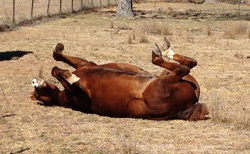
bob rollingBut I have to ask, what price a dignified end? It seems that the attraction of a couple of hundred bucks, symbolized by Bob’s severed tail, is simply too much for their owners to turn away.


Filed Under: Viewpoint Tagged With: bob the pony, GA, rescue

8 Golden Rules For Helping Your Thoroughbred Get Right Off The Track

August 2, 2014 by Guest Author 38 Comments

OTTB Header

In this guest post, Kerry Warren Couch responds to the article on this site about ex-racehorses by stating, clearly and simply, how she has helped her OTTBs over many years, mainly by initially doing very little at all.

(c) All text copyright of the author at www.thehorsesback.com. No reproduction of partial or entire text without permission. Sharing the link back to this page is fine. Please contact ja**@***********ck.com for more information. Thank you!

Kerry writes:

Sometimes, you can achieve more by doing very little. There’s a lot advice around about what you can do to help ex-racehorses, or OTTBs (Off the Track Thoroughbreds). Much of it focuses on what can be done through retraining, while some of it focuses on dealing with physical issues.

I have ridden many OTTBs over the decades of my riding career, professionally and for sheer pleasure. I just adore them – they have so much heart, and they give  everything if the rider is willing to be extraordinarily patient, partnering with their horse and never forcing them.

I loved the Buying an Ex-Racehorse: Can You Spot the Major Physical Issues? article – it’s absolutely on target. I have a few suggestions for folks to consider when they bring their OTTBs home. These come from my personal experience – they may not apply to everyone and all cases, so do keep that in mind.

The author's new OTTB
The author’s new OTTB

Seven months ago, I purchased yet another OTTB. He came from a top trainer/track and we knew his entire medical history, including x-rays. This is NOT typical – I was very fortunate to have access and for my vet to be able to talk with the stable and their vets. Very lucky me.

Despite coming from a top trainer, my new OTTB does have some issues – he IS an ex-race horse, so this is to be expected.

He has benefited from my usual approach, which helps the horse long before we start work.

What follows is my approach to helping every OTTB that comes to live at my farm.


1. Allow the OTTB plenty of downtime

My OTTBs have always needed time to ‘defuse’ from the training barn life, so I turn them out, slowly to acclimatize.

But then as they come to understand turn out, I find them pasture mates and allow turn-out at will, so they can go in their stalls or walk out to the field as they wish.

2. Give the OTTB a full check-up

I have a complete chiro assessment done before ANY work is begun – and that includes groundwork.

We start working on the serious physical issues right away, but leave simple ones for a little later, so we don’t overwhelm the horse in his transition to a non-track life.


3. Use paddock time as self-help time

I am lucky that my farm has hills, so I can help my OTTBs work on symmetrical muscle building long before I begin groundwork.

I purposefully keep their water in their stalls so they must walk the hills every day, from pasture to barn and back.

Their attitudes really change with this time to ‘reprogram’.

OTTB SandI also have a designated ‘rolling area’ near the paddock, filled with super soft sand.  I have been amazed at how smaller, simpler issues can be naturally worked out by allowing horses to relax and roll in lovely sand.

My region has hard clay soil, so I had the sand area made, because I know that rolling on hard clay can actually cause or exacerbate injuries. It’s not that expensive and I’ve found that horses LOVE it.

Do consider putting it in a well-drained area with a little bit of full sun, as warm sand is wonderful!

4. Use grooming as therapy time

I groom them every day ­– slowly and methodically.  I fully believe this has wonderful therapeutic benefits.

It helps with circulation and muscle tone, and helps me partner with my horses without asking anything of them.

5. Work out an individual nutritional plan

Where feed’s concerned, I have full blood panels done and put a nutrition program together based on each horse’s needs. These vary from horse to horse.

I have been fortunate to acquire OTTBs from known training barns, so my horses typically have few deficiencies. This may NOT be the case for so many people who are purchasing OTTBs from a TB rescue operation or general sale.

By the way, I am NOT implying that rescue groups do not take care of the horses. It’s just that sometimes, the rescue folks aren’t told about the horse’s medical history, so they simply don’t know. It is not due to any lack of care or concern on their part.

Hills at the author's place
Hills at the author’s place

We some times see minor anemia, and imbalance in the micro-minerals.  Many OTTBs do have some signs and symptoms of gastric discomfort. This may reflect fore or hind gut ulcers.

I don’t like to have an endoscopy performed, as the pre and post procedures often exacerbate the ulcers, if they do exist.

I actually prefer to treat this area empirically. So, if my vet and I both feel the horse is exhibiting signs consistent with ulcers, we treat them without the instrumental diagnostics.

That said, if there IS a serious issue, one certainly may wish to pursue the endoscopy.

Diet is really individualized to the horse. It is not advisable to suddenly change a horse’s diet. I like to implement a tapering program. I keep the horse on whatever he was being fed at the training barn for two weeks, with a very slow changeover to whatever program we have determined for the new horse.

I typically have acquired very young OTTBs, ie, 3-4 year olds. So I know my horses are still growing and will require nutrition appropriate to a growing horse. We do feed a LOW carbohydrate feed mix and will supplement as warranted.

If one feeds the proper amount as recommended by the feed company and one’s vet, the horse ought to receive the right blend of vitamins and minerals.

I do like to add flax seed meal, not the seeds. If a horse has really thin walls or poor feet, I add a hoof supplement with biotin and trace minerals. If a horse requires, we will add probiotics.

If a horse is a poor drinker, I may add some soaked, drained, no-molasses-added beet pulp.

I think the main thing here is that no two horses are exactly the same.  There is NO cookie cutter approach to caring for horses. There are only general principles:

  • Fresh, clean water, daily (scrub out those water buckets).
  • Plenty of quality hay and forage at will, so the horse does not stand for hours without roughage (the average 1100 lbs horse requires approx 22 lbs of total quality forage a day, which can be a combination of pasture and hay, all hay or all pasture).
  • Get the horse out, moving at will in a pasture so the fore and hind gut can work effectively.
  • Make sure a dentist has assessed their teeth.
  • A fecal test is also a good idea, especially for OTTBs coming from a rescue or general sale.  Good training barns have a worming routine.  This may not be the case with a rescue operation or at a general sale when one doesn’t know much about the OTTB’s origin.
  • I also know the vaccination history of my newly acquired horses, but this may not always be the case for others.  I’d advise anyone to discuss this with the veterinarian.


6. Improve poor hoof balance slowly

I get the farrier in from the beginning to slowly – NOT rapidly – change those hoof angles over several months of trims.

Most OTTBs have under run heels, long toes and flat soles.

A slow correction  allows longer term adaptation of the hoof structures and avoids short term soreness. It also avoids dramatic changes that affect posture

OTTBOne MUST take it very slowly.  I believe this holds true for any horse, but particularly for the OTTBs.

Their muscles, tendons and ligaments are put at risk if angle changes are made too rapidly. It leads to transitory lameness, soreness and increased risk of injury, even in the pasture.

I offer the analogy of a person wearing barn boots, day-in, day-out.

Then, suddenly switching to three inch high heels and attempting to carry out the same daily chores. OUCH!

I think it is SO important to have all the professionals involved in the horse’s care/transition on the same page and are informed of each other’s interventions with the horse.

It’s really important to have the big players on the ‘team’ communicating with one another:  the chiropractor, the farrier, the vet/nutritionist, hay and feed dealer.

7. Allow time for slow and steady progress

I have also found that my OTTBs have really needed to learn how to enjoy other horses and life before I start any type of training program.

We humans seem to be in such a hurry.  It’s so helpful to let their bodies and minds defuse.

I have noted that less experienced horse owners would do well to remember that these horses are NOT, at this stage, pets. They have frequently not been cuddled or hand fed carrots, or hugged or loved.

These horses were working horses. They had a job to do.

I have observed some people new to horses being so enthralled with the idea of adopting an OTTB that they immediately want to love them, pet them, stand very close to them and even throw their arms around their necks.

This is a lovely sentiment but oh, so dangerous. Ex-track horses are often more accustomed to varied stall muckers coming in, varied groomers, different hot walkers, exercise riders, jockeys, etc.

So many OTTBs are simply NOT accustomed to being fussed. They may pin their ears and toss their heads to even bite or nip at the new owner, raise a hind foot, or wring the tail as a warning.

People new to horses who start with an OTTB really really need to be aware of this and put together a realistic plan to allow the horse to defuse, detox, rebuild and SLOWLY re-acclimatize to a life where his new people will show affection.

This happens over weeks or months – NOT days. Take it very slowly and give the horse his personal space and time to come to you – don’t force your eager affection on the horse too soon. It may likely backfire.

In time, with patience and understanding, you WILL have a lovely, affectionate horse. But not right away, as a general rule.

Talking to your horses daily, or singing, is good – I sing a lot to my horses so that they learn my voice and intonations.  I do this over a long period, way before I ever attempt to be affectionate with my new OTTB. And even then, I wait for my horse to show me he is ready for me to rub his ears, etc.

Grooming helps this along, too. I often sing while I groom.

8. Enjoy starting work with your OTTB

(c) retiredracehorseblog.com

With all this, they are so much easier to work with – even for their rehab therapies, and physical therapy is always part of the program.

They ARE off the track and there WILL be issues, almost always hips, pelvis, back and others…

I give my OTTBs six full months, and sometimes up to a year, as each horse is different.

I know that may not be reasonable for many people, but even so, at least three months would yield a big benefit.


I do hope others have suggestions to add in the Comments section, below. Horses are such magnificent and amazing creatures.  I have spent my lifetime, to date, with them, and I feel I have merely scratched the surface of understanding. I learn something new every single day.  They are wonderful teachers, if we simply have the heart and open mind to ‘listen’ to their voices. 


Filed Under: Guest Posts, Thoroughbreds Tagged With: ex-racehorse, ex-racehorses, Flat racers, GA, off the track, off the track thoroughbreds, OTTB, OTTBs, Thoroughbred, thoroughbreds

How The Anatomy Books (Unintentionally) Fail Us Over The Nuchal Ligament

July 13, 2014 by Jane @ THB 5 Comments

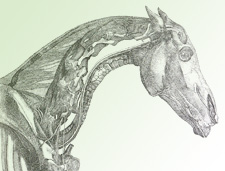
nuchal-ligament-header-1

The nuchal ligament is a soft tissue structure that is widely discussed in dressage circles. Unsurprisingly, given its deep location, relatively few of us get to cast eyes on it or feel it directly under our hands.

It’s equally unsurprising, then, that most of us don’t realize that the image we hold in our heads is somewhat different to the reality of the ligament inside our horse.

 © All text copyright of the author, Jane Clothier, www.thehorsesback.com. No reproduction of images, partial or entire text without permission. Sharing the link back to this page is fine. Please contact me for more information. Thank you!

I have recently been fortunate enough to attend another dissection with renowned Australian gross anatomist (and she will point out repeatedly that despite this title, she is not gross – or, at least, not that often), Sharon May-Davis.

In this dissection workshop, Sharon had yet another opportunity to show us that an aspect of textbook anatomy is incorrect.

Yes, apparently there are many points where this is the case.

Where the nuchal ligament is and what it connects

The structure in question is the nuchal ligament, or the nuchal ligament lamellae to be exact.

George Stubbs illustration
George Stubbs, 1777, showed the NLL attaching from C2 to C7.

To quickly explain, the funicular part of the nuchal ligament is the cord-like part that runs from the withers to the occiput (back of skull). The lamellae is the fibrous sheet-like part that extends from the funicular part to the cervical (neck) vertebrae.

According to the majority of anatomy diagrams and textbooks, it extends down to attach to the cervical vertebrae, from C2 to C7.

According to Sharon, it doesn’t. And here’s why.

Findings on the nuchal ligament’s true location

In this study of 35 horses on the dissection table, Sharon found:

  • No cases where the attachments were from C2 to C7.
  • No horses where the attachments were from C2 to C6.
  • In all 35 horses, the attachments were from C2 to C5.
  • And in 9 of the 35, the attachments to C5 consisted of thin and feeble fibers.
  • The horses were of a mixture of identifiable breeds, aged 2 to 28 years old.

So, why do the majority of anatomical drawings of the deeper structures of the horse show something different?

When received knowledge can be a problem

Nuchal ligament, 5yo TB [click to enlarge]
Many of today’s illustrators are referring to illustrations that have themselves been amended from earlier illustrations.

(The header image for this site’s most viewed post, The Disturbing Truth About  Neck Threadworms and Your Itchy Horse, shows an inaccurate rendering of this ligament, as do most of the other illustrations I used. Dang!)

Inaccuracy is a recognized problem when it comes to received knowledge – was this anomaly due to an earlier artist’s error, or was it a characteristic of some 17th century horses that has been progressively bred out over subsequent centuries?

  • And this raises the question of which structure, exactly, is supporting the base of the neck of the horse in motion? Read more about m. Spinalis cervicis in this post, Meet Spinalis, the Forgotten Muscle in Saddle Fitting.
  • And how does this awareness inform current training approaches that require horses to raise themselves into self-carriage?

The findings from this study are in a peer-reviewed paper by Sharon May-Davis and Janeen Kleine currently in press with the Journal of Equine Veterinary Science. The paper includes a detailed review of illustrations in equine anatomy literature, an explanation of the study, and a thought-provoking discussion on the implications for our understanding of equine biomechanics.

Variations and implications of the gross anatomy in the equine nuchal ligament lamellae, Sharon May-Davis, Janeen Kleine, Journal of Equine Veterinary Science 30 June 2014 (Article in Press DOI: 10.1016/j.jevs.2014.06.018)

Have you read about Sharon’s findings on arthritis of the humeroradial (elbow) joint in all ridden or driven horses?


Questions, thoughts or comments? Join us at The Horse’s Back Facebook Group. 


Filed Under: Bodywork, Sharon May-Davis Tagged With: equine anatomy, equine bodywork, GA, horse anatomy, Nuchal ligament, Sharon May-Davis

Debunked: The Lie That’s Told About Adjustable Gullet Saddles

May 19, 2014 by Jane @ THB 63 Comments

adjustable-header-2

One of the best innovations in the world of saddle making has been the interchangeable gullet plate in the synthetic saddle tree. I mean, there’s no getting away from it, it’s brilliant. With the removal of a few screws, every horse owner can adjust their own saddle in minutes. Easy.

saddleWhy so good? Well, they can be fitted to a lot of horses. They can accommodate the changing shape of a growing young horse, as well as seasonal weight gain and loss, or the development of back muscle through training.

So what’s my problem with them?

Unfortunately, such saddles are often accompanied by extra inventions,
this time originating in the marketing department.

Before I go on, I must declare an interest here. I fit saddles. What’s more, I fit saddles with interchangeable gullet plates. I’m not going to say which brand, because that’s not what this post is about. I say this simply to demonstrate that I’m not against adjustable saddles.

My problem is very much with the misleading statements that are made in order to sell them, and in particular the notion that these saddles can be adjusted to fit any horse. Not just a single weight-changing or shape-changing horse, or a few horses in the same yard, but any horse.

They can’t. It’s not true. They simply can’t.


Back to the horse’s back

XchangeLet there be no doubt that many horses experience a lot of pain from ill-fitting saddles that are too tight, or too wide, at the front of the tree. Most people are familiar with the sight of horses with white hair behind the shoulder blade, and areas of mild to profound muscle wastage.

The so-called wither profile is incredibly important for this reason. Gaining a correct fit across the gullet (and I mean gullet in the Australian sense – referring to the front of the saddle tree only, rather than the entire channel) is a highly important aspect of saddle fitting.

Yet it isn’t the only aspect. Astonishing as it may seem, horses are 3-dimensional organic structures. Yes! And they have many profiles in that area where the saddle sits.

S/W Ver: 96.66.76RThink about horses’ backs. The gullet plate matches the profile across the withers. But what about the profile along the withers, as well? Withers have different heights and lengths…

There are other profiles, too. There’s along the spine. There’s across the back at the rear of the saddle area, close to the last ribs. All of these profiles have both lengths and angles.

This is one of the reasons why many experts in the world of saddle making and fitting refer to the 9 points of saddle fitting. Several of these points involve the length and angle of the profiles I’ve just mentioned.

genesisGoing back a few years, the common view was that there are 5 points. Times have moved on, anatomy and biomechanics are better understood, and saddle design has evolved dramatically to reflect more recent ideas about how a saddle should interact with the horse’s body and movement, as well as the rider’s. And yet…

Fitting saddles isn’t like buying a pair of socks

Going by a single measurement might be OK for some things, but it isn’t for saddles. There’s more than one measurement involved, and I’m not just talking about the rider’s seat size. Think again about horses’ backs.

  • We have high withers, middling withers and rangy tabletops. High withers can extend way back into the area of the saddle.
  • Looking along the spine, we can see dippy backs, straight backs and bumpy backs.
  • Looking across the spine, we can spot angular A-frame backs and smooth, flat and pudgy backs.
  • It’s easy to spot uphill and downhill backs.
  • Not to mention short backs and long backs (or, to be more accurate with saddle fitting, rib cages).
  • And spines may have wide spinal processes or narrow ones.
  • And how about round rib cages that spring out nearer the spine, or narrow, flat-sided rib cages that drop sharply away, and everything in between?
  • This is before we even look at damaged backs, uneven shoulders, laterally curved spines, and all manner of physical issues affecting the horse, rider and the saddle in between.

Horses have a combination of these features. Many horses have one or two that can make saddle fitting a bit tricky.  Some have combinations that make saddle fitting an utter nightmare.

The saddle’s tree must reflect all those variations. It’s what makes saddle fitting such an interesting challenge, and occasionally a very hard one.


More on this Topic

Exclusive posts on Saddle Fit are available on The Horse’s Back Patreon, including The Deep, Deep Pain Caused by a Poor Saddle Fit and The Princess and the Pea… or, the Saddle and the Ding in the Back. Join today and have access to 25 archive posts straight away. Membership from US$ 7.50 per month.

But what about adjusting the flocking?

images6

Well, what about it? Adjusting flocking is the saddle fit version of fine-tuning. It is not changing the overall fit of the saddle.

Adjusting the flocking when the tree is the wrong shape is like (ahem) whistling in the wind.

It’s like adding an extra hole to your belt in an attempt to make a pair of jeans fit, despite the fact that the waist is a size too narrow and the legs 6  inches too short.

Adjusting the flocking only works when the tree is already a fundamentally good fit. The same goes for any flocking substitute, such as risers or wedges inserted into the panels. It is not enough to make a saddle fit the horse, when the tree is the wrong shape.

The message is being massaged

screwdriver

Adjustable gullet plates are now free of the original designer’s patent restrictions and a number of companies are now using them.

As already said, that’s great, providing the saddles are fitted well.

And who determines that? It can be hard to be sure when certain departments continue to make this ongoing, inaccurate claim about their brand of saddles being adjustable to all horses.

It’s marketing at its worst. It’s not just misleading, it’s plain untrue. Worse, it’s willful mis-education that leads horse owners into the mistaken belief that because they have the right gullet plate, then their saddle fits and their horse can’t possibly be in any pain. 

It bugs me that people are being misled. It bugs me far more that horses end up being the silent incumbents of a problem with so much potential to lead to back pain. (And I have worked with the results first-hand.)

As I said earlier, when the saddle fits, FANTASTIC. In fact, FANTASTIC with bells on.

And when it doesn’t, it’s the horse who suffers, no matter how many professionals are saying that black is in fact white, and that with the right ‘system’, an adjustable saddle can be made to fit any horse.

It can’t.

June 2019 update: 5 years after publishing this article, I received the following message from the Ruiz Diaz company in Argentina:

“I am part of the team producing Pessoa, PDS and Anky saddles. I just want to let you know that we have been working on our saddles for better fitting on the rest of the body and not only the withers. Thanks for your article once again, it was really nice to read your words and realize that with a wrong concept we have been saying that the x-change system was fitting every horse but there is much more apart the horse withers.”


Questions, thoughts or comments? Join us at The Horse’s Back Facebook group. 


Filed Under: Saddle Fit Tagged With: anky saddles, bates saddles, buying saddles, GA, genesis saddles, homepage, pessoa saddles, saddle fit, saddle fitting, thorowgood saddles, wintec saddles

Why Thinking About Neck Threadworms Still Leaves Us Scratching Our Heads

April 20, 2014 by Jane @ THB 34 Comments

header neck threadworms

Less than 12 months ago, I wrote about neck threadworms and how they might be behind many horses’ frantic itching. The uptake on that article continues to astonish me. It has now had well over 60,000 visitors from all over the world and is still climbing steadily.

All text (c) Jane Clothier, https://thehorsesback.com No reproduction without permission. Thanks!

Itchy horses, it seems, are a perennial worry for thousands if not hundreds of thousands of horse owners (that’s counting the many who haven’t read the article).

At time of writing, it’s Spring in the northern hemisphere, and the reader numbers are building up again. So are the microfilariae levels.

The itchy horses are starting to scratch.

And the more I think about the neck threadworm issue, and read comments under the articles, the more I’m scratching my head.

[Article continues after advert.]

Who am I to write about Neck Threadworms?

Unsurprisingly, there have been a few knock-backs as well. I’m not a vet and, although I read as many papers as possible and discuss my thoughts with research vets before I post my blog articles, my assertions, which are based on observations and backed up with research, have still tickled the inside of a few noses.

To be honest, neck threadworms aren’t exactly an easy subject. Filarial nematode parasites are a complex life form so fundamentally different to those within our normal understanding. They rely on more than one host and undergo several stages in their development – they make the caterpillar to butterfly transformation look unambitious. (What, just two life stages? Onchocerca Cervicalis (neck threadworms) has twice that...)

And we are looking at not two, but three species here. The horse, the neck threadworms, and the biting midge (culicoid fly) that does the middle man part. The microfilariae leave the horse, courtesy of the midge, get flown around, travel through the midge’s body parts and enter different larval stages, and are then returned to the horse when the midge returns to ingest blood.

A lot of people are confused, and I don’t mean just horse owners. There are vets working for manufacturers of worming products who swear that their product can bump off the adult neck threadworms.

This would be welcome news to the World Health Organization, I’m sure, as decades of research have yet to find a chemical that successfully infiltrates the central nervous system of the adult Onchocerca Volvulus (the human version of the parasite, which currently affects an estimated 18 million people throughout Africa, Latin America and the Yemen) and eliminates it.

Moving on…

1. About standard texts on neck threadworms

“Oh, but those are the wrong signs for neck threadworms.” After “we don’t have that problem around here”, a lot of people are hearing this line when asking for professional help with their itchy horse. The problem, apparently, is that their horses don’t have the ‘typical’ itching along the ventral line, ie, the underside of the neck and belly.

I do wish that instead of saying, “it can’t be that, as it’s not described that way in the textbooks”, more people would wonder instead if there were something that could be added to those textbooks.

Textbooks tend to be based on research that other people have done. In the case of neck threadworms, there is relatively little out there. This means that a lot of information that finds its way into books and training is already reasonably dated, and not exactly far ranging.

Here’s how to put together a program of treatment for your horse with neck threadworms (and maybe the Itch) – How to Fight the Big Fight Against Neck Threadworms

2. Neck threadworms may be the same worldwide, but biting midges aren’t

This is something we’re especially aware of here in Australia, where geographical isolation has led to the evolution of some remarkable indigenous species, found nowhere else in the world. Our ticks are different. Our flies are different. We have marsupials.

Most of the research on neck threadworms hails from the US. When findings of research involving vectors – the biting midge ‘middle man’ – are applied worldwide, it’s important to remember that some conditions can be ‘similar but different’.

Indeed, when we look at research on Onchocerca Volvulus, neck threadworms’ well-studied cousin that affects humans, we can come across statements like this one: “Many simuliid species have been incriminated to a greater or lesser degree in the transmission of O. volvulus, their relative vectorial roles contributing to shape diverse transmission patterns across endemic areas.” (Basáñez M-G et al, 2006.)

Say what? Different flies are active in different areas and create different patterns of transmission? I think the point is made well enough.

[Article continues after advert.]

3. The biting midges must be studied too

If we consider the possibility of different culicoides acting as vectors, then other differences come into consideration as well.

European studies into Sweet Itch (Summer Itch, Queensland Itch) have shown that different types of biting midge have a preference for different parts of the horse’s body.

What? But that’s breaking the rules, surely? Yup. That’s what nature does – makes its own rules.

4. More rule breaking

It doesn’t stop there: studies of cattle in Darwin (a hotbed for livestock research due to its tropical climate) have revealed the presence of more than one type of Onchocerca, with at least two species of the parasite being found in the ‘wrong’ animal.

This suggests that one or more species of biting midge are ‘cross-contaminating’ the parasite by moving from one species of mammal to another. Possibly. But the point here is that variation exists – we can’t assume that because a few studies have identified certain conditions, these are replicated globally.

5. Neck threadworm life cycle: what happens and when

Another point that isn’t clearly answered by existing research is how much the microfilariae travel. If the adult worms are living in the nuchal ligament, that is where they give birth to zillions of microfilariae. Some flies must bite in this area in order to ingest the microfilariae and take off with them. It then follows that there are millions that don’t get ingested, and die off. It’s the die off that causes the itching, both during normal times and after treatment with ivermectin.

So here we have itching that’s not on the ventral midline.

It’s more remarkable that horses do itch on the ventral midline. If adults live in the nuchal ligament, mostly, and microfilariae are dying on the ventral line, either the microfilariae are traveling long distance, subcutaneously, or there are adults living in the ‘white line’ that runs from the the sternum to the umbilical area.

At the very least, we can say that this is problem isn’t confined to the underside of the horse.

If your horse has the Itch, Queensland Itch, Sweet Itch, Summer Itch, Summer Sores… sometimes it’s really neck threadworms. Read the original article, The Disturbing Truth About Neck Threadworms and Your Itchy Horse

6. And look at the behavior of itchy horses

Whatever the country, whatever the culicoid species, the horse that’s going insane with itchiness can only ever scratch the parts that it can reach. Most horses can easily scratch their toplines on branches and fences, whereas far fewer are seen scratching their bellies on the ground. Horses will always break the skin in any area that they scratch in earnest, and consequently the blood attracts the biting midges to that area.

As the immune system goes into stratospheric hypersensitivity, intense itching can become an all-over sensation. Remember having chicken pox, or measles? Or ask any person who has such an uncontrollable immune response.

Let’s not overlook the possibility that horses displaying lesions on their undersides are in the more advanced stages of parasitic infestation, or are rugged (fewer areas are available for the midges to bite), or even – taking the earlier points on board – that they live in areas where local midges prefer that part of the horse’s body.

7. And let’s not forget owner behavior

Who is that calls the vet, and why? Not the horse… An owner who notices their horse scratching its mane and tail head is way less likely to contact a vet than the owner who sees bald, scratched patches on their horse’s underside.

It’s the difference between “dang, my horse has the itch” and “what the heck’s my horse doing, rubbing under there?”

It entirely makes sense that the more advanced cases, with all over itching and rubbed patches, are more likely to be seen by vets, and to make it into veterinary research. (Note: in research, not all horses whose nuchal ligaments were dissected at necropsy displayed ventral lesions, far from it, although many tested positive for Onchocerca Cervicalis.)

[Article continues after advert.]

Where to next, with neck threadworms?

Well, what do you think? I know what I think. I know what I’ve experienced with my horse.

I trust my observations. I trust the research that I’ve read and that fits closely with my observations. And no, I’m not cherry-picking research to prop up my own emotionally driven ideas.

At present, other explanations aren’t available, but lots of questions remain. Looking at the ones here, it’s easy to understand why research is such a long and painstaking process – it’s not possible to go from A to Z or even A to D without covering the intervening steps.

For the horse owner, just one thing is clear, and that is that we have a horse being driven mad by itching. So, please do stick with ivermectin for identifying the initial reactions. Stick with ivermectin or moxidectin/praziquantel wormers for reducing the problem (moxidectin will not cause the itching response post-worming).

And remember, that not every itchy horse has neck threadworms.


© All text copyright of the author, Jane Clothier, www.thehorsesback.com. No reproduction of partial or entire text without permission. Sharing the link back to this page is fine. Please contact me for more information. Thank you!


Questions, thoughts or comments? Join us at The Horse’s Back Facebook group. 


Reference

Basáñez M-G, Pion SDS, Churcher TS, Breitling LP, Little MP, et al. (2006) River Blindness: A Success Story under Threat? PLoS Med 3(9): e371. doi:10.1371/journal.pmed.0030371


Filed Under: Neck Threadworms, Parasites Tagged With: GA, horse itching, neck threadworms, onchocerca cervicalis, queensland itch, summer itch, summer sores, sweet itch

  • « Go to Previous Page
  • Page 1
  • Interim pages omitted …
  • Page 6
  • Page 7
  • Page 8
  • Page 9
  • Page 10
  • Go to Next Page »

Primary Sidebar

Where therapy meets comfort - BEMER in Australia

From the author of this blog…

Click to view the eBook: All You Need to Know About Neck Threadworms and Your Itchy Horse

Support This Site!

Has an article on this site helped you to help your horse? If so, please consider making a small donation to help with the monthly costs of keeping this site live.

Bodywork Articles

  • How Early Intervention Can Help Straighten Your Foal’s Crooked Legs April 5, 2026
  • Hiring an Equine Chiropractor: 10 Crucial Questions You Need to Ask June 28, 2025
  • BEMER And Bodywork: What I’m Seeing And Why I’m Hooked February 26, 2025
  • Why Do Horse Owners Keep Hiring Unqualified Equine Chiros? November 14, 2024
  • Physio at Feed Time: Using Food to Mobilize Your Horse’s Body October 18, 2024
  • How to Create Better Before And After Photos of Horses (and Spot Misleading Ones) February 22, 2024
  • All About That White Lacing On Your Horse’s Back January 8, 2024
  • More Than a Blemish: How a Knocked Down Hip Can Affect Horses August 2, 2023
  • 10 Equine Bodywork Responses That Tell Us Heaps About Horses July 29, 2023
  • Swaying Opinion: Can Ataxia Cause Hind Hoof Rings? May 6, 2023
  • 10 Tips for the Risk-Free Use of Equine Massage Guns February 10, 2023
  • Learn Equine Osteopathy to Restore Function and Health to Horses October 20, 2022
  • Beyond Sidebone: Pastern Pain and the Lateral Cartilage May 31, 2022
  • Here’s a Round Up of My Premature and Dysmature Foal Research May 26, 2022
  • Yes, We Can Image for Transitional Vertebrae in Horses September 23, 2021
  • 10 Rehab Tips for Horses with High-Low or Upright Hooves January 1, 2021
  • A Pelvic Blow Out? The Widened Pubic Symphysis in Horses November 15, 2020
  • All About Crooked Legs: Angular Limb Deformities in Horses and Foals April 5, 2020
  • ‘The Size of a Walnut’ – Does Equine Brain Size Matter? November 5, 2019
  • Not Quite Classical… Better Lungeing for the Rest of Us July 14, 2019

Saddle Fit Articles

  • Introducing Common Saddle Fit Problems in Arabian Horses December 12, 2024
  • When Half Breed Saddles Fit The Rider But Not The Horse November 14, 2023
  • Introducing Common Saddle Fit Problems in Quarter Horses October 24, 2022
  • The Crazy Logic of Saddle Fitting That You Probably Haven’t Thought About August 12, 2019
  • How Much Do You CAIR What’s In Your Saddle? March 26, 2017
  • 5 Ways Your Seat Can Screw Up Your Horse Without You Even Noticing January 26, 2017
  • Meet Spinalis, the Forgotten Muscle in Saddle Fitting December 20, 2016
  • Debunked: The Lie That’s Told About Adjustable Gullet Saddles May 19, 2014
  • 10 Ways to Seriously Mess Up When Buying a New Saddle October 5, 2013

Parasite Articles

  • The Disturbing Truth About Neck Threadworms and Your Itchy Horse June 12, 2013
  • How to Fight the Big Fight against Neck Threadworms October 2, 2013
  • Why Thinking About Neck Threadworms Still Leaves Us Scratching Our Heads April 20, 2014
  • All You Need to Know About the New Biological War on Worms July 7, 2018

Footer

Contact Me

Send your questions this way…

Get in Touch

  • Store Support
  • Shipping
  • Returns
  • Contact

Copyright © 2026 · Parallax Pro on Genesis Framework · WordPress · Log in