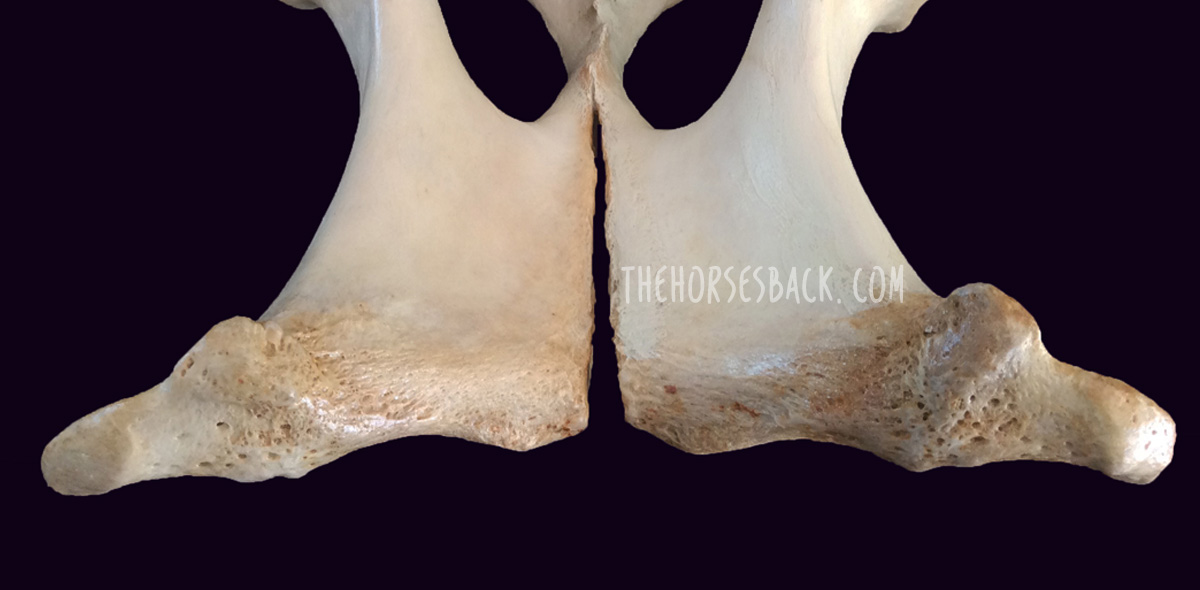
Now here is something that’s just so common that people seem to think it’s normal. I guess that if you define ‘normal’ as something that’s nearly always seen, then yes, it’s probably normal – but that doesn’t make it a good thing.
So what are we looking at here?
Note: this article was edited for improved clarity on 19 May 2024.
First, a ‘Normal’ Equine Pelvis
The horse’s pelvis is made up of two halves, these being the pelvic bones (os coxae). Each half – or hemipelvis – is made up of three flat bones, the ilium, pubis and ischium, which are fused into one.
The ilium attaches to the sacrum at the sacroiliac joint, a combined synovial and fibrocartilagenous joint which is supported by ventral, dorsal and lateral sacroiliac ligaments. The sacrum articulates with the lumbar spine and coccygeal (tail) vertebrae.
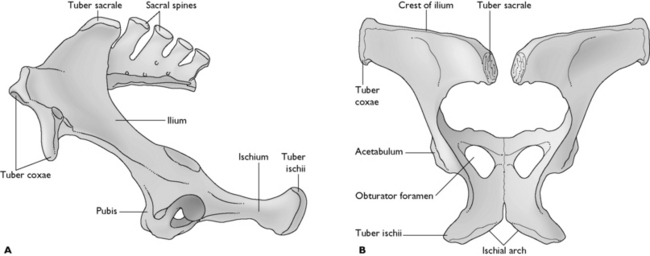
The two halves join at the pelvic floor, via a cartilaginous joint called the pubic (or pelvic) symphysis. Made of hyaline cartilage and fibrocartilage, this gradually ossifies so that by around 6 years of age, it is usually bone and mostly fused.
It is common to see a short opening at the rear, which possibly enables some valuable shock-abosrbing motion in the overall structure.
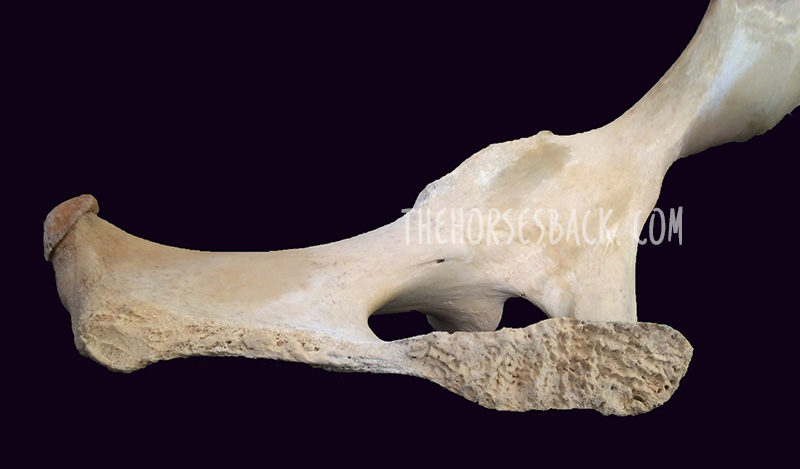
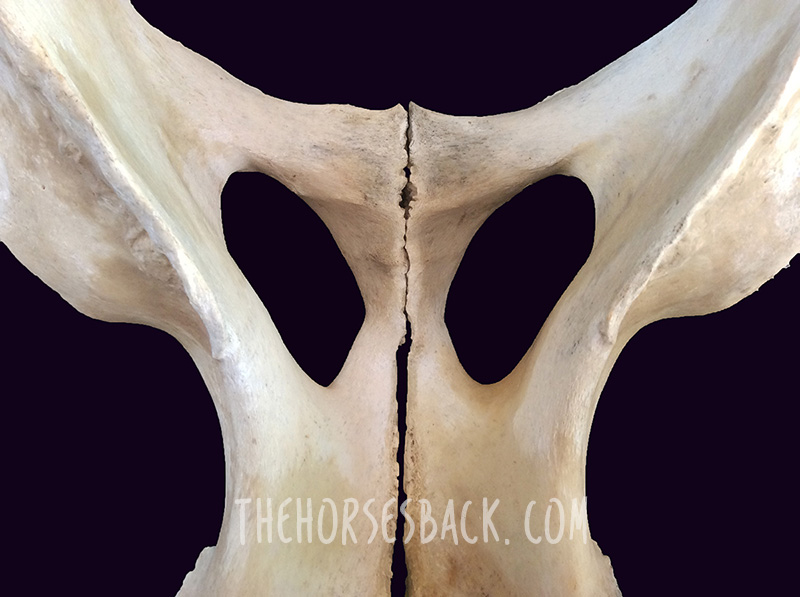

In older horses, this joint would normally completely ossify, so that the base of the pelvis is solid bone. Given that many of the equine pelvises we do get to see are from older horses, you’d think we’d see them all fused and ossified.
However, that’s not the case. While it’s normal for a short section to be widened at the rear of the symphysis, many are separated along 1/3 to 2/3 of their length, being fused only at the cranial (front) end of the pubic symphysis.
Separation of the Pubic Symphysis
We can sometimes see this condition without looking at the bones. The reason for this is that the two halves of the pelvis have opened out to the extent that there’s no symmetry in the living horse’s structure at all. The pelvis is both distorted and twisted.
- The tuber sacrales tell us about sacroiliac damage, usually when these are of different heights > 5 mm.
- The tuber coxae (point of hip) are positioned differently, with one higher or further forward.
- The tuber ischii (seat bones) may be at different heights, or one may be further forward.
- The horse is very often rotated along the thoracolumbar spine, with a noticeable direction change at T18-L1 (thoracolumbar junction).
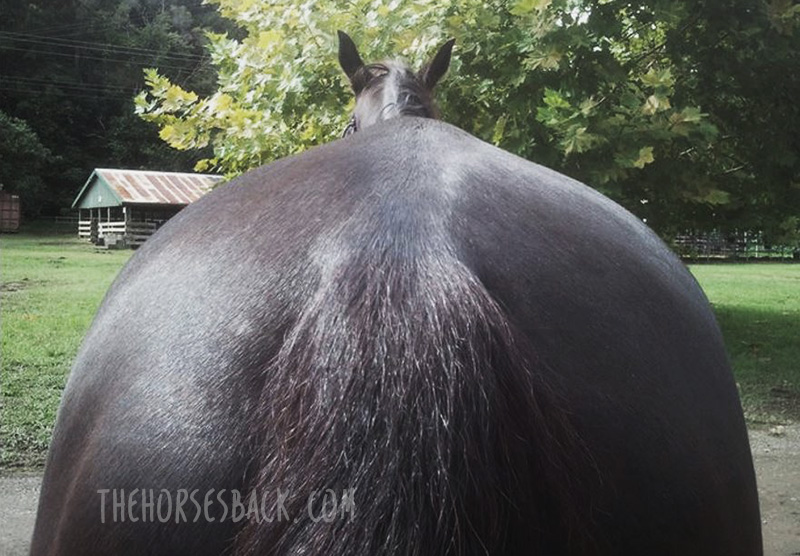
The problem can be very obvious. Always check under the tail, as what you see there can tell you a lot… The following horse had an outwardly rotated left hindlimb.
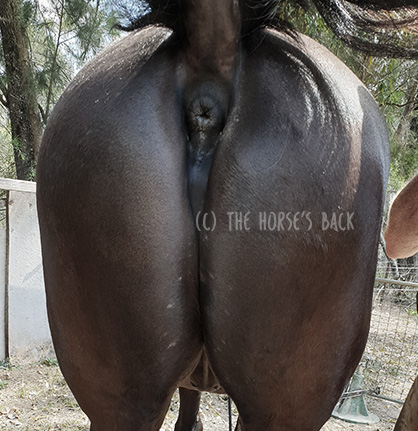
An older horse’s pelvis may become distorted due to a fall, trauma or long term muscular stresses, without the pubic symphysis being separated. This is because it has fully ossified.
The difference lies in the degree of the problem: a major trauma might cause additional fractures or ligaments rupture, with signs of serious injury at the time. Ongoing stress can gradually affect angles of the tuberosities (sacrales, ischii and coxae), albeit not as dramatically as in major trauma.
What About The Sports Horse’s Pelvis?
In ridden horses and especially in ex-racehorses, it’s not uncommon to see significant widening and associated asymmetry of the two pelvic halves. It can’t all be due to heavy falls, at least not in flat racing.
The following two photos show the pelvis of an ex-racehorse. This wasn’t an extreme case by any means, but look at how far forward the separation extends. It reaches right to the weakest part of the structure, between the obturator foramen (the two openings). This primes the pelvis for distortion.
Outcome? The bones show an overall distortion, nowhere more so than in the different angles of the acetabulum (cup part of the hip joints).
It can, of course, be worse.

It’s Not Always a Disaster
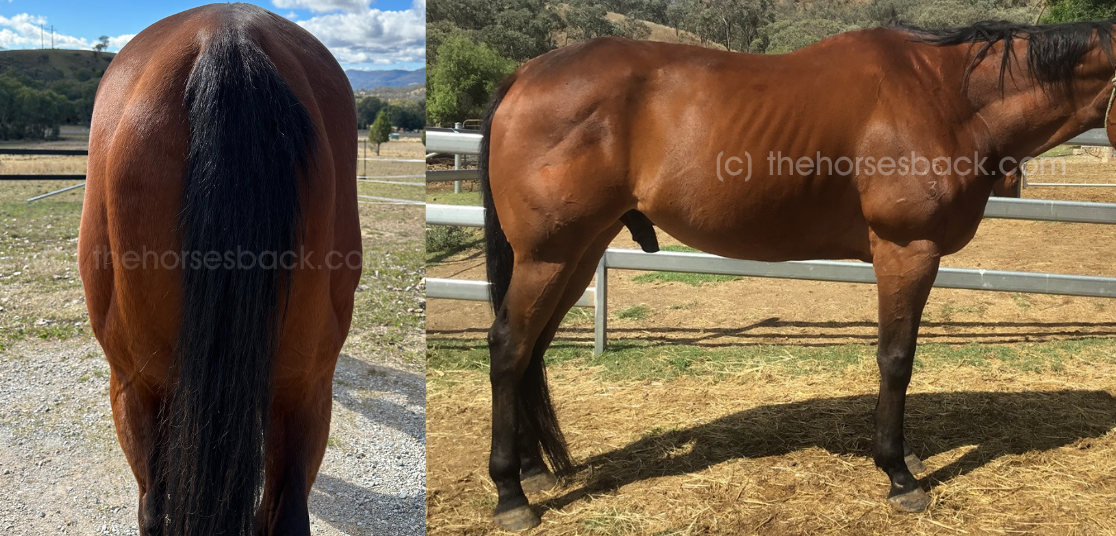
Some horses can do very well after experiencing this type of pelvic distortion. Here’s a TB who never made it to the track and has considerable distortion.
And yet, through a series of compensatory adjustments along his spine, he stands squarely and works quite well.
OK, so he only takes part in local competitions and is never going to be working at a serious level, but with good management of his body and hooves, and correct training and saddle fit, he’s very functional. He just needs those things to be absolutely correct, as there’s no wriggle room for further compensations.
This problem can be a career-changer without sounding a death knell.
If Horses Can Live With It, Should We Worry?
Let’s be clear: this may well have hurt when it happened. Whether through trauma or the effects of ongoing physical stress on bone, the wide separation of the pelvis would be painful.
The pain of a sacroiliac ligament lesion might get noticed and the horse be rested. A check for more common stress fractures in the ilium might yield no findings.
The fortunate ones will get rehabilitation exercises as they get going again.
Yet going by how rarely we hear about this issue, it can be assumed that it’s often overlooked.
But What About Later?
Once the horse is through the original trauma, does this distorted pelvis remain a problem? It all comes down to how bad it is.
Please note the use of “may” in the following points.
- Some horses are fully able to compensate for a milder or fully symmetrical presentation and there is no effect on performance.
- If the pelvis is distorted and the coxofemoral (hip) joints are in different positions, then stride length, lateral and circle work may be affected.
- Different hindlimb positioning can also lead to asymmetric weight bearing, with different concussion through the hind limbs, and diagonal effects flowing forward.
- If it’s bad, co-existing sacroiliac damage may lead to an ongoing vulnerability. Tuber sacrales may be extremely close together because the pubic symphysis has widened.
- Pelvic asymmetry may link to rotation of the spine and scoliosis along its length.
- Plus, a horse may retraumatise an existing opened pubic symphysis, leading to renewed pain.
As I always say, awareness is everything.
It’s always wise to check the pelvic symmetry of your horse, particularly a potential purchase off the track, while being sure to understand how and why this will affect performance.
[1] https://epos.myesr.org/poster/esr/ecr2020/C-08782/Findings%20and%20procedure%20details#poster
[2] Beatty T. Osteitis pubis in athletes. Curr Sports Med Rep. 2012 Mar-Apr;11(2):96-8. doi: 10.1249/JSR.0b013e318249c32b.
Footnote
In 2012, I asked Dr Sharon May-Davis about an ex-racehorse I was seeing. The TB, who had a very asymmetrical pelvis, had done some damage to himself and had obvious pelvic pain, with that dull, dull look of pain in the eye that I associate with fractures. Sharon asked me if I had a photo of the structure under his tail, and I did – it was so asymmetric that I’d photographed it. Sharon sent me a photo of some pelvic bones and for the first time, I saw the underlying nature of this problem. Yet again, I have to thank Sharon for alerting us to this disturbingly common issue in horses.