• Skip to main content
  • Skip to footer

The Horses Back

Body Talk for Thinking Owners

  • Home
  • Articles
  • BEMER
  • Store
    • Store
    • Shipping
    • Returns
    • Support
  • Equine Healthworks
    • Bodywork for Horses
    • Reviews
    • Leave a Review
  • About & Contact
    • About
    • Contact

equine sacroiliac

10 Tips for the Risk-Free Use of Equine Massage Guns

February 10, 2023 by Jane @ THB Leave a Comment

Wait – you didn’t know there could be risks to your horse when using an equine massage gun? Then you’d best read on.

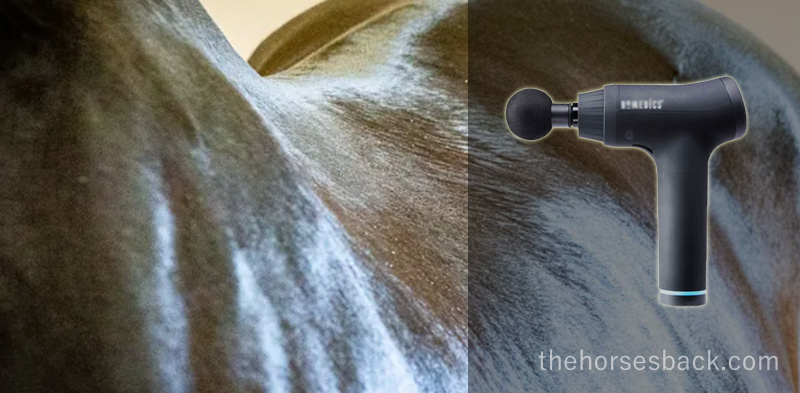
First, there are certainly benefits to  massage guns. They’re easy to use and time friendly when you’re time-poor.

They retail to suit every budget, and there’s no difference between ‘human’ and ‘horse’ devices.

They can help with pre-work warm-up and post-work relaxation, and may help to reduce post-work soreness.

But, but, but – you do need to switch on your mind at the same time as your gun.

And here’s why.

Note: this page includes some links. At no extra cost to you, if you make a purchase, these links may make a small contribution towards the costs of running this site, including my extensive writing time.

1.  Check the horse with your hands first.

This way, you can see if there are any adverse reactions to touching in certain areas. It’s better to know in advance, rather discover a problem with a device that isn’t giving you feedback.

Remember, these are designed primarily to be used by humans on themselves – humans know where their own spots are, or can tell you, but horses rely on you to be cautious.

2.  Vibration is fantastic for myofascia. 
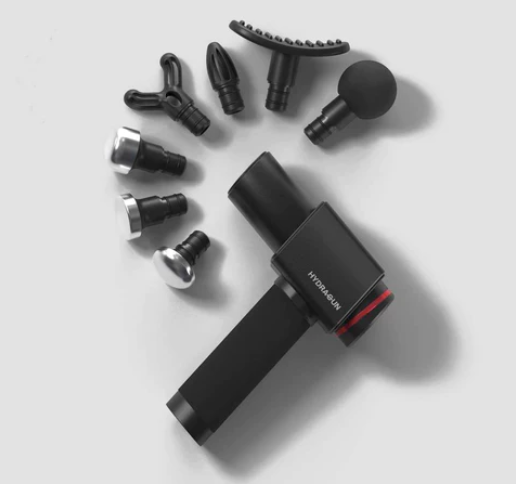
Hydragun with 7 attachments, including 3 flat heads.

Soft tissue generally doesn’t need to be hammered.

Hint 1: using the side of the round massage head will achieve more vibration than percussion.

Hint 2: the less intrusive flat head used gently and flat to the surface also creates more vibration.

Please don’t use the hard pointy applicators, which are so much more likely to hit directly into a painful spot, or worse, penetrate an area of torn fascia.

3.  Go lightly and keep it moving. 

You’re not mashing potatoes here – this is a sensitive body. By minimizing pressure, you’re allowing more of a vibrational effect to happen.

You also don’t risk creating bruises (as can happen in humans, apparently). Your horse can’t tell you until it has already happened.

Don’t work closely over bone – and remember that older horses may have arthritic joints that don’t benefit from heavy percussion.

4.  Little and often is better. 
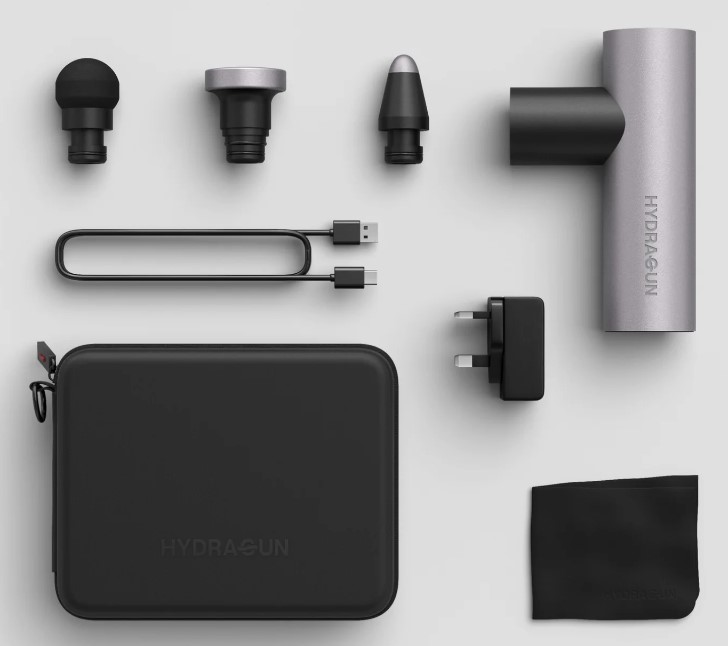
The Mini Atom is travel-sized with USB-C charging

Too much work starts to cancel out the good work that’s already been achieved through a light approach.

Massage guns are best used on small, targeted areas in short bursts.

And a practical conern is that you don’t want to overheat the device – many have an automatic shut-off after 10-15 minutes for this reason.

5.  Check your horse’s responses.

If your horse is showing any signs of tension, stop. The whole point here is relaxation. Tense muscles + percussion = high impact => pain.

If your horse starts leaning into it and groovin’, then fine, turn it up – but only if they say so.

It’s not a goal in itself (question why they’re so tense in that spot – maybe change something in training?). If there’s any flicker of discomfort in their eye, stop right now.
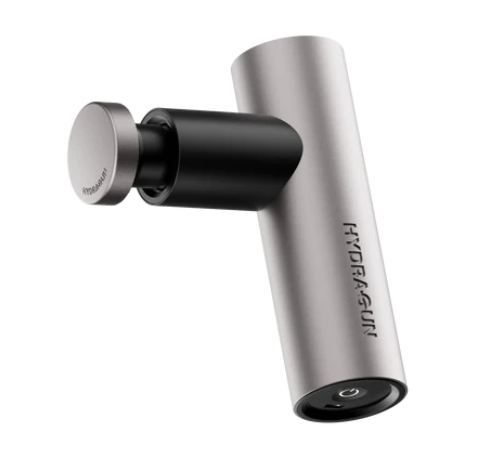
The Mini Atom Gun enables a focused, smooth and effective approach.

6.  Don’t go higher than the base of neck.

Think about it: you’ll be vibrating the skull. Try that on yourself if you’re not sure why it might be unpleasant!

Lots of horses have tension and pain around the poll and the temporomandibular joint (TMJ). It’s always better to do the upper neck with your hands and a whole lot of love.

7.  Ask why some muscles are always sore.

There may be muscles that are always sore, particularly as your horse steps up the work.

Maybe that spot would benefit from a gentle hand rub?

And maybe slow down the work pace down as well, if tension keeps developing?

Don’t be the Cozy Powell of massage gun users – think prevention and therapy, not heavy rock!

8.  Steer well clear of injuries.

If your horse is injured, don’t try to help with your massage gun. Doing so could likely disrupt the healing process.

Wait until the healing process is well under way and then start really lightly and only in adjacent areas. This is the best time to think about vibration rather than percussion.

9.  Take note of fresh pain responses.

If your horse is reactive in an area that was fine yesterday or last time you worked, stop. You may be right above an injury.

Worse, if you’ve been using too much pressure, you may have intensified an issue.

10.  Don’t forget nutrition.

If muscles are always super-tight in spite of careful conditioning and therapeutic work, there may be an imbalance in your horse’s nutritional and mineral intake that’s having a metabolic effect.


Interested in equine massage guns?

How do you know which massage guns for horses present really good options?

I don’t believe in buying on the basis of a label alone, but at the same time, demonstrated reliability is a good thing.

And don’t worry about whether it’s called an equine massage gun or not. They’re all the same technologies, whether marketed for human or horse use.

Learn more about the Hydragun’s massage gun and the Atom Mini Massager in The Horse’s Back Store. Renowned for being the quietest devices on the market, these excellent, durable devices are built with smoothly operating components within high-grade aluminimum casing. For the equine bodyworker, they offer a reliable solution that is so lightweight it won’t tax your body.
 

Filed Under: Bodywork Tagged With: best massage guns for horses, equine bodywork, equine massage, equine massage guns, equine sacroiliac, GA, homedics massage guns, massage guns for horses

A Pelvic Blow Out? The Widened Pubic Symphysis in Horses

November 15, 2020 by Jane @ THB 20 Comments

Now here is something that’s just so common that people seem to think it’s normal. I guess that if you define ‘normal’ as something that’s nearly always seen, then yes, it’s probably normal – but that doesn’t make it a good thing.

So what are we looking at here?

Note: this article was edited for improved clarity on 19 May 2024.


First, a ‘Normal’ Equine Pelvis

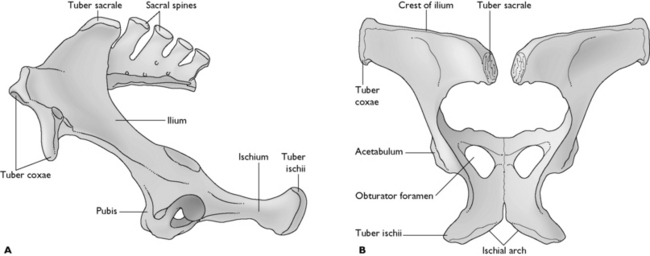
The horse’s pelvis is made up of two halves, these being the pelvic bones (os coxae). Each half – or hemipelvis – is made up of three flat bones, the ilium, pubis and ischium, which are fused into one.

The ilium attaches to the sacrum at the sacroiliac joint, a combined synovial and fibrocartilagenous joint which is supported by ventral, dorsal and lateral sacroiliac ligaments. The sacrum articulates with the lumbar spine and coccygeal (tail) vertebrae.


The equine pelvis. (c) Veterian Key


The two halves join at the pelvic floor, via a cartilaginous joint called the pubic (or pelvic) symphysis. Made of hyaline cartilage and fibrocartilage, this gradually ossifies so that by around 6 years of age, it is usually bone and mostly fused.

It is common to see a short opening at the rear, which possibly enables some valuable shock-abosrbing motion in the overall structure.

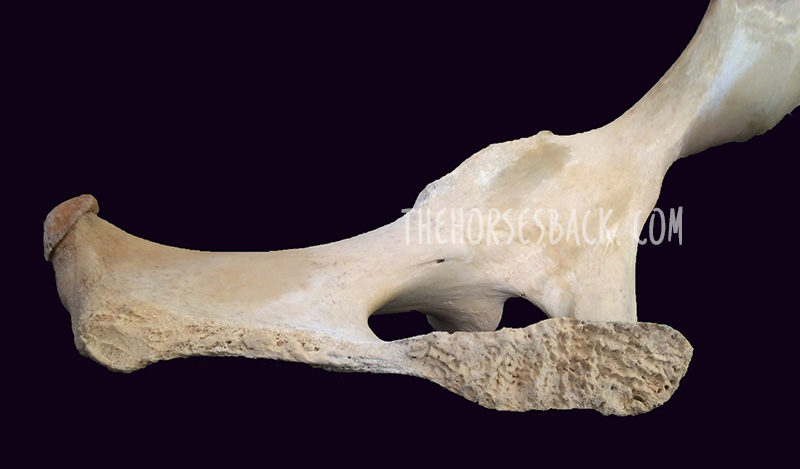
Hemi-pelvis (os coxae) of a 5- yo Australian Stock Horse, showing the pubic symphysis. Only the cranial (front) part of the ligamentous joint was intact. (c) The Horse’s Back


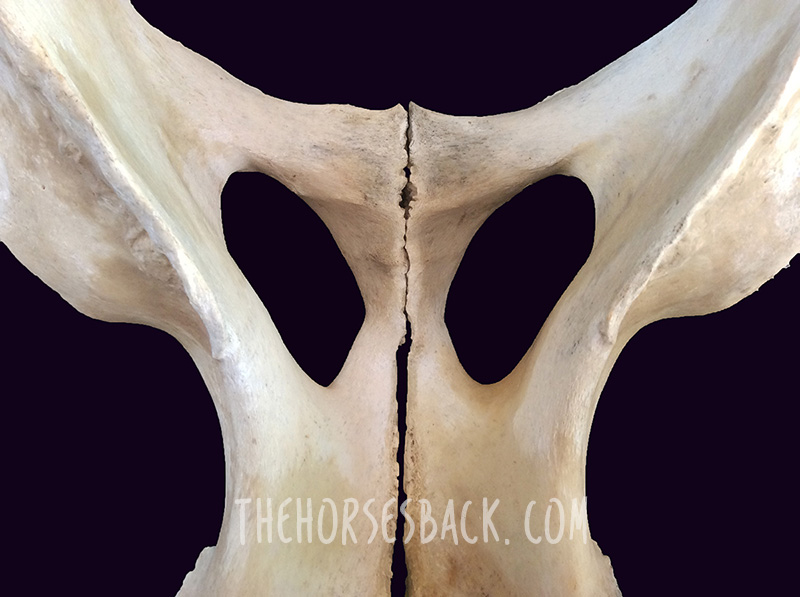
How the two halves would have been positioned in the living horse. The cranial part (top of photo) was still ligamentous at the time of death. The caudal section (bottom of photo) was separated as a result of traumatic falls. (c) The Horse’s Back


In older horses, this joint would normally completely ossify, so that the base of the pelvis is solid bone. Given that many of the equine pelvises we do get to see are from older horses, you’d think we’d see them all fused and ossified.

However, that’s not the case. While it’s normal for a short section to be widened at the rear of the symphysis, many are separated along 1/3 to 2/3 of their length, being fused only at the cranial (front) end of the pubic symphysis.

Separation of the Pubic Symphysis

We can sometimes see this condition without looking at the bones. The reason for this is that the two halves of the pelvis have opened out to the extent that there’s no symmetry in the living horse’s structure at all. The pelvis is both distorted and twisted.

  • The tuber sacrales tell us about sacroiliac damage, usually when these are of different heights > 5 mm.
  • The tuber coxae (point of hip) are positioned differently, with one higher or further forward.
  • The tuber ischii (seat bones) may be at different heights, or one may be further forward.
  • The horse is very often rotated along the thoracolumbar spine, with a noticeable direction change at T18-L1 (thoracolumbar junction).
The ex-racehorse’s pelvis can be particularly distorted. (c) The Horse’s Back

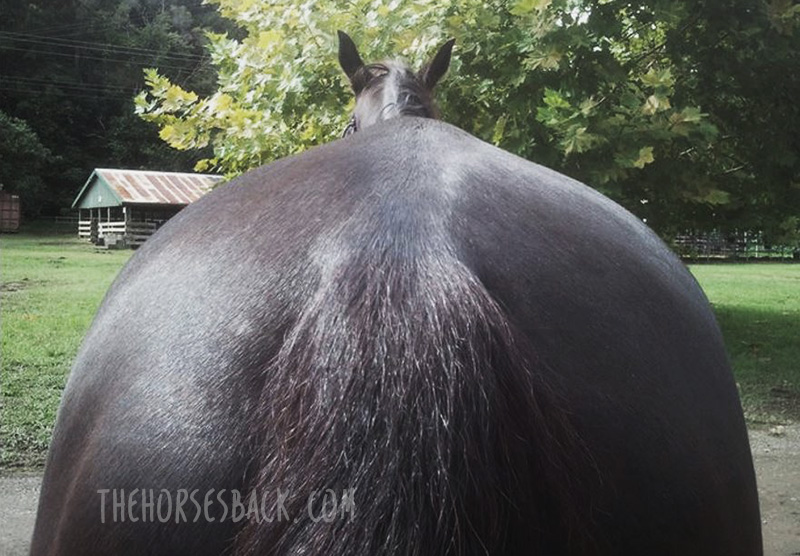
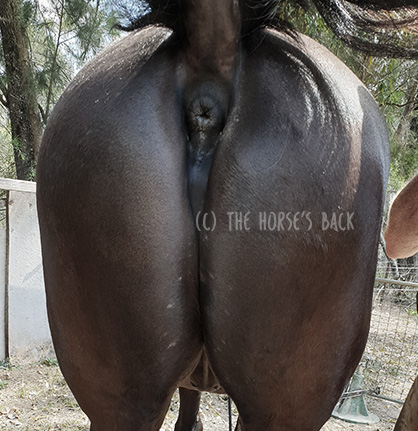
The problem can be very obvious. Always check under the tail, as what you see there can tell you a lot… The following horse had an outwardly rotated left hindlimb.

The asymmetrical height and position of the tuber ischii (seat bones) is visible under the tail, where it looks as if the anus is off to one side. Warmblood gelding, presumed traumatic fall (c) The Horse’s Back, posted with owner permission.

An older horse’s pelvis may become distorted due to a fall, trauma or long term muscular stresses, without the pubic symphysis being separated. This is because it has fully ossified.

The difference lies in the degree of the problem: a major trauma might cause additional fractures or ligaments rupture, with signs of serious injury at the time. Ongoing stress can gradually affect angles of the tuberosities (sacrales, ischii and coxae), albeit not as dramatically as in major trauma.

What About The Sports Horse’s Pelvis?

In ridden horses and especially in ex-racehorses, it’s not uncommon to see significant widening and associated asymmetry of the two pelvic halves. It can’t all be due to heavy falls, at least not in flat racing.

The following two photos show the pelvis of an ex-racehorse. This wasn’t an extreme case by any means, but look at how far forward the separation extends. It reaches right to the weakest part of the structure, between the obturator foramen (the two openings). This primes the pelvis for distortion.

Outcome? The bones show an overall distortion, nowhere more so than in the different angles of the acetabulum (cup part of the hip joints).

It can, of course, be worse.

Pelvis of a 9-yo OTTB gelding. The separation extends along the caudal 2/3 of the symphysis. This extends to the narrowest, weakest part of the symphysis, enabling greater lateral distortion of the two pelvic halves. (c) The Horse’s Back

It’s Not Always a Disaster

Some horses can do very well after experiencing this type of pelvic distortion. Here’s a TB who never made it to the track and has considerable distortion.

And yet, through a series of compensatory adjustments along his spine, he stands squarely and works quite well.

OK, so he only takes part in local competitions and is never going to be working at a serious level, but with good management of his body and hooves, and correct training and saddle fit, he’s very functional. He just needs those things to be absolutely correct, as there’s no wriggle room for further compensations.

This problem can be a career-changer without sounding a death knell.


If Horses Can Live With It, Should We Worry?

Let’s be clear: this may well have hurt when it happened. Whether through trauma or the effects of ongoing physical stress on bone, the wide separation of the pelvis would be painful.

The pain of a sacroiliac ligament lesion might get noticed and the horse be rested. A check for more common stress fractures in the ilium might yield no findings.

The fortunate ones will get rehabilitation exercises as they get going again.

Yet going by how rarely we hear about this issue, it can be assumed that it’s often overlooked.

But What About Later?

Once the horse is through the original trauma, does this distorted pelvis remain a problem? It all comes down to how bad it is.

Please note the use of “may” in the following points.

  • Some horses are fully able to compensate for a milder or fully symmetrical presentation and there is no effect on performance.
  • If the pelvis is distorted and the coxofemoral (hip) joints are in different positions, then stride length, lateral and circle work may be affected.
  • Different hindlimb positioning can also lead to asymmetric weight bearing, with different concussion through the hind limbs, and diagonal effects flowing forward.
  • If it’s bad, co-existing sacroiliac damage may lead to an ongoing vulnerability. Tuber sacrales may be extremely close together because the pubic symphysis has widened.
  • Pelvic asymmetry may link to rotation of the spine and scoliosis along its length.
  • Plus, a horse may retraumatise an existing opened pubic symphysis, leading to renewed pain.

As I always say, awareness is everything.

It’s always wise to check the pelvic symmetry of your horse, particularly a potential purchase off the track, while being sure to understand how and why this will affect performance.


[1] https://epos.myesr.org/poster/esr/ecr2020/C-08782/Findings%20and%20procedure%20details#poster

[2] Beatty T. Osteitis pubis in athletes. Curr Sports Med Rep. 2012 Mar-Apr;11(2):96-8. doi: 10.1249/JSR.0b013e318249c32b.


Footnote

In 2012, I asked Dr Sharon May-Davis about an ex-racehorse I was seeing. The TB, who had a very asymmetrical pelvis, had done some damage to himself and had obvious pelvic pain, with that dull, dull look of pain in the eye that I associate with fractures. Sharon asked me if I had a photo of the structure under his tail, and I did – it was so asymmetric that I’d photographed it. Sharon sent me a photo of some pelvic bones and for the first time, I saw the underlying nature of this problem. Yet again, I have to thank Sharon for alerting us to this disturbingly common issue in horses.

Footnote 2 (June 2025)

In the past 18 months, I have experienced some grief over this post on social media. I am now republishing it under a refreshed title, although with some reluctance. I stand by the information it contains, which was not formerly in the general domain until this appeared in late 2020. This pelvic issue is a contributory or causal factor to asymmetry in the horse, yet is not (in the vast majority of cases) a catastrophic event. However, this issue and consequent asymmetry, if serious, may prevent performance at the higher athletic levels, even if not in itself a source of pain or breakdown. As owners, we must recognise this and make appropriate decisions for the horse’s activities and career. If horses are to be helped and understood, I believe such topics should not be the sole preserve of articles in scientific journals. There are places for information at many levels – if some popular terminology help owners to understand, then I also question whether that is a bad thing.

Filed Under: Bodywork Tagged With: equine anatomy, equine pelvic symphysis, equine pelvis, equine pubic symphysis, equine sacroiliac, equine skeleton, fractured pelvis horses, GA, horse anatomy, horse skeleton, pelvic fracture horses, sacroiliac dysfunction

Footer

Contact Me

Send your questions this way…

Get in Touch

  • Store Support
  • Shipping
  • Returns
  • Contact

Copyright © 2026 · Parallax Pro on Genesis Framework · WordPress · Log in