• Skip to main content
  • Skip to footer

The Horses Back

Body Talk for Thinking Owners

  • Home
  • Articles
  • BEMER
  • Store
    • Store
    • Shipping
    • Returns
    • Support
  • Equine Healthworks
    • Bodywork for Horses
    • Reviews
    • Leave a Review
  • About & Contact
    • About
    • Contact

Equine Physio

Physio at Feed Time: Using Food to Mobilize Your Horse’s Body

October 18, 2024 by Guest Author 2 Comments

In this guest post, Tanja Kraus introduces variable feeding positions, which bring musculoskeletal benefits while also enriching your horse’s day.

As an equine educator from the East Coast of Australia, Tanja’s passion is using kind horsemanship philosophies and connection to develop a partnership horse with the rider.

This extract comes from her latest book, Lessons from Horses: Movement, whch provides insight into why and how our horses should be moving each day, with exercises to contribute to their physical health, mental wellbeing, and longevity.

She writes about variable feeding positions with the support of Dr Sharon May-Davis, who developed this combined feeding approach.

You can find Tanja’s books here.

All text is copyright of the author Tanja Kraus. No reproduction without permission.

The Day I Heard About Variable Feeding Positions and Horse Posture

I first heard about variable feeding positions when attending an Equine Symposium where Dr. Sharon May-Davis was presenting.

Sharon presented on variable feeding positions, and showed many examples of the benefits of variable feeding she had seen, both in wild horses and in domestic horses managed in this way.

This included reduced asymmetry in the body, improved teeth and hooves, a more complete and balanced recovery from injury, and improved performance across multiple disciplines.

Comparing wild herds to domestic horses, she discovered that domestic horses with restricted lifestyles suffer with issues not only in the musculoskeletal system, but also uneven teeth wear. Jaw alignment and foot growth due to the limited postures.

Horses commonly ignore easy grass pickings to nibble from trees. (c) Hilary Graham

Natural Feeding Behaviors in Horses

As Dr May-Davis was talking, I was imagining my own horses and what I had seen them doing naturally in their paddock, and she was, of course, right.

My own horses who run in a herd of around 10 (give or take) in a paddock of varying terrain of about 40 acres adopt ‘variable feeding positions’ regularly and quite naturally.

And when I say regularly, I mean daily, through all the seasons.

So, they are not driven by lack of resources, which many people will argue ‘horses only eat out of trees when they have no choice’ – this is 100% incorrect.

My horses will happily roam their paddock and graze and browse and everything in between every day.

Images (c) Dengie: ‘Hedgerow Haynets for Horses’

We’re fortunate that our paddock contains a wonderful variation of pasture, different types of grasses, trees, and weeds that our horses can pick and choose from.

They are regularly seen choosing to eat ‘above the knee’, which is the measurement used to define browsing.

This can involve something as simple as eating the top of long grass around knee height, to completely outstretching their head and neck until their teeth are facing the sky to pull leaves from trees.

When you observe horses doing this, and pay attention to their bodies as they do it, you can see just how significant the range of motion is.

Horses extend their backs and stretch forward when eating from height. Indoor and outdoor spaces need to be large enough for them to do this.  (c) thehorsesback.com

Naysayers are often heard grumbling that horses ‘shouldn’t hollow their backs’ and that ‘high feeding is bad’ for this reason.

However, if you observe other animal species such as dogs and cats, they can all be seen stretching their spines by rounding and then hollowing.

And where would our own Yoga classes be without the classic ‘cat / cow’ pose?  Range of motion is healthy, natural and necessary.

Our domestic horses are often denied any type of variable feeding as we feed hay and hard feeds on the ground, and many horses are kept in paddocks that have limited access to appealing trees, shrubs, and long grass to facilitate variable feeding.

So how can we help?

Horses with good spinal mobility appear happy to eat from any angle on a hill. (c) Tanja Kraus


Offer Your Horses Variable Feeding Positions

Provide opportunity for variable feeding, with the following examples:

  • High hay fixed
  • High hay swinging
  • High feeder on rail
  • High feeder with ramp
One flake of hay per day in a swinging high net keeps this herd, which lives out, actively mobilizing their necks. (c) Sally Taylor

If hay has to go on the ground, you can make use of the natural lie of the land.

  • Feed on slope uphill / downhill
  • Hay scattered around to encourage movement
  • Multiple haynets and feeders to encourage movement
This mare stands square while eating on a gentle slope and raising her cervicothoracic spine. Note that she could stand at the top and eat virtually on the level if she preferred to. (c) thehorsesback.com

The Benefits of Variable Feeding Positions

Basically, we can try any variation from the usual static grazing position.

Feeding in variable positions can also be a useful ‘passive physio’ technique. They may find it harder at first, but it gets easier as their bodies become more supple and mobile.

It follows that horses being rehabbed from injury or restriction can be fed to encourage beneficial postures that activate or stretch particular muscles or body areas.

Gypsy needed encouragement to load an injured forelimb. Unlike most horses, she had been loading her hindquarters rather than her forehand. The gate encourages her to come forward and raise the lower neck. (c) thehorsesback.com

It’s important to note here that I have had some equine dentists express concern as they have seen terrible damage to horses’ teeth (namely racehorses) who are fed only in high feeders.

But, those horses are stabled and fed only in up positions, and therefore the grazing position is not a part of their daily routine. A recent study suggests there is no negative dental effect in horses using haynets for a period of one year [1].

Below, these horses are fully mobilising their necks while eating from a shared large small-hole haynet – and from the ground. Note the near squared position of the grey mare, who suffered a fractured pelvis as a yearling.

We can also reverse engineer this – if your horse has an asymmetry, or difficulty working in one direction, is the way you position their feed having a negative effect?

Horses, when given the freedom to choose, graze approximately 80% of the time, and browse 20% of the time, and this balance should be sought when providing variable feeding positions for their benefit.


Solid and safe ramps and pedestals can be created to replicate environmental factors. (c) Footloose Barefoot Hooves

I have adopted variable feeding positions for my own horses, student horses, and for horses when they come in for training.

I’ve taken photos and filmed their start of variable feeding, and as they progress, and I have noticed a significant improvement in their posture while eating, along with their resting and grazing stances.

Depending on what you are trying to achieve there are many options, and the best part is the horse is doing their own physio in a gentle way.
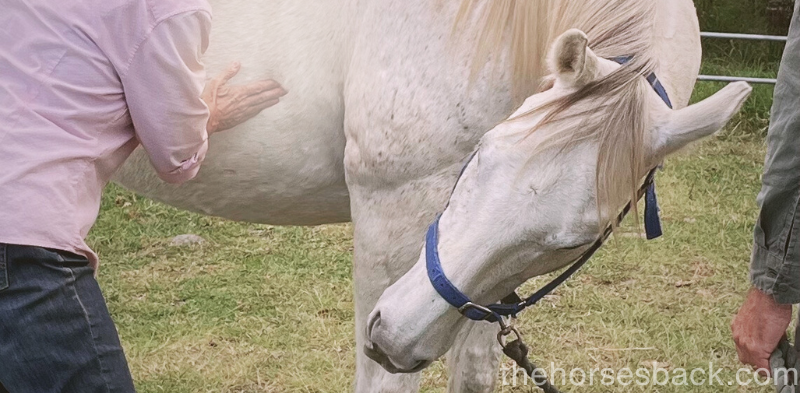
 

Read more about enrichment in this blog post:  How Well Are We Doing? Why Some Horses Thrive While Others Just Get By
Reference
[1] Johnson L, Martinson K, Keener L, DeBoer, M. A preliminary study: Effect of hay nets on horse hay usage, dental wear, and dental conditions in mature adult horses. Journal of Equine Veterinary Science; 2023;124;104366; doi.org/10.1016/j.jevs.2023.104366.

Filed Under: Bodywork, Guest Posts, Sharon May-Davis, Viewpoint Tagged With: Equine Physio, equine posture, GA, horse posture, natural feeding horses, passive physio horses, Sharon May-Davis, tanja kraus, Tanja Kraus Horsemanship, variable feeding positions

10 Equine Bodywork Responses That Tell Us Heaps About Horses

July 29, 2023 by Jane @ THB 8 Comments

In an equine bodywork session, having a feel for the horse’s mental and emotional state is important.

It helps us to understand where they’re at, why they’re responding the way they do, and how we’re likely to be moving onwards in future sessions. We can then use this understanding to improve our connection and the holistic health outcomes.

Here are 10 of the common responses I see in horses I work with. For ease of communication, I’ve given them names.

It’s not science (and isn’t meant to be), but it is all about listening to the horse.

See any horse you recognise here? Enjoy 😉

(c) Jane Clothier, The Horse’s Back. No reproduction of text or images without permission.


1. The Enthusiast

This horse is the equine bodywork practitioner’s number one fan. If there were a t-shirt, they’d be wearing it.

They nicker at the sight of the therapist, and when led to the yard will often walk alongside their bodyworker instead of their owner. Someone’s made them feel good and THEY LIKE IT.

(c) J. Clothier

As a result, they exude huge warmth and give great cuddles and neck hugs.

And let’s just say they look bereft when ‘their’ therapist arrives and works on a different horse. They’ll probably stand nearby to tune into the energy of the session anyway. 

2. The Child

This horse is often but not always young, projecting an air of total innocence.

And it’s genuine: they’re full of wonder for everything good that happens in their world.

And it’s safe to assume that up until now, it has all been good. As a result, they’re curious about everything that happens around them.

They’ve no defences set up and respond to the GOOD FEELS easily, sometimes apparently to their own surprise.

(c) J. Clothier

Their eyes will lock onto the therapist, the source of this remarkable experience.

Then they’ll turn their head from one side to the other, eyes following you as you move around the yard after the session.

‘Who are you? What did you do? Why am I feeling this?’

It’s impossible not to be enchanted by their bright, beautiful curiosity.


3. The Lightweight

This horse is a sensitive flower who has mixed feelings about this whole therapy business.

Their responses come super quickly, for good or for bad. Then they’ll take a huge amount from very little, and that goes both ways, for better or worse.

They can flinch at the unfamiliar nature of touch. If all’s well after that, they’ll often zone out at the first opportunity.

(c) J. Clothier

If you touch a spot with even a tiny problem, be prepared for flattened ears, a swinging head, tail swishing and a raised foot – sometimes all at once.

This horse is often a mare, affectionately known as ‘princess’ by her owner. But some geldings get complimentary membership too.

Once you get it right, don’t expect thanks, but do take heart watching the softness that unfolds before you.

Next time, you’ll be back to the beginning, but not quite, for now you’ll know very well that less is more.

4. The Superior Being

This trouper of a horse is a great competitor. They brush minor issues aside. They’ll often look down on you from a great height, as if at a mildly irritating fly. They don’t care to do anything as weak as going with the flow – yawning, licking and chewing is for losers.

‘Oh, are you still down there?’ …  goes on to win 1st LWT. (c) J Clothier

They occasionally forget themselves and the eyes start to close. It doesn’t last though: they’ll catch themselves and return to consciousness, with a ripple of irritation.

This doesn’t mean they’re not feeling it. They’ll remain tight-lipped until the pesky human is out of sight, then do all of their letting go in private.

Stallions and lead mares often march to this drum too. 

5. The Survivor

This horse shows you very little at all.

They’ve often been through a previous episode of pain that lasted too long. Or, they may have become used to locking down a source of pain, as they still have a chronic issue today.

At the slightest recurrence of pain, they revert to the lock down posture or attitude they had before. It’s what got them through it last time – they’ve survived by gritting their teeth and ploughing on.

A recent hoof abscess sent this mare back into her old laminitis responses. (c) J Clothier

You can almost hear this horse ignoring you and your hands. When you first work with them, they don’t yield and go with the flow. Instead, they stand with firm lips and a fixed stare.

But unlike the Superior Being, their vibe isn’t a light one.

Any effects happen in their own time, when the halter is off. They may stand in a corner or seek the presence of their closest friend… You’ll only know how well it went on the next visit, when the horse suddenly starts to respond.

6. The Anxious

This is the horse that can’t switch off.

They stand with their head up, always on the lookout, with a giraffe like posture that’s not great for their body and especially not for their neck.

They don’t feel safe and their attention flits around. Their breathing is shallow and/or fast.

Some of them can’t let go. They’ve a nervous system in overdrive and its buzzing signals won’t allow the horse to relax.

(c) J. Clothier

This is your challenge: to help this horse rediscover a deactivated state.

Pain may well be an issue, particularly in its shoulders and neck (and a headache). Nutrition and environment, too. Oh, and humans.

Initially settle for a horizontal neck, with a slightly closed eye being a bonus. 

7. The Controller

This horse prefers not to let go, even if they show early signs of doing so. They step and move around frequently. Displacement activities include chewing the rope, rubbing their head on the handler, a fence, anything. They can be mouthy.

Although there’s no real hostility, there’s a constant ‘push back’ as you work – and you’ll be aware of it. Don’t expect to feel quickly accepted. Better get used to life outside their bubble – and their tough-guy efforts to keep you there, outside their safety zone.

Controlling their space and tuning you out: there’s usually a reason. (c) J Clothier

However, it can all change when you successfully relieve an issue that they never, ever expected to go. Suddenly you’re allowed in and find yourself looking into their huge, deep eyes.

This can be because they’ve been resolutely ignoring an uncomfortable body issue. If so, their fidgeting may have been because you were drawing their focus to exactly that. 

8. The Watcher

This horse may stand in a quiet manner that’s initially encouraging. They may show early signs of relaxation, yet there’s still the feeling that they’re holding something back.

Then whoah! You’re met with a sudden tail swish, a swing of the hindquarters, or a snap of the teeth. You’ve touched a trauma spot and they’re telling you: ‘It’s right there! Watch yourself!’

The horse has some pain and you’ve just committed the cardinal sin of touching it.

(c) J. Clothier

Some may be alert throughout the session as they wait for you to find that spot. Little do you know that you’re being subject to a test. Better tune up your psychic abilities…

No matter what you do, the horse holds on and won’t let go until that breakthrough moment when you find the problem that’s highest in their awareness.

The painful spot may be an old or newer issue, but one thing is sure: there’s a lot of emotion wrapped around it.

Stay safe.

9. The Over-Trained

This horse stands with resolute obedience, as they know they should. They’ve been taught to wait with statuesque stillness, no matter what happens around them.

Whatever happens, they’re just waiting until it’s over, doing their best not to get in the way. They’ve learned that if they do, there’ll be a reprimand or sometimes heavy correction.

Receiving bodywork, these horses are often in their new home, where more self-expression is allowed.

To the therapist, this horse feels mentally and emotionally absent from their own party.

Some horses have been taught that they must remain completely still until asked to move. I find it’s very common with working station horses. (c) J. Clothier

Watch out for this horse’s return to their body, as their responses may be elevated.

They may love you to pieces, or they may shout about a problem that’s been long overlooked. Finally permitted to say what they think, they’ve lost the volume control.

It’s up to you to find a way through this, along with their people.

10. The Depressed

This horse knows it’s not worth even trying to connect or respond, probably because last time they did, it got them nowhere.

Their vibe is a dull one, and their eye contact is minimal or non-existent. They’re not into engaging with you.

They  may stare off into the middle distance, as if disocciating. There’s very little response until the relaxing sensations completely take over – then you may receive a single look, or a tentative touch on the hand.

It’s a start. That has to be enough for now.

(c) J. Clothier

This horse will hopefully learn from the beneficial after-effects of the work. They will slowly start to feel that life can feel better and that humans have something to give.

With these horses, working with their mind and emotions is even more important. If they’ve had physical stresses forced on them in the past (and they usually have, leading to pain issues), the last thing we want to do is pressure them again.

Negotation is always the best way when we need to move forward, with lots of acceptance and thinking time.


Now I said there’d be ten, but there’s one more to come. I don’t meet too many of these extreme cases, and for that I’m grateful.


11. The Broken

This horse is so badly damaged that there seems to be no way back.

Very often, they’ve had multiple negatives in their lives, on multiple levels. Pain is a huge factor, with the horse having a condition that’s been ignored and frequently overridden (literally… it’s often back pain).

Some are both desperate and furious, having been forced beyond their limits. They can be highly dangerous to work with.

This horse has probably given enough for one lifetime – or had it taken from them.

I met this chestnut mare in a UK horse sanctuary. (c) J Clothier

Bodywork is our fleeting gift as we try to help these horses feel better.

By helping to ease their stress, we may to a tiny extent counter the less positive experiences they’ve had at the hands of  other humans.

In return, they take us into a silent place, with depths unknown. Go gently while you’re there.

Filed Under: Bodywork, Viewpoint Tagged With: equine bodywork, equine massage, Equine Massage Therapy, Equine Physio, Equine Sports Massage, equine therapies, Equine Therapist, equine therapy, equine welfare, GA, Horse Health, Horse Massage, horse welfare, Performance Improvement, Physical Therapy, Remedial Massage, Sports Massage Therapist

Footer

Contact Me

Send your questions this way…

Get in Touch

  • Store Support
  • Shipping
  • Returns
  • Contact

Copyright © 2026 · Parallax Pro on Genesis Framework · WordPress · Log in