• Skip to main content
  • Skip to footer

The Horses Back

Body Talk for Thinking Owners

  • Home
  • Articles
  • BEMER
  • Store
    • Store
    • Shipping
    • Returns
    • Support
  • Equine Healthworks
    • Bodywork for Horses
    • Reviews
    • Leave a Review
  • About & Contact
    • About
    • Contact

Guest Author

Timing is Critical for your Foal’s Crooked Legs – An Equine Vet Covers the Basics

February 14, 2026 by Guest Author Leave a Comment

This post on the early treatment of ‘crooked legs’ in foals (Angular Limb Deformities) is written by Dr Lauren Jones, the veterinarian behind Kentaro Veterinary Services, a mobile equine practice on the Coffs Coast of NSW, Australia.

Known for her calm, practical approach, Lauren spends her days helping horses from foals to elite eventers. She’s passionate about education, preventative care, and the demystification of veterinary medicine, giving owners clear, no-nonsense advice they can actually use. 
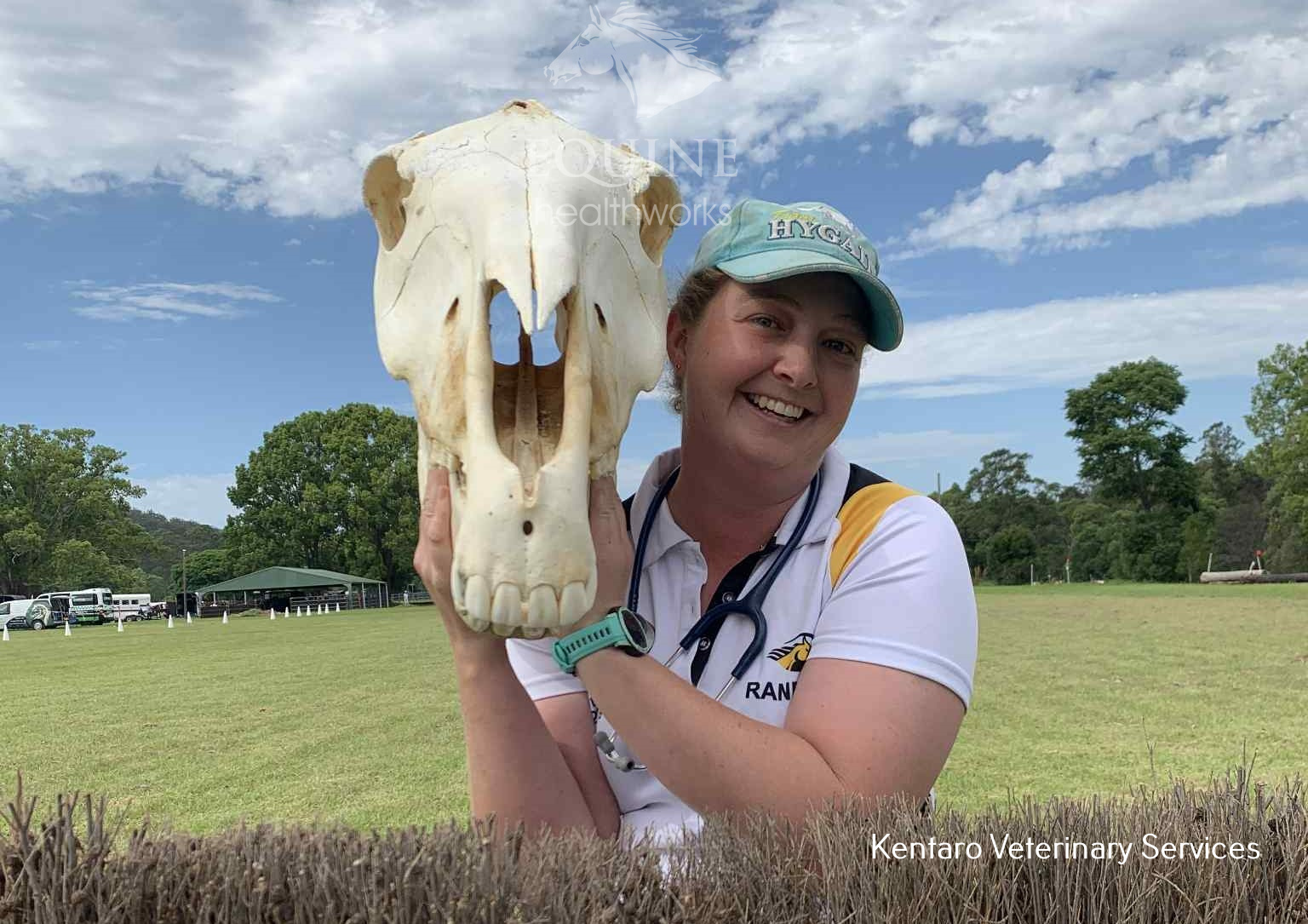
Dr Lauren Jones, Kentaro Veterinary Services

Dr Lauren writes:

Ever had someone say your horse is duck-footed or pigeon-toed? Or maybe that they paddle or have a wonky gait?

That’s often due to a conformational fault. The good news is that in foals, it’s something we can often correct before it becomes a long-term problem.

There are all types of these – legs that bend in, out, or are contracted or lax. Each type changes the way the joints line up and the way forces travel down the limb.

This is exactly why I’m so particular about foal checks at birth. Early intervention gives us the best chance to guide those growing legs into alignment.

It’s never a one-person job – it takes a team effort: dedicated owners, a skilled farrier, a bodyworker, and a vet with an eye for detail. Together we can make a huge difference in how that foal matures and moves for life.
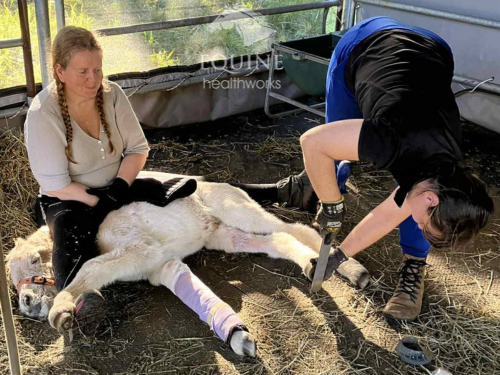
Foal hoof trimming and taping. Image (c) Lauren Jones
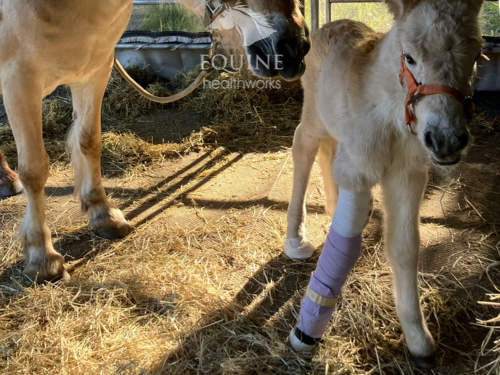
Foal hoof splinting and bandaging, plus trimming. Image (c) Lauren Jones

A quick run-down on those crooked legs

Angular Limb Deformities (ALD) can look like a foal doing the hokey kokey, but what’s really happening is much more complicated. These deformities come in a few different flavours and can be congenital (born that way) or acquired (develop after birth).
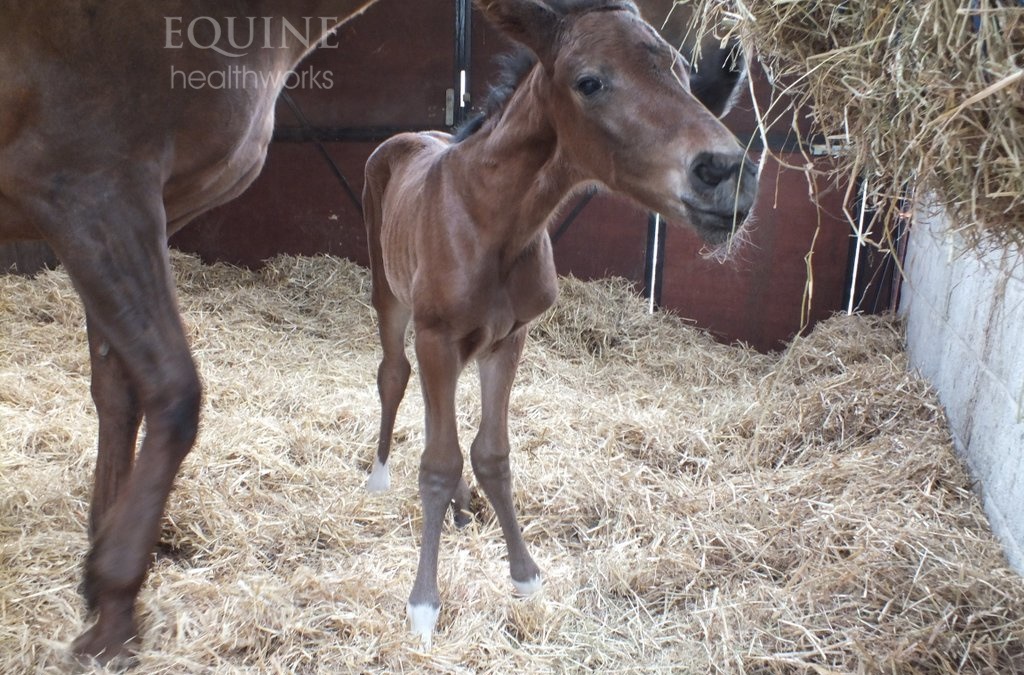
Carpal valgus (‘knock knees’) is one of the most frequently seen angular limb deformities. Image (c) M. Power

Congenital causes

These are usually linked to what happens before or around birth.

  • Soft tissue trauma during delivery.
  • Lax or flaccid joints, when the ligaments and tendons are just a bit too stretchy at birth.
  • Premature birth, twin pregnancies, placentitis, etc. can cause underdeveloped bones (incomplete ossification)
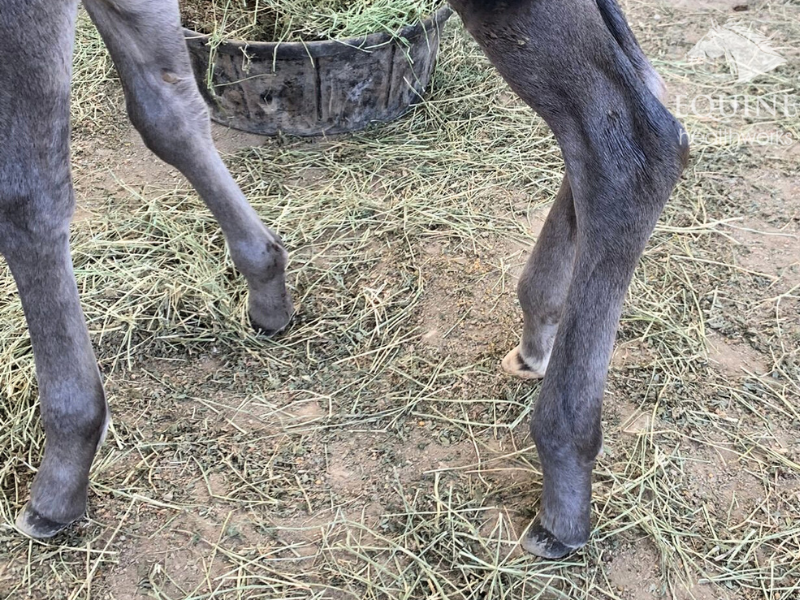
Congenital angular limb deformity
Forelimb and hindlimb contracture is a less commonly seen congenital angular limb deformity

Developmental (acquired) causes

These are termed ‘acquired’. They tend to show up a bit later and are often influenced by:

  • Unbalanced nutrition (too much, too little, or the wrong mix for growing foals).
  • Excessive exercise or trauma – those young legs take a lot of load too quickly.
  • Environmental factors – a hill can cause a slant if a foal is already tending one way or another.
  • Lack of good hoof care early can lead to abnormal wear, changing the forces on the foot.

Some of these can be sneaky and hard to spot until the foal hits the ground and starts moving.
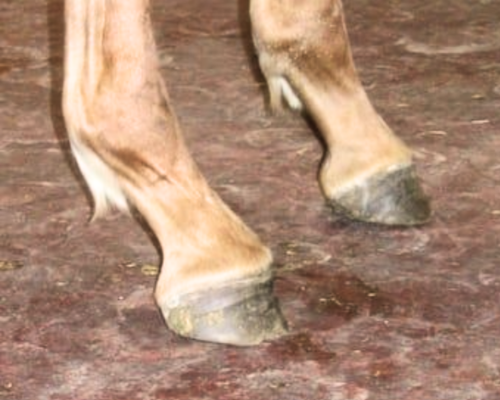
Acquired flexural deformity in a foal (c) Dr. C. Whitton, MSD Manual

In simple terms, we talk about:

  • ‘Valgus’ is when the limb angles outwards (toes point out, knees or hocks in).
  • ‘Varus’ is when the limb angles inwards (toes point in, knees or hocks out).
  • Contraction is when everything is too tight.
  • Laxity is when everything is too loose.
  • A combination of all the above.

Windswept at birth


And ever seen a little foal that looks like the wind’s been blowing from one side a bit too long? Meet the windswept foal – a classic example of Angular Limb Deformities in action. This foal is half Valgus, half Varus. You put your left foot in and your right foot out and shake it all about…


Straight talk about treatment

Every foal is different, and the key is working out whether that crooked leg needs a bit of time, a trim, or a team approach to get things straight again.

The good news? With the right plan and good teamwork, these cases can do brilliantly, and what’s more, they do so in a pretty short period of time.

Here’s how we can tackle mild to moderate limb deformities with conservative management. For more severe cases, surgical management is an option.

Exercise-restriction or controlled exercise

When the muscles are too tight, then we need to rest them to let them relax. When the muscles are too loose, they need gentle exercise to strengthen them.

Corrective trimming

Our farrier team works magic here! Small, frequent trims can help rebalance how the foot hits the ground and redirect forces up the limb.

Here we are looking at left-to-right imbalances. When you pick up the foot of a pigeon-toed horse, you will notice that one heel is longer than the other. The first step is to even the heels up (it can be millimeters), before reassessing.

If the fetlock is straight, great! If not, we can come back and take off a couple more millimeters. Be wary, as there isn’t much foot to play with. It’s best to do this trimming under an experienced eye.
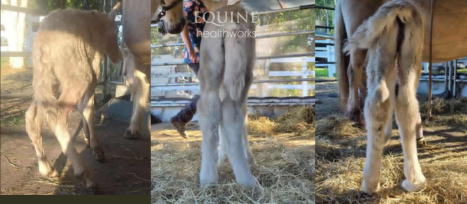
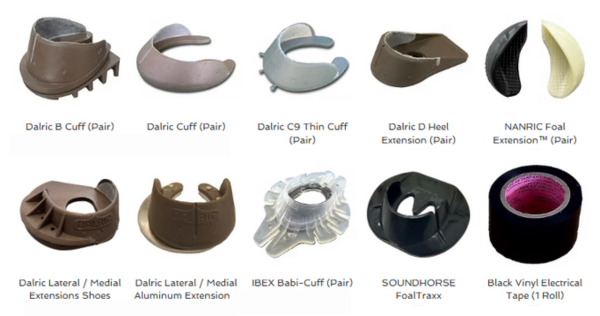
Hoof extensions

Glue-on or lightweight extensions can shift the weight distribution and give growing bones a little nudge in the right direction.
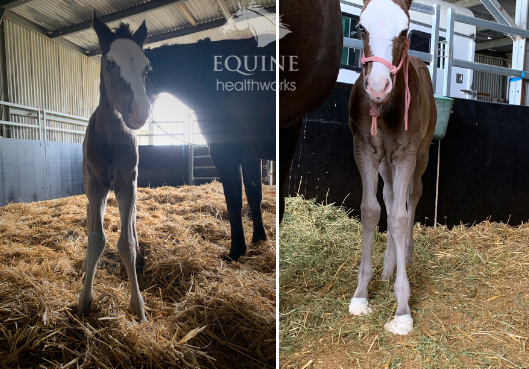
Carpal valgus is one of the most common angular limb deformities. Image (c) Lauren Jones


Foal hoof extensions
Dalric hoof extensions by Nanric. Available https://www.nanric.com/foal-shoes

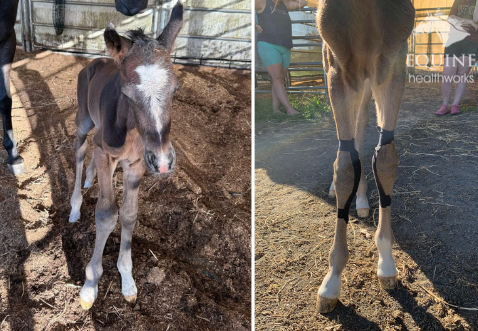
Physio tape

This fires the nerves to work more on one side than the other, due to gentle tactile feedback. This can encourage the muscles to work slightly harder on one side in order to straighten the leg.
Splints and bandages

Used carefully and for short periods, these help support weak or lax joints while the soft tissues strengthen. They can also be used to gently stretch tight joints. Note: these look simple, but are not without risk, as they can heat up the leg, slip, or cause rub. It’s very easy to end up with long-lasting scar tissue and white hair. If used incorrectly or if the foal is too boisterous, they can cause negative effects quickly!
Bodywork

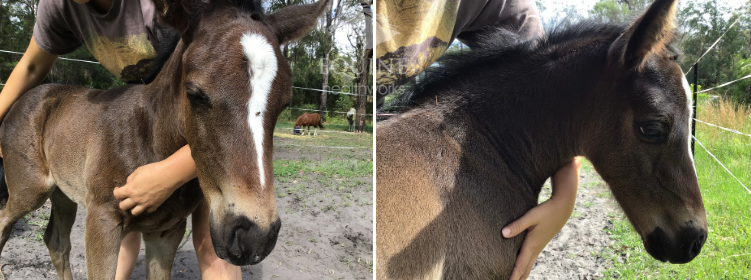
Some gentle bodywork, including a little limb mobilisation and stretching, or acupuncture can help ease the muscular tensions that build up as the foal works hard to balance itself. Some modalities will stimulate the nervous system and help it to ‘forget’ the incorrect posture as the limbs improve.
Surgery

For more severe or stubborn cases, we can use veterinary surgery. ‘Stripping’ is when the bone membrane is lifted to speed growth on the ‘short’ side of the leg. ‘Stapling’ is when a screw or pin is fixed across the growth plate to slow growth on ‘long’ side of leg. That’s how surgery influences bone growth. It’s a higher level of intervention, but timing is still critical.

Should your foal be confined or not?

Owners are often ‘advised’ by well-wishers that they should keep their foal confined, or allow it to run around to exercise – with the same advice being given for all manner of Angular Limb Deformities.

Try not to take such advice, but instead get a vet with an experienced eye for forelegs AND hindlegs to have a look at mare and foal in the first 12 to 24 hours. Doing so gives many advantages.

 For the mare, we check that:

  • She has passed her membranes,
  • Her udder is comfortable,
  • Any minor tears are treated.

We can also assess whether she is going to need a post-foaling flush treatment.
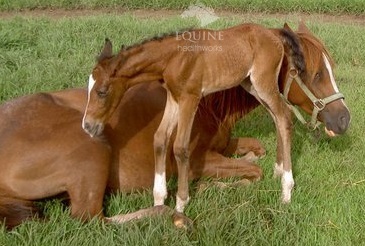
For the foal, we check that:

  • Meconium has passed normally,
  • The bite is strong,
  • The heart has no murmurs,
  • The lungs are clear,
  • The umbilicus is clean and dry,
  • There are no hernias,
  • Temperature is normal.

We also do an IGG test to check the immune system has absorbed enough antibodies from mum’s first milk, which carries colostrum.

Importantly, we check legs for straightness and development, seeing problems that the owner might not spot. We create a plan if they need treatment.

It’s best to keep both mum and foal confined until then! This also has another advantage: the pair bond in a safe place so that mum doesn’t need to get over-protective or run from that ‘lion’, over-exercising those vulnerable baby legs.

Be sure to act in time

No matter the approach, monitoring is critical. Foals grow fast, sometimes changing week to week, and what’s perfect timing for one joint might be too late for another.

Don’t leave it too late! Fetlock deformities are best addressed before 4 months of age, as growth plates near closure. The window for knee and hock deformities is longer, but the best results are achieved before 6-8 months.

Where possible, early management is nearly always better, as you’ll see faster results for less intervention. It also leaves less time for problems to worsen or lead to additional issues.

That’s why early checks and ongoing follow-up visits make all the difference to your growing foal’s legs.
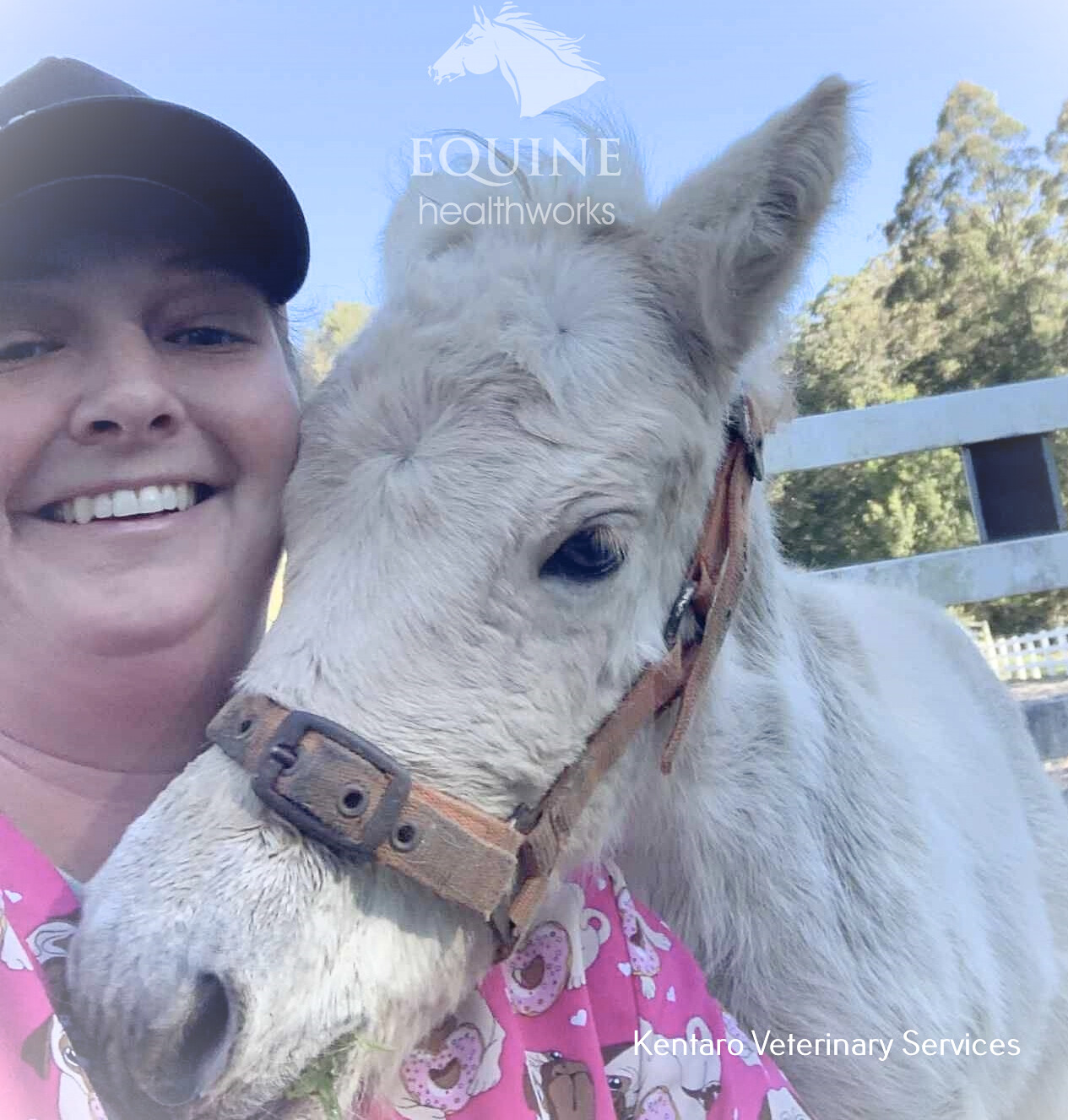
Dr Lauren Jones and friend

Filed Under: Bodywork

Physio at Feed Time: Using Food to Mobilize Your Horse’s Body

October 18, 2024 by Guest Author 2 Comments

In this guest post, Tanja Kraus introduces variable feeding positions, which bring musculoskeletal benefits while also enriching your horse’s day.
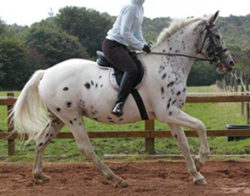
As an equine educator from the East Coast of Australia, Tanja’s passion is using kind horsemanship philosophies and connection to develop a partnership horse with the rider.

This extract comes from her latest book, Lessons from Horses: Movement, whch provides insight into why and how our horses should be moving each day, with exercises to contribute to their physical health, mental wellbeing, and longevity.

She writes about variable feeding positions with the support of Dr Sharon May-Davis, who developed this combined feeding approach.

You can find Tanja’s books here.

All text is copyright of the author Tanja Kraus. No reproduction without permission.

The Day I Heard About Variable Feeding Positions and Horse Posture

I first heard about variable feeding positions when attending an Equine Symposium where Dr. Sharon May-Davis was presenting.

Sharon presented on variable feeding positions, and showed many examples of the benefits of variable feeding she had seen, both in wild horses and in domestic horses managed in this way.

This included reduced asymmetry in the body, improved teeth and hooves, a more complete and balanced recovery from injury, and improved performance across multiple disciplines.

Comparing wild herds to domestic horses, she discovered that domestic horses with restricted lifestyles suffer with issues not only in the musculoskeletal system, but also uneven teeth wear. Jaw alignment and foot growth due to the limited postures.

Horses commonly ignore easy grass pickings to nibble from trees. (c) Hilary Graham

Natural Feeding Behaviors in Horses

As Dr May-Davis was talking, I was imagining my own horses and what I had seen them doing naturally in their paddock, and she was, of course, right.

My own horses who run in a herd of around 10 (give or take) in a paddock of varying terrain of about 40 acres adopt ‘variable feeding positions’ regularly and quite naturally.

And when I say regularly, I mean daily, through all the seasons.

So, they are not driven by lack of resources, which many people will argue ‘horses only eat out of trees when they have no choice’ – this is 100% incorrect.

My horses will happily roam their paddock and graze and browse and everything in between every day.

Images (c) Dengie: ‘Hedgerow Haynets for Horses’

We’re fortunate that our paddock contains a wonderful variation of pasture, different types of grasses, trees, and weeds that our horses can pick and choose from.

They are regularly seen choosing to eat ‘above the knee’, which is the measurement used to define browsing.

This can involve something as simple as eating the top of long grass around knee height, to completely outstretching their head and neck until their teeth are facing the sky to pull leaves from trees.

When you observe horses doing this, and pay attention to their bodies as they do it, you can see just how significant the range of motion is.

Horses extend their backs and stretch forward when eating from height. Indoor and outdoor spaces need to be large enough for them to do this.  (c) thehorsesback.com

Naysayers are often heard grumbling that horses ‘shouldn’t hollow their backs’ and that ‘high feeding is bad’ for this reason.

However, if you observe other animal species such as dogs and cats, they can all be seen stretching their spines by rounding and then hollowing.

And where would our own Yoga classes be without the classic ‘cat / cow’ pose?  Range of motion is healthy, natural and necessary.

Our domestic horses are often denied any type of variable feeding as we feed hay and hard feeds on the ground, and many horses are kept in paddocks that have limited access to appealing trees, shrubs, and long grass to facilitate variable feeding.

So how can we help?

Horses with good spinal mobility appear happy to eat from any angle on a hill. (c) Tanja Kraus


Offer Your Horses Variable Feeding Positions

Provide opportunity for variable feeding, with the following examples:

  • High hay fixed
  • High hay swinging
  • High feeder on rail
  • High feeder with ramp
One flake of hay per day in a swinging high net keeps this herd, which lives out, actively mobilizing their necks. (c) Sally Taylor

If hay has to go on the ground, you can make use of the natural lie of the land.

  • Feed on slope uphill / downhill
  • Hay scattered around to encourage movement
  • Multiple haynets and feeders to encourage movement
This mare stands square while eating on a gentle slope and raising her cervicothoracic spine. Note that she could stand at the top and eat virtually on the level if she preferred to. (c) thehorsesback.com

The Benefits of Variable Feeding Positions

Basically, we can try any variation from the usual static grazing position.

Feeding in variable positions can also be a useful ‘passive physio’ technique. They may find it harder at first, but it gets easier as their bodies become more supple and mobile.

It follows that horses being rehabbed from injury or restriction can be fed to encourage beneficial postures that activate or stretch particular muscles or body areas.

Gypsy needed encouragement to load an injured forelimb. Unlike most horses, she had been loading her hindquarters rather than her forehand. The gate encourages her to come forward and raise the lower neck. (c) thehorsesback.com

It’s important to note here that I have had some equine dentists express concern as they have seen terrible damage to horses’ teeth (namely racehorses) who are fed only in high feeders.

But, those horses are stabled and fed only in up positions, and therefore the grazing position is not a part of their daily routine. A recent study suggests there is no negative dental effect in horses using haynets for a period of one year [1].

Below, these horses are fully mobilising their necks while eating from a shared large small-hole haynet – and from the ground. Note the near squared position of the grey mare, who suffered a fractured pelvis as a yearling.

We can also reverse engineer this – if your horse has an asymmetry, or difficulty working in one direction, is the way you position their feed having a negative effect?

Horses, when given the freedom to choose, graze approximately 80% of the time, and browse 20% of the time, and this balance should be sought when providing variable feeding positions for their benefit.


Solid and safe ramps and pedestals can be created to replicate environmental factors. (c) Footloose Barefoot Hooves

I have adopted variable feeding positions for my own horses, student horses, and for horses when they come in for training.

I’ve taken photos and filmed their start of variable feeding, and as they progress, and I have noticed a significant improvement in their posture while eating, along with their resting and grazing stances.

Depending on what you are trying to achieve there are many options, and the best part is the horse is doing their own physio in a gentle way.


Read more about enrichment in this blog post:  How Well Are We Doing? Why Some Horses Thrive While Others Just Get By
Reference
[1] Johnson L, Martinson K, Keener L, DeBoer, M. A preliminary study: Effect of hay nets on horse hay usage, dental wear, and dental conditions in mature adult horses. Journal of Equine Veterinary Science; 2023;124;104366; doi.org/10.1016/j.jevs.2023.104366.

Filed Under: Bodywork, Guest Posts, Sharon May-Davis, Viewpoint Tagged With: Equine Physio, equine posture, GA, horse posture, natural feeding horses, passive physio horses, Sharon May-Davis, tanja kraus, Tanja Kraus Horsemanship, variable feeding positions

The Very Big Problem of Dwarfism in Horses

February 22, 2019 by Guest Author 9 Comments

In this guest post, Dr. Sonja Dominik describes equine dwarfism and what the latest tests mean for horse breeders. Sonja is a Research Scientist in Quantitative Genetics at CSIRO, Australia’s national science agency.
She is currently a Superstar of STEM, appointed by Science & Technology Australia to increase the public visibility of women in science. To top that off, she was also a competitor in the 2018 series of Australian Ninja Warrior.

Sonja writes :


There’s small and then there’s very small.

There’s cute – and then there’s dwarfism, which isn’t cute at all.

Equine dwarfism is a very complex genetic condition. However, a few facts apply to all dwarf types in horses.

First, dwarfism in horses is caused by a disruption of the structural processes in bone and / or ligament development. It can potentially occur in any horse breed, but is most prevalent in Miniature horses, Shetland ponies and Friesians, but has also been described in Mustangs and donkeys.

All characterized dwarf types in horses are disproportional, meaning that only some parts of their bodies – eg.  their limbs – are reduced in size.

Dwarfs can suffer secondary conditions, usually due to their skeletal deformations, and multiple health problems, such as metabolic, digestive or respiratory disorders.

In genetic terms, dwarfism is a recessive condition (more on that below). Not all dwarf types are genetically characterized, but genetics tests are available for some.

Bond Tiny Tim (b.1970) was an American dwarf miniature horse breeding stallion, whose name appears throughout miniature horse pedigrees. Image copyright unknown.


Horses with dwarfism aren’t just tiny

Four types of equine dwarfism have been defined, based on their physical characteristics. However, there are a lot of overlaps and there are dwarf horses that are difficult to fit into any of the described types.

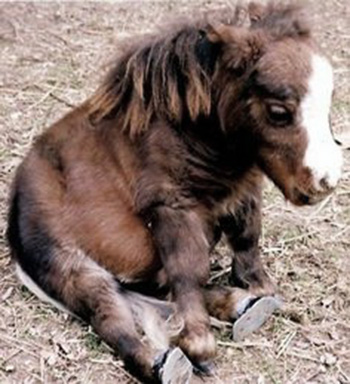
1. Short legs, long bodies.

Achondroplasia is the most common form of dwarfism. Affected horses have short-limbs with a normal trunk, although often with an elongated back.

The term achondroplasia actually means ‘without cartilage formation’, although that is not quite correct…. these dwarfs have cartilage, but the problem is that cartilage is not turned into bone while they are gestating.

However, this type of dwarf can lead a relatively normal life.

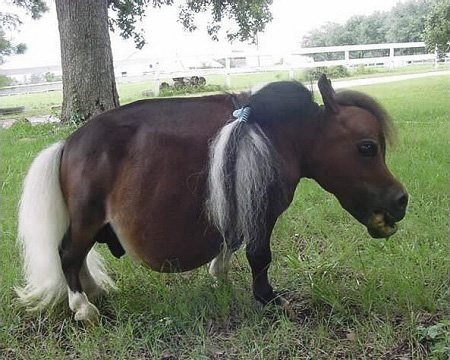
Foal with achondroplasia. These miniature horses can lead relatively normal lives. Image copyright unknown.


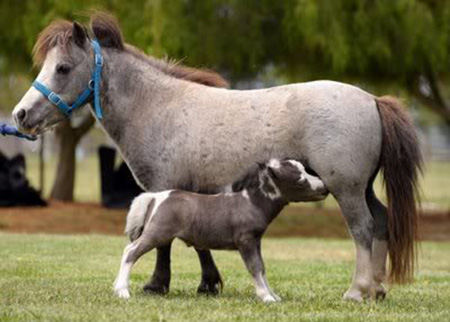
2. Large heads, distorted features.

Brachycephalic dwarfs have a bulging forehead, with a short and flat nasal bridge, overly large eyes, and nostrils that are higher than what is considered normal.

They also have a short neck and limbs, and often have spine deformations. This type of dwarf often has a shortened life span.

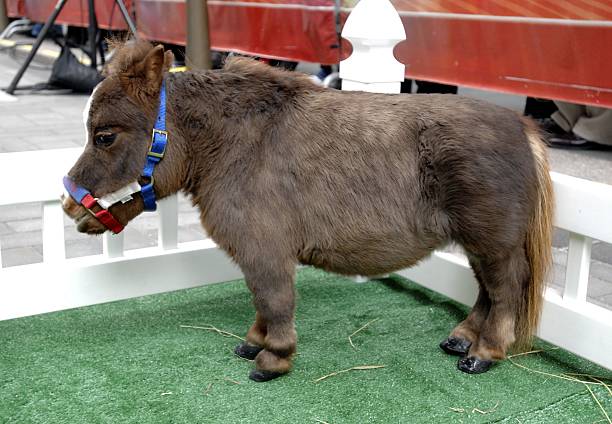
Thumbelina (b. 2001), a brachycephalic dwarf miniature, was celebrated as the smallest horse in the world at 43cm tall. Image: Brad Barket, Getty Images

3. Multiple deformities.

Diastrophic dwarfs can have twisted limbs and / or multiple limb deformities and other characteristics such as a domed head and roached back and a pot belly.

Due to the severely deformed limbs, affected animals would require splints or surgery to move properly.

Diastrophic dwarfs are prone to colic due to the small size of the abdominal cavity and pressure on the intestines. Image copyright unknown.

4. No bone.

Hypochondrogenesis is the most severe condition of dwarfism where the bones are not ossified at all. Affected fetuses are normally aborted before birth.


Here’s what we know about dwarfism genetics

Recently, a genetic test for dwarfism in miniature horses was developed at the Gluck Equine Research Center, University of Kentucky.

This tests for achondroplasia-like dwarfism, which is caused by mutations in the so-called ACAN gene.

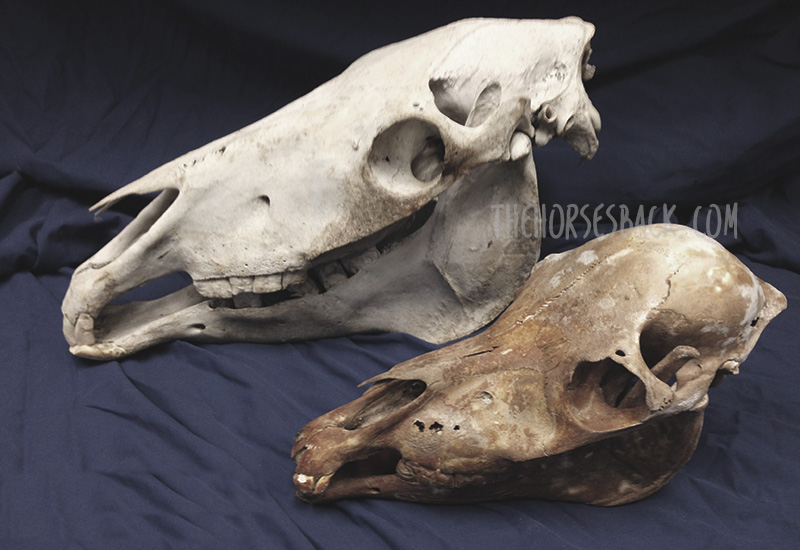
Skull of a dwarf miniature horse compared with a full size horse’s skull. Dwarfs experience more dental problems due to the large size of their teeth in relation to their skulls. Miniature skull courtesy of S. May-Davis. Image (c) J. Clothier

Every horse carries the ACAN gene, which encodes the protein Aggrecan, an integral part of the extracellular matrix in cartilaginous tissue. Four variants of the gene have been identified that cause the above types of dwarfism – there might be even more.


What does a genetic test tell us?

Every horse inherits two copies of the genetic code, one from each parent. This is really important in our understanding of dwarfism and genetic test results, because all known dwarfism types are recessive conditions.

What this means is that only horses carrying two copies of affected genes, ie. one from each parent, will actually be dwarfs. Horses with one affected and one unaffected gene will be a carriers.

Thumbelina as a foal. Image: Youtube video via www.sunnyskyz.com blog.

Carriers are normal in appearance, but there is a 50% chance that they will pass the affected copy of the gene on to their offspring. This means that if two carriers are bred, there is a 25% chance that the offspring is affected by dwarfism.


And there’s a second gene too

As well as ACAN, another gene has been identified that causes dwarfism if it is mutated. This gene is B4GALT7, which, if mutated, leads to disrupted bone and cartilage formation. (In humans is associated with  Ehlers-Danlos Syndrome, a group of connective tissue disorders.)

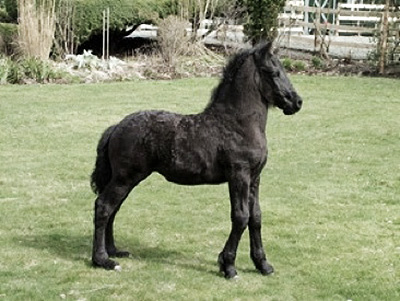
This mutation is prevalent in the Friesian breed – affected horses have also short limbs, deformation of the rib cage, and hyperextension of the fetlock joint5.

Dwarf Friesian foal with hindlimb hyperextension. Image copyright unknown.

Dwarfism in the Friesian horse is also recessive and again, only horses with two copies of affected genes are dwarfs.


Why is dwarfism only present in certain breeds?

There are a number of possibilities.

  • Selective breeding may have played its part: horses with favorable features have sometimes been carriers of a defective version of a gene.
  • A single copy of the defective gene might have had a favorable effect on small size, so animals with a single copy might have been preferentially selected.
  • However, as size in horses is influenced by a large number of genes, the defective version of the genes might be linked to versions of other genes that cause small size.  It could have “hitchhiked” during the selection for small stature.

In this way, selection for smaller stature, obviously without genetic testing, has led to a higher frequency of the defect gene in the Miniature horse population.1

It is less clear which favorable feature might have been selected for in the Friesian horse, although we do know that the stallions Paulus 121 (b.1913) and Us Heit 126 (b.1917) each sired 7 dwarf foals.

Image copyright unknown.


What is skeletal atavism?

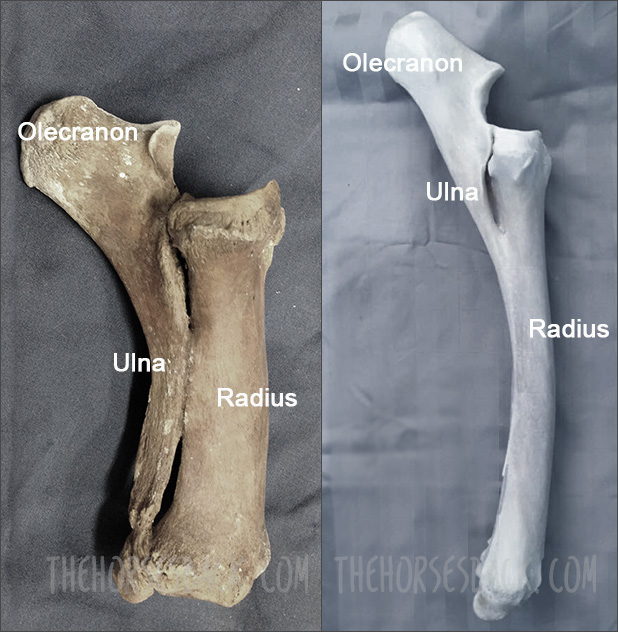
Skeletal atavism has similar physical features to dwarfism, with horses being deformed and with shortened limbs. It also occurs in Miniature horse and Shetland ponies.

The characteristics include abnormal bone growth, which is evident in the upper limb bones, including the ulna in the forelimb and the fibula in the hindlimb.1

In atavistic horses, the ulna extends from the humeroradial to the carpal joint (ie. elbow to knee) and the fibula from the femerotibial to the tarsal joint (ie. stifle to hock).6

This can cause splayed legs and create movement difficulties.6

Atavistic ulna and radius from a miniature horse (L) and normal ulna and radius (R). Miniature bone sample courtesy of S. May-Davis, TB bone sample J. Clothier (Image (c) J. Clothier

Atavistic characteristics have been observed in fossil records of earlier ancestors of a species, and have then reappeared quite recently.4  The earliest report in recent times was in Shetland ponies in 1958.7

Genetically speaking, these are not new mutations, but are ones that became dormant, only recently being re-expressed.2

Like dwarfism, atavism is a recessive condition, which means that affected horses need to have inherited an affected copy of the gene defect from each parent.


How can we avoid dwarfism?

The occurrence of dwarf horses is a matter of chance, but the fewer horses in a population that carry the affected genes, the lower the chances that two carrier horses will be bred and produce a dwarf foal.

To avoid dwarfism and reduce the frequency of affected genes in a population, carriers of affected genes should not be bred.

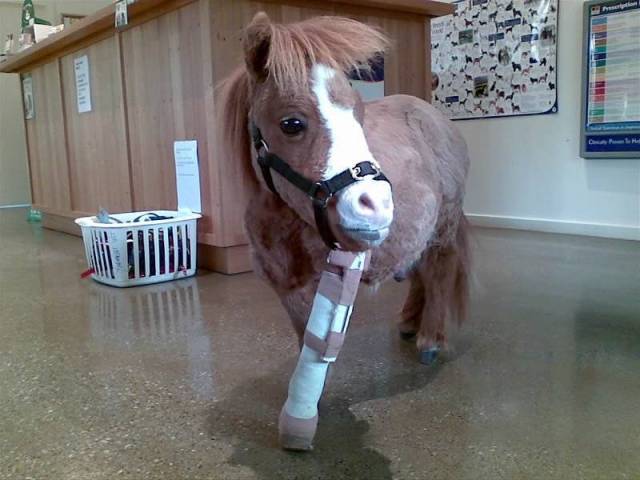
Koda, adopted permanent resident at Yarrambat Veterinary Hospital in  Australia, has experienced “a barrage of health problems and major surgical procedures” Image (c) thevetsurgery.com.au

How do we know that a horse is a carrier?

There are only two ways to know if a horse is a carrier:

1. If the horse ever had a dwarf foal, it is clearly a carrier.

2. Genetic testing.

In North America, you can test for dwarfism in Friesians here and for dwarfism in miniature horses here.

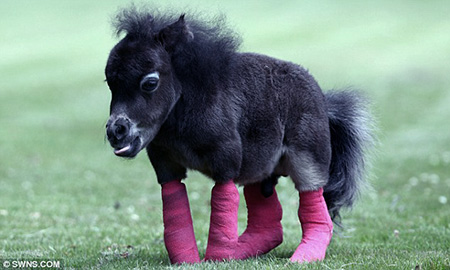
“Cuteness overload”… or a health and welfare issue? Image (c) SWNS.com


What tests are available?

Genetic tests to identify carriers of the variants that cause dwarf appearance are now available for dwarfism in Miniature horses and Friesian horses, and for skeletal atavism in Shetland ponies.

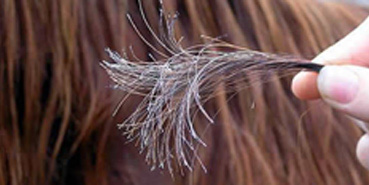
Genetic testing is straight forward. All that is required is a sample of hairs, including hair bulbs, that is sent to a testing laboratory and the test will establish if the sample originates from a carrier of defect genes that cause dwarfism.

Hair follicles are all that is needed for a low cost, genetic test. Image (c) www.imagenesmi.com


If a test is positive, it can be devastating. However, if your horse is a carrier and is only bred with horses that are also tested and shown to be unaffected non-carriers, all offspring will be unaffected.

However, the defect gene will still be passed on to the offspring, with a 50% chance to create a new carrier and dwarfism gene remains in the population.

That means you’re depending on future owners to do the right thing – and they very well may not do so.


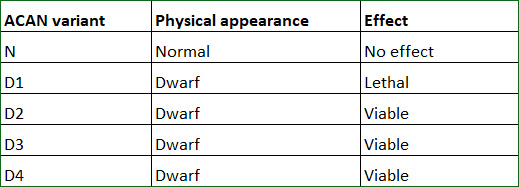
Finally, here’s how different versions of the ACAN gene affect the horse (adapted from Eberth et al. 2018)

Examples of some mutations. Image (c) Genetic Testing at Gluck – https://gluck.ca.uky.edu/disease-mutation – click on image for link.


If you love horses and love your breed, then the truly responsible option is to test every horse you breed from. If you then breed and sell a mare or entire horse colt that’s a carrier, it remains that someone less responsible than yourself may then breed it to an untested stallion. 


If you’ve enjoyed Sonja’s writing, do take a look at another of her public posts on The Conversation’s blog, about the giant cow Knickers – yes, THAT giant cow.  Read her article: Yes, Knickers the steer is really, really big. But he’s far short of true genetic freak status


References:

  1. I.J.M. Boegheim, P.A.J. Leegwater, H.A. van Lith, W.Back (2017) Current insights into the molecular genetic basis of dwarfism in livestock. The Veterinary Journal 224: 64.
  2. J.M.Cantu, C. Ruiz (1985) On atavisms and atavistic genes. Ann Genet 28: 141.
  3. J.E. Eberth, K.T. Graves, J.N. McLeod (2018) Multiple alleles of ACAN associated with chondrodysplastic dwarfism in Miniature horses. Animal Genetics 49: 413.
  4. B.K. Hall (1995) Atavisms and atavistic mutations. Nature Genetics 10: 126.
  5. P.A. Leegwater, M. Vos-Loohuis, B.J. Ducro, I.J. Boegheim, F.G. van Steenbeek, I.J. Nijman, G.R. Monroe, J.W.M. Bastiaansen, B.W. Dibbits, L.H. van de Goor, I. Hellinga, W. Back, A. Schurink (2016) Dwarfism with joint laxity in Friesian horses is associated with a splice site mutation in B4GALT7. BMC Genomics 17:839
  6. Rafati, L.S. Andersson, S. Mikko, C. Feng, T. Raudsepp, J. Pettersson, J. Janecka, O. Wattle, A. Ameur, G. Thyreen, J. Eberth, J. Huddleston, M. Malig, E. Bailey, E.E. Eichler, G. Dalin, B. Chowdary, L. Andersson, G. Lindgren, C.-J. Rubin (2016) Large Deletions at the SHOX Locus in the Pseudoautosomal Region Are Associated with Skeletal Atavism in Shetland Ponies. G3 Genes Genomes Genetics 6: 2213.
  7. Tyson, J.P. Graham, P.T. Colahan, C.R.Berry (2004) Skeletal Atavism in a Miniature Horse. Veterinary Radiology and Ultrasound 45 (4): 315

Links:

https://thehorse.com/18222/12-miniature-horse-health-risks 

https://www.ofhorse.com/view-post/Equine-Dwarfism-Not-a-Desireable-Trait,

https://www.facebook.com/aryathedwarfpony/photos/facts-about-equine-dwarfism-1-equine-dwarfism-is-most-prevalent-in-miniature-bre/800155847006325/

http://www.littlemagicshoes.com/page5.html

https://www.vgl.ucdavis.edu/services/horse/Friesian.php

https://gluck.ca.uky.edu/sites/gluck.ca.uky.edu/files/2022-01/dwarfism_miniatures_submission_form_april_2017.pdf

http://www.friesianhorses.com.au/healthdwarfism.htm

Filed Under: Guest Posts, Uncategorized Tagged With: Dwarfism, friesian horses, GA, genetic testing, horse breeding, miniatures

5 Ways Your Seat Can Screw Up Your Horse Without You Even Noticing

January 26, 2017 by Guest Author 2 Comments


In this Guest Post, the UK’s ‘Classical Seat’ trainer Heather Moffett looks at how the rider’s seat can make movement harder for the horse. It’s something that saddle fitters know about, but it’s often the last thing riders think of: the riding position as much as the saddle fit affects their horse’s back and movement. 

Heather Moffett has over 40 years’ instruction experience. Chiefly following the French school of classical equitation, which focuses on dressage as an art form rather than competition, she is best known as an authority on the Classical Seat. 


We all keep hearing about ‘connection’.  It’s a current buzzword and usually means connecting with your horse on the ground, either through loose or in-hand work.

Many riders assume this will enable them to achieve the same connection once mounted.

There is nothing wrong with that. However, they often then wonder why they lose that connection – sometimes literally, complete with the saddle(!) – once they start riding. The fact is that they are, in ignorant bliss, impeding the horse!


The Disconnected Seat

If the rider is out of sync with the horse’s movement, the flow and harmony will always be disrupted as the horse struggles to balance the rider as well as himself.

Or, he endures the discomfort of a rider sitting like a lump of lead, driving with the seat against his sensitive back, or bouncing stiffly in the saddle.

The horse has only one way to show his discomfort or pain, as he is mute, and that is by behaviour that is then construed as ‘misbehaviour’.

I often ask riders who kick and hit their horses if they would do the same to their dog. The dog is able to cry out in pain. The horse cannot, and it is his muteness, throughout history, that has led to his downfall and still does to this day.


What Gets My Goat is This

I’ve been a specialist trainer/teacher of the Classical seat for 46 years. In that time, there has been little interest in increasing knowledge of the seat and refinement of the aids.

So many teachers and trainers say that it is necessary to ignore imperfections in the seat until “the horse is going well”. Then they wonder why the horse never progresses, or why force must be resorted to, in order to make the horse submit!

Yes, there is that word submit (or submission) that’s a requirement in a dressage test.

My own teachers soon found that it worked far better to encourage my cooperation in school rather than forcing me into submission! And a horse is no different.

I would like to see the word submission in tests replaced with willing cooperation.

How different would the expression be on many a horse’s face, if he were trained as a partner, and not as an adversary?

So, are you screwing up your horse with your seat, without even noticing? Here are the 5 top points I’d like you to think about.


1. Saddle Fit Woes (Yes, Again)

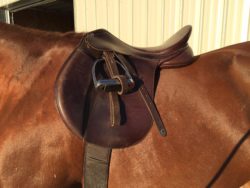
Poor saddle fit can cause the seat to tip back.

No surprises for this one. Saddle fit is probably the most obvious thing that needs to be right, but many saddles are a long way from perfect. That’s true even in my home of the UK, where saddles are most often professionally fitted.

But, what amazes me is the number of saddles I see with clients coming to me for lessons that have faults that make it damn near impossible for the rider to sit either straight or in balance!

Here are the worst offenders.

The saddle is too narrow. This is still one of the most common faults – it pinches the horse and tips the rider’s pelvis backward, aiding a chair seat rather than the ear/shoulder/hip/heel line which is the only position of balance.

Try walking with your butt stuck out behind you and knees up, as though sitting on a chair! It’s hard enough to even remain upright! Your weight will be over the cantle region, making it difficult for the horse to lift and round his back, and causing him to go hollow.

Stirrup bars are, almost without exception, even on many dressage saddles, too far forwards. This is why the rider is constantly being nagged by instructors to “get that lower leg back”!

I do wonder why instructors and even top dressage trainers, never seem to notice that all of their students are not anatomically challenged and there might just be something wrong with the saddle design and balance!! (Don’t get me started!!)


2. An Insecure Seat
Sucks (for Both Horse and Rider)

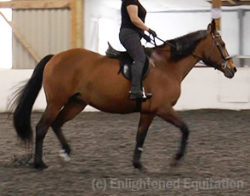
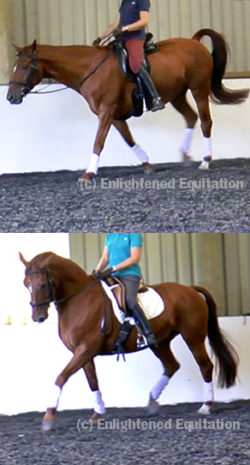
7yo Oldenburg x Irish Sport Horse. 1st day to 2nd day of HM course.

Here’s what I mean by insecure. Riders are not taught to absorb and sync with the horse’s movement.

We hear:

“Sit deeper!”

“Relax your back!”

“Go with the movement!”

“Follow the horse’s movement!”

Well, usually if you are following something you are behind it!

Is it any wonder beginners are confused and often never learn to move in sync with the horse?

If this describes you, fear not. I have had riders here on my horse movement simulator workshops who’ve been riding 10, 20 or more years, and still they have never learned to move in sync with the horse.


3. Saddle Seat Glue Hasn’t Been Invented Yet

Gripping the saddle blocks movement.

If you’re bouncing around, or driving with both seat bones to achieve some adhesion to the saddle, or sitting on your back pockets and collapsing the rib cage, you will be making your horse’s life more difficult.

It is so NOT rocket science to learn this!

But until teachers are trained to teach it, the situation will not improve!!

And it is not just novice riders who block their horse through incorrect adhesion to the saddle.

Look at the nodding head, flailing legs (usually with spurs attached) riders to be seen even in the Grand Prix dressage arena…


4. Horses Have the Low Down on Our Weight Issues…

How many times do you hear it said that a horse can feel a fly land on his back? So how much more can he feel his rider, whether good or bad?

For me, my aim – both as a rider myself and also as a trainer – is to be as little burden on the back of my horse as possible.

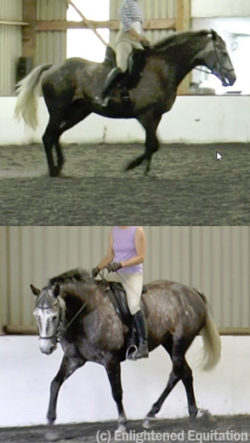
The horse copes with the crooked rider. Day 1 of HM course.

I aim to do this by sitting lightly, but deeply, in sync with his movement.

If the rider is crooked, possibly due to a problem with the saddle, or is asymmetric due to their own physical problem, the horse suffers.

He has to cope with this and compensate, usually by going crookedly himself.

And there’s more. The use of the rider’s body as a primary aid, is so rarely taught. Yet when utilised, it is the most invisible aid of all. Combined with the seat bones moving in sync with the horse’s back, it is the secret to an elegant harmonious seat, that appears to be doing nothing.

That’s when the horse and rider glide through all the movements as though they are one being – like a Centaur.


5. ‘Feel’ Begins in your Backside (I Mean It!)

Hanoverian X. 1st and 2nd day of HM course.

‘Connection’ means being able to feel, and not just when working from the ground. We all have nerve endings in our backsides – if you are taught what to feel and how to feel, it is within the grasp of any rider, even beginners.

And ‘aid’ really means ‘help’. If you learn to use aids that make biomechanical sense to the horse, they do become truly invisible as the horse becomes more and more sensitive with correct training.

BUT, if the horse hasn’t been schooled to respond to specific aids, then is it any wonder he is confused and ‘misbehaves’? It’s a bit like us lazy Brits here, shouting at foreigners in the hope they will understand English then getting annoyed when they don’t!

Your seat can genuinely aid (help) your horse. This happens when you’re taught not only the hand and leg aids, but also:

  • the weight aids for turning,
  • the seat aid for collecting and for downward transitions,
  • the precise positioning of the torso in lateral work and circles/ bends, etc.

At this point, riding becomes a whole language, which almost all horses quickly understand. Why? Because it is working with, not against, their own body.

Moving in sync with the horse allows the rider to learn ‘feel’, that term that often seems to imply that only a favoured few have the ability to learn it.

Rubbish!


So, in closing, if you wish to have true connection with your horse, you need to:

a) Absolutely not screw up either his back or his brain,

b) Learn to ride to the best of your ability, and

c) Treat your horse as a partner and friend, and not as a tool merely to win the next rosette.

If winning happens as a by-product of good riding, even better, but if your horse is not progressing, look to your own riding and equipment before you blame your horse. Get these 5 points sorted and you’ll be well on your way to true connection with your horse!


Filed Under: Bodywork, Guest Posts, Saddle Fit Tagged With: classical dressage, classical seat, GA, saddle fit

The Brooke: Why It Matters To 112 Million Working Equines That You Read This Post

April 18, 2015 by Guest Author 2 Comments

Brooke Header

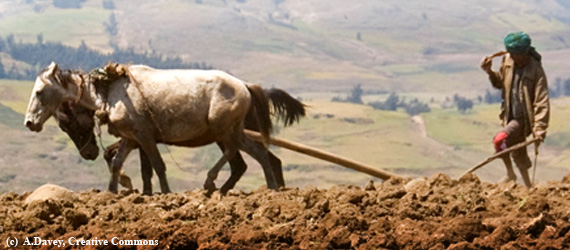
Most of us have a good idea of what animal welfare means and why it’s important. But in developing nations, cultural and economic concerns can prevail when it comes to issues such as ending a working equine’s pain.

It is not so long ago that horses, donkeys and mules across Europe, the US, Canada, Australia and New Zealand were primarily working animals. For many equines in other nations, that is still the case.

This thoughtful and sensitive post by Melissa Liszewski, Animal Welfare & Community Engagement Advisor of the Brooke, an international animal welfare organisation, gives an insight into a difficult subject, and describes a compelling legal solution developed in Ethiopia. It was first published on the Brooke’s blog in January 2015.


“I myself have seen animals in the countries we work in and I don’t even know how they have managed to remain standing, let alone pull heavy loads day in and day out …”

There are so many challenging aspects of the work we do here at the Brooke, but there is nothing like coming across an animal suffering from protracted or incurable disease, injury or debility to really put our animal-loving hearts and minds to the test.

Working Gharry horse abandoned when he became lame, with badly damaged right eye and very low body condition (c) the Brooke

We work hard to relieve hard working horses, donkeys and mules from their suffering.  But what happens when despite our best efforts, and the best efforts of local stakeholders, an animal’s illness, injury or overall condition means they have a poor outlook for a fit and pain free working life?

I have often pictured a lush green oasis where all those hard working horses, donkeys and mules can retire and live out the rest of their days pain free with all the care they need, full bellies and lots of space to just do whatever they please all day as thanks for their many hard years of service.

“The hard reality is that such a beautiful retirement for both the animals we serve and the communities they serve is just a picture in our heads.”

The truth is that there are an estimated 112 million working equines in this world and although we work tirelessly to help as many of them as possible in a meaningful way, we are still only able to reach about 2 million of them.

Much like the owners of the animals we serve, we do not have endless resources so we have to do the best we can for the animals with what we have.

At the Brooke, we accept that euthanasia is an effective way to alleviate suffering and prevent future suffering.  We have a Euthanasia Policy to ensure that when the practice is carried out by our staff or partners it is done with the utmost care and consideration of the animal’s experience.

(c) the Brooke. No reproduction of partial or entire text without permission of the Brooke. Sharing the link back to this page is fine. Please contact ja**@***********ck.com for more information. Thank you!

When euthanasia is the only option

When suffering cannot be alleviated by any other means, euthanasia is the only humane solution. However, there are many complexities surrounding the practice of euthanasia that must be considered:

  • Can euthanasia be done humanely?

The answer is yes, but in some countries we work in certain methods of euthanasia are not available, cannot be imported and/or are not legal.

Our teams then have the difficult task of weighing out potential suffering at the point of death with potential suffering if the animal was not euthanized, in order to always aim for the best welfare outcome for the individual animal.

  •  Are there legal implications?
Abandoned for 3 months, this horse was blind and suffered from joint problems (c) the Brooke

In Halaba, Ethiopia our local team worked hard to get by-laws in place that would allow abandoned animals to be euthanized without the legal risk of someone coming forward after the fact and claiming their animal was taken without consent.

Nationwide in Pakistan, our team is working tirelessly to overcome the challenge of carcass disposal due not only to environmental and practical concerns, but also the fact that illegal donkey meat is a rising problem that could be wrongfully attributed back to our organisation if a euthanized animal weren’t disposed of properly, allowing someone to eat it and get sick.

These are considerations we must keep at the forefront of our euthanasia decisions as the effects could be catastrophic to local initiatives benefiting whole communities of animals if our reputation became damaged or trust lost.

  • Is it culturally acceptable?

There are places where we work that euthanasia is not seen as an acceptable practice due to religious or cultural reasons, or because owners feel they are killing an animal that provided them with a service, and prefer a natural death for the animal.

Our staff work sensitively with individual owners in such cases, trying to balance respect for cultural practice or religious beliefs with the welfare needs of the animal concerned.

  • Is it ethical for us to intervene?

It is crucial that euthanasia is not carried out without the owner’s permission, meaning our teams must always obtain informed consent. Our teams in the field strive to ensure owners do not feel coerced into the practice, but come to the decision based on the facts they have been given by medical professionals, and their own desire to do what is best for their animal.

Sometimes, euthanasia is refused because an owner has no other source of income to provide for their family. In some communities we work, for example in India, the Brooke has helped set up group savings funds and equine insurance schemes, which can help owners make the best decision for their animal without economics being a barrier.

When Euthanasia Simply Isn’t Possible

Despite our best efforts, for all of these reasons and more, euthanasia is simply not always an option, and we must be prepared to do whatever we can in such cases to work with owners to ensure the animal is well cared for, relieved of their pain and rested until the very end. This is a painful reality at times for our staff in the field.

I myself have seen animals in the countries we work in and I don’t even know how they have managed to remain standing, let alone pull heavy loads day in and day out; deformed and damaged limbs, debilitating disease, old, weak and worn down animals at the end of their working life.

I have also seen and talked to owners with their own heart-breaking stories of survival, not knowing what the future holds for their family and how they will get by.

Abandoned for over 3 years before euthanasia, this gelding was suffering from severe knee and pastern joint damage. (c) the Brooke

Most often, the owners of these animals are not intentionally cruel, and although it may be easy to judge from far away, we must put ourselves in their shoes, as they work hard every day to put food on the table for their family and provide a better life for their children than they had for themselves.

Making assumptions or judging others will not erase or improve the suffering of working horses, donkeys and mules but what may help is a good dose of compassion for both the animals and the humans who care for and depend on them.

Yes, I have seen debilitated working animals abandoned to fend for themselves against hungry hyenas in Ethiopia, but just a few kilometres away in the same country I have also seen poor owners steadfastly caring for animals that cannot work or contribute anything economically to their family, bringing them into their own homes at night to protect them from those very same hyenas.

There are many reasons and situations where euthanasia may be considered and it is always an emotional decision, both for our own staff and the local people we work with, but it is our duty to do what we can to provide comfort and relief to suffering animals who work so very hard for the people depending on them.

The success of the by-laws in Halaba, Ethiopia, along with training of local service providers to ensure humane euthanasia is possible for suffering animals, mixed with engaging local communities to improve preventive husbandry practices and ensure euthanasia is an acceptable option when required, is proof of what can be done to help hard working animals.

This is our mission and this is what we stand for at the Brooke – I hope that you will stand behind us.

The Brooke is an international animal welfare organisation dedicated to improving the lives of working horses, donkeys and mules in some of the world’s poorest communities. The charity provides treatment, training and programmes around animal health and wellbeing, operating across Africa, Asia and Latin America.

You can follow the Brooke on Facebook, while more information on the organisation’s work is available on the website: www.thebrooke.org.

Filed Under: Guest Posts Tagged With: equine welfare, euthanasia, GA, horse welfare, the brooke, working horses

  • Page 1
  • Page 2
  • Go to Next Page »

Footer

Contact Me

Send your questions this way…

Get in Touch

  • Store Support
  • Shipping
  • Returns
  • Contact

Copyright © 2026 · Parallax Pro on Genesis Framework · WordPress · Log in