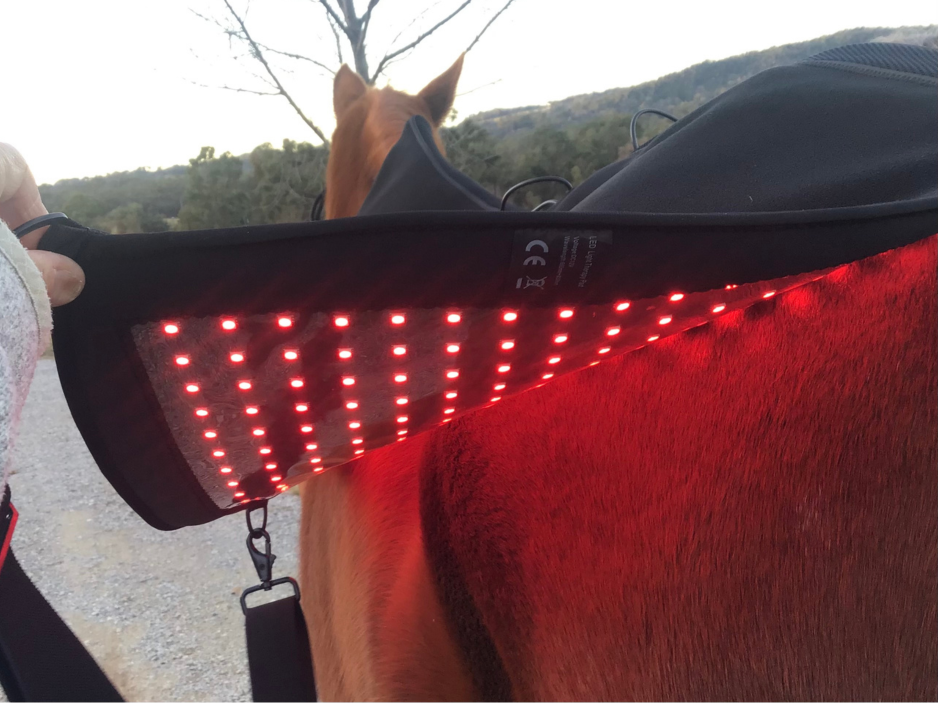
How exactly do Red Light and Near InfraRed therapy devices help our horses? It’s a valid question and one that many people are asking as these boots and pads appear in the equestrian marketplace.
Are they as good as lasers? And are we even comparing like with like, when one costs a few hundred dollars and the other thousands?
In this quick run through, I sum up:
- What Red Light NIR is
- What we know
- Dosage
- Other factors
- Comparing laser with RL NIR
- A different approach?
What is known about Red Light and Near Infrared therapy for horses
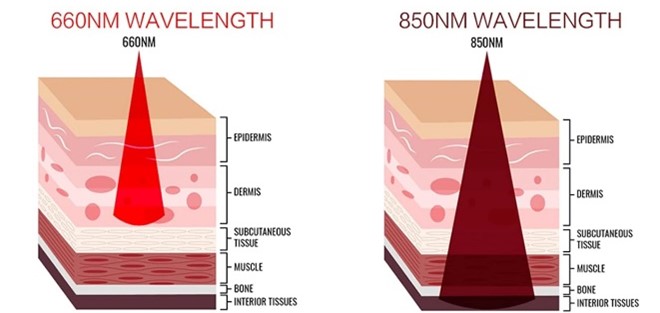
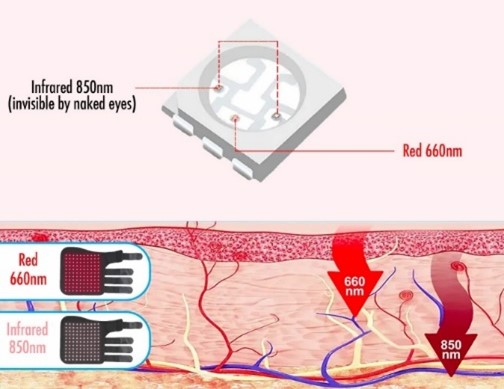
Red Light is visible and has a frequency of 620-750 nm. The optimal range within this is 630-670 nm.
Near InfraRed can’t be seen with the naked eye, as it has a frequency of around 800-2000 nm. The most effective range within this is 810 nm to 850 nm.
These wavelengths penetrate tissue to different depths. They have an effect on animal tissue through a process called Photobiomodulation (PBM), as does laser therapy.
The abundance of similar products for humans has led to more research into their effects. Despite some conflicting results, there is evidence of three effects on tissue: decreased inflammation, decreased pain, and accelerated healing.
This occurs at cellular level, with PBM stimulating production of ATP (adenosine triphosphate), nitric oxide (NO) and reactive oxygen species (ROS) – substances responsible for a cascade of effects that influence inflammation, pain, and healing.
If there’s one thing to remember, it’s this: with PBM, the mitochondria in the cells produce more energy (adenosine triphosphate or ATP). This leads to an energy boost that triggers further responses:
Increased Blood Circulation. Red and NIR light improve blood flow (vasodilation – vessels widen). This brings oxygen and essential nutrients to damaged tissues, while helping to remove waste products that contribute to inflammation and pain.
Reduced Inflammation. Inflammatory markers (cytokines) are reduced, thereby addressing the underlying cause of many chronic pain conditions – especially arthritis.
Faster Healing. With cellular metabolism and regeneration stimulated, the body’s natural healing processes accelerate, benefiting tissue repair.
Horse Owners Report Back
Research is still emerging, so in the meantime we’re often relying on ‘anecdata’ – i.e. strong anecdotal evidence, the type that might underpin new studies – in our evaluation of benefits.
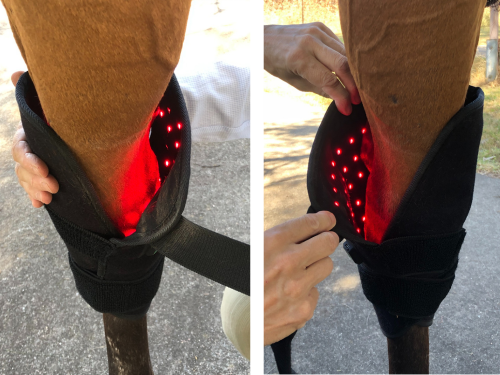
I hear regular reports of pain being alleviated, inflammation reduced, and swelling (oedema) moving in multiple cases. These include tendon and ligament injuries. More recent reports from customers include improvement in cellulitis (in horse and owner).
I’ve received a few reports of improvement around fetlock level ligaments, with reductions in shape change around the fetlock and sesamoids. These have come with frequent and usually daily use.

What About Dosage?
Dose is important and yet, with so much research happening, it is hard to specify what the dose is.
The dosage is usually given as joules (energy output) per square centimetre (J/cm2). Generally, the dosage given for superficial tissue is around 1-4 J/cm2, and deeper tissue 8-20J/cm2.
However, this only really works if we are looking at a single source of light waves, such as a laser head (or probe).
What Also Needs to be Considered
Other variable factors are the anatomic site, tissue depth, species, coat colour and length, skin colour, and body condition score.
And then there’s patient preparation, application technique, frequency of administration, and patient management.
That’s already complex. However, an enormous difficulty is that this formula presumes an instrument with a single head (also called a probe or node) that is held directly against the skin to increase the depth or penetration.
The Difference Between RL NIR and Laser
You may be familiar with the previously used term ‘low level laser therapy’. The ‘low’ part referred not to the power of the instrument, but to the non-damaging low response in body. This is where our RL NIR devices sit.
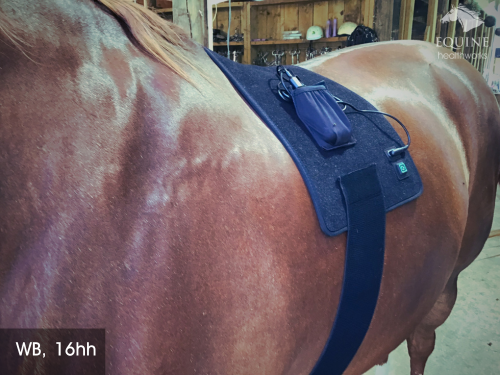
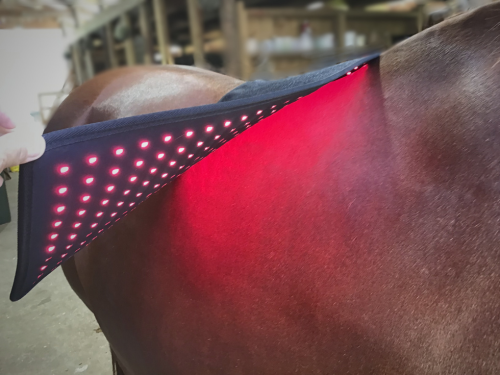
RL NIR devices commonly have multiple diodes providing coverage of a wider area. The diodes produce an arc of light, unlike the collated straight beams of a laser.
Here is the comparison of the energy delivered by a single diode light source, if isolated from our boots, and that of a high-powered veterinary instrument. Clearly, they are very different.
| 5 mins | 10 mins | 15 mins | |
| Veterinary laser at 10 W | 3000 J/cm2 | 6000 J/cm2 | 9000 J/cm2 |
| Individual diode at 150mW (0.015 W) | 45 J/cm2 | 90 J/cm2 | 135 J/cm2 |
If we were looking at a spot treatment, we would ask how can the diodes work at all? However, the power used doesn’t determine depth of wave penetration – that comes down to wavelength (ie. 660nm, 850nm, 940nm, etc).
What it does heavily influence is the speed of application, by accelerating the number of photons that can achieve the maximum depth penetration, in a particular tissue, in a fixed amount of time.
This matters a lot if you’re standing next to a horse with your arm raised, holding a device in a particular spot. Time is very much of the essence. Likewise it is valuable in the veterinary treatment of an acute injury or condition (or in an acupuncture session where the collated laser beam is replacing a needle insertion).
Yet with repeated use of pads and boots, we don’t have the same need for a super rapid treatment.
Red Light NIR Therapy – a Different Approach
Nobody is claiming that this approach has the same effect as laser, or red light torches for that matter.
There is increasing evidence that the broad coverage of red light and infrared diodes has a more generalised, systemic effect on a region of the body, particularly when used frequently and repeatedly.
Although the light’s penetration isn’t deep, it seems to bring about some significant changes.
- Cellular interaction: Red and near-infrared light penetrates tissue and is absorbed by chromophores, primarily cytochrome c oxidase within the mitochondria.
- Mitochondrial boost: This absorption stimulates the mitochondria, leading to increased production of adenosine triphosphate (ATP), the energy currency of the cell.
- Antioxidant and anti-inflammatory effects: The process up-regulates the body’s antioxidant defences and can decrease levels of reactive oxygen species (ROS) in stressed cells, thereby reducing inflammation.
- Modulating inflammatory response: It can activate signaling pathways to decrease inflammatory markers and promote cell survival, proliferation, and migration, which aids in tissue repair.
In this scenario, using multi-nodal devices with around 100 diodes, a lower wavelength is actually a benefit, not a deficiency.